

If you’ve ever wandered through a palace and thought, “Lovely… but a bit quiet,” South Korea has a polite answer this April: come back when it’s alive.
The K-Royal Cultural Festival 2026 is doing exactly that, taking five of Seoul’s grandest palaces and giving them a pulse. Not in a theme-park sort of way, but with just enough theatre, music and storytelling to remind visitors these places were once very much lived in.
Running from 24 April to 3 May, the festival is now in its 12th year and, quietly, has become one of the country’s most effective tourism drawcards. Last year, it pulled in around 1.37 million visitors. That’s not a cultural sideshow, that’s a crowd.
This time, there’s a noticeable shift. International visitors are no longer an afterthought. They’re being actively courted, with dedicated programs bookable via Creatrip from 16 March.
Not just a festival, more of a staged comeback
The theme for 2026, “Palaces, Awakening the Arts,” sounds grand. It is. But it’s also fairly literal.
Across Gyeongbokgung, Changdeokgung, Deoksugung, Changgyeonggung and Gyeonghuigung, plus the Jongmyo Shrine, the idea is simple: don’t just show history, stage it.
There are performances. There are guided walks. There are food experiences. And, crucially, there are moments where the usual ropes and signs give way to something more engaging.
It’s the difference between looking at a painting and stepping into it.
Opening night: less dust, more drama
The curtain rises at Gyeongbokgung Palace, and it’s not a modest start.
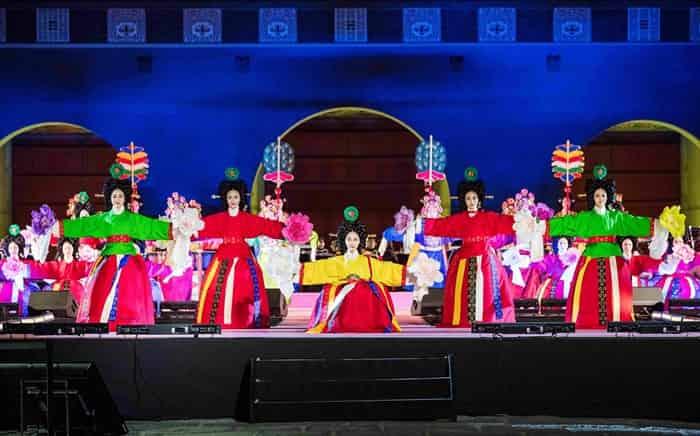
Directed by Yang Jung-woong, best known recently for steering the artistic direction of the 2025 APEC Summit, the opening ceremony leans into spectacle. Royal court dance sits alongside media façades. Traditional hanbok meets modern styling. And somewhere in the mix, gugak (traditional Korean music) finds itself paired with EDM.
On paper, that shouldn’t work. In practice, it probably will.
There are 300 free tickets set aside for international visitors, which is either a generous or a clever way to ensure the right kind of buzz.
Changdeokgung after dark: where it gets interesting
If the opening is about scale, Changdeokgung is where things become more personal.
The nighttime program, “The Dance of Crown Prince Hyomyeong and the Moon,” is less a performance and more a moving story. Visitors walk through the palace grounds while following the life of Crown Prince Hyomyeong, a figure who did more than most to push the arts forward during the Joseon Dynasty.
Forty people per session. English-language delivery. No rush.
It’s the sort of experience that doesn’t photograph particularly well but tends to stay with you.
Early mornings, quiet palaces
Then there’s “Awakening the Morning Palace.”
No theatrics here. Just a slow walk through Changdeokgung and its Secret Garden before the crowds arrive. A guide fills in the gaps: architecture, history, the occasional anecdote, but largely lets the place speak for itself.
In a festival full of moving parts, this is the pause.
And, if you’ve done enough fast-paced itineraries, you’ll know how valuable that can be.
Dining like an emperor (without the politics)
At Deoksugung Palace, things take a more indulgent turn.
“The Emperor’s Dining Table” is part history lesson, part culinary experience. Guests sample dishes inspired by imperial banquets while learning how food once doubled as diplomacy.
Only 20 seats per session. Which means it will sell out. Quickly.
It’s also a reminder that culture isn’t just seen or heard, it’s tasted.
A hundred musicians, one very large statement
For those who prefer something a little grander, the “Palace Concert: A Performance by 100 Artists” delivers exactly what it promises.
Held in Changdeokgung’s Injeongjeon Hall, it brings together 100 gugak musicians in a performance that leans heavily into tradition but with enough structure and explanation (in both Korean and English) to keep newcomers on board.
Big, bold, and unapologetically cultural.
Jongmyo: where things slow right down
At the Jongmyo Shrine, the tone shifts again.
The Royal Ancestral Ritual Music Nighttime Performance introduces visitors to Jongmyo Jeryeak, which UNESCO has recognised as Intangible Cultural Heritage.
There’s no attempt to modernise it. No clever twist.
Just ritual, music, and atmosphere.
And, frankly, that restraint is part of the appeal.
For those who prefer to wander
Not everything requires a booking.
Across the festival, open-access programs like the K-Heritage Market and Gyeongbokgung Time Travel – Royal Palace Daily Life offer a more relaxed way to engage.
You can browse, watch, drift in and out.
Sometimes, that’s exactly what travellers want.
The bigger picture: smart tourism, well played
Strip it back, and this festival is doing something quite deliberate.
It’s packaging heritage in a way that feels accessible without being diluted. It’s offering depth without demanding expertise. And it’s giving international visitors a reason to stay longer than a quick palace photo and a coffee.
In a competitive tourism market, that matters.
A lot.
What you need to know
Bookings for international programs opened at 2 pm (KST) on 16 March via Creatrip (www.creatrip.com).
Capacities are tight; some sessions are limited to just 20 or 40 people, so hesitation will likely mean missing out.
Final thought
There’s a fine line between preserving history and putting it on show.
The K-Royal Cultural Festival walks that line rather well.
Not by over-explaining it. Not by dressing it up too much.
But by letting visitors step inside it, even briefly, and draw their own conclusions.
by Soo James – (c) 2026.
Read Time: 5 minutes.
About the Writer.
 There’s nothing rehearsed about Soo James, and that’s precisely the point. Malaysian by heritage, Sydney by schooling, she arrived at UNSW to study Arts, then took a left turn into IT, not out of ambition, but curiosity. Somewhere among systems and schedules, she worked out what really held her attention: people, language, and the quiet spaces between them.
Writing followed naturally. Travel and lifestyle gave her room to observe, to listen, to notice the details others rush past. Soo writes the way good travellers move, watching the room before admiring the view, catching the gesture before chasing the headline.
At Global Travel Media, her stories don’t shout or sell. They linger. They slow you down, open a door, and gently suggest there’s more to see if you’re willing to look.











