

If ever there was a reminder that aviation runs on more than just passenger numbers, the latest findings from Airports Council International World deliver it in spades.
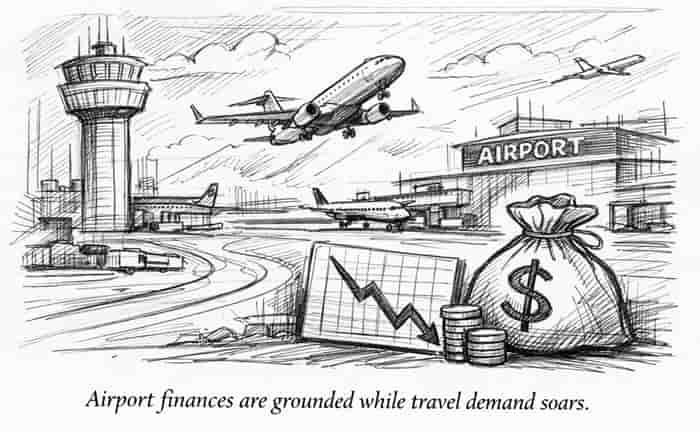
Global travellers are back indeed; they’ve returned in greater numbers than before the pandemic, but the money, rather inconveniently, has not quite kept pace.
According to ACI World’s freshly released Airport Economics Report, airports worldwide processed a hefty 9.4 billion passengers in 2024, comfortably eclipsing 2019 levels by 4%. On the surface, it sounds like a full recovery. Scratch beneath that glossy headline, however, and the balance sheet tells a more sobering tale.
Total global airport revenues reached US$194.9 billion last year, still 2.1% shy of pre-pandemic levels when adjusted for inflation. Not disastrous, certainly, but hardly the triumphant rebound many had pencilled in when borders reopened, and aircraft once again filled the skies.
The uncomfortable arithmetic of recovery
Airports, as any seasoned industry watcher knows, are peculiar beasts. They are capital-intensive, heavily regulated, and expected to perform a delicate juggling act between efficiency, safety, and commercial viability.
In 2024, aeronautical revenues, which are tied directly to aircraft operations, accounted for 54% of total income but remained 3% below 2019 levels. Encouragingly, these are forecast to recover sometime in 2025.
The real laggard, however, is the commercial side of the ledger. Non-aeronautical revenues, retail, parking, food and beverage, still sit 9% below pre-pandemic performance and are not expected to fully rebound until mid-2026. For an industry that increasingly relies on passengers lingering (and spending) between flights, that’s a material gap.
Add to this a global return on invested capital (ROIC) of 6.3%, still trailing the sector’s weighted average cost of capital, and it becomes clear that many airports are operating in what might politely be described as a financially tight environment.
A sector under pressure
The timing of the report is hardly coincidental. Aviation continues to navigate a rather turbulent global backdrop, geopolitical tensions, fluctuating airspace availability, and persistent cost pressures, all combine to test even the most robust airport balance sheets.
In short, while passengers have returned with enthusiasm, the operating environment has become more complex and, crucially, more expensive.
As ACI World Director General Justin Erbacci put it with characteristic clarity:
“Passenger demand has fully rebounded, but airport revenues are still catching up, underscoring the financial pressures airports continue to face.”
It is a polite way of saying what many airport executives have been muttering behind closed doors for some time.
The policy imperative
Where this report sharpens its tone is in its call to action. ACI World is unequivocal: policymakers must step up.
Airports are not merely transport hubs; they are economic engines, facilitating trade, tourism, and connectivity on a global scale. Yet without supportive regulatory frameworks and access to sustainable financing, their ability to invest in infrastructure will be constrained.
And that investment is not optional. With long-term passenger growth projected to rise steadily over the coming decades, capacity constraints, ageing infrastructure, and evolving passenger expectations will demand significant capital outlays.
From runway expansions to digital transformation and sustainability initiatives, the bill will be substantial, and someone, inevitably, must foot it.
Looking ahead
There is, to be fair, light at the end of the runway. From 2026 onwards, airport revenues are expected to finally surpass pre-pandemic levels and grow in line with passenger demand.
But, and it is a meaningful “but”, the pace of that recovery will hinge on several variables: financing conditions, inflation, regulatory settings, and the ever-present wildcard of geopolitical uncertainty.
For now, the message from ACI World is both clear and timely. The passengers have returned. The planes are full. The demand is undeniable.
What remains is ensuring the financial foundations of the world’s airports are robust enough to support what comes next.
Because in aviation, as history has shown time and again, growth without investment is not a strategy, it’s a risk.
by Octavia Koo – (c) 2026.
Read Time: 3 minutes.
About the Writer.
 Octavia Koo arrived in Australia from Indonesia in the early eighties, drawn by Sydney’s creative pull and a place at UNSW. Studying Arts, she quickly developed an eye for visual storytelling, starting in graphic design before naturally moving into digital building websites and crafting copy that invited people in and kept them there.
Singapore came next. There, she ran blogs for tourism platforms and developed an instinct for SEO well before it had a name, working the corridors of ITB Asia and learning how stories travel online. There, she met Stephen, who suggested Global Travel Media.
A few years later, she joined.
Today, Octavia is part of GTM’s editorial family, bringing a quiet brilliance to every piece, blending art, technology, and intuition to make travel stories both charming and effective, much like their author.











