

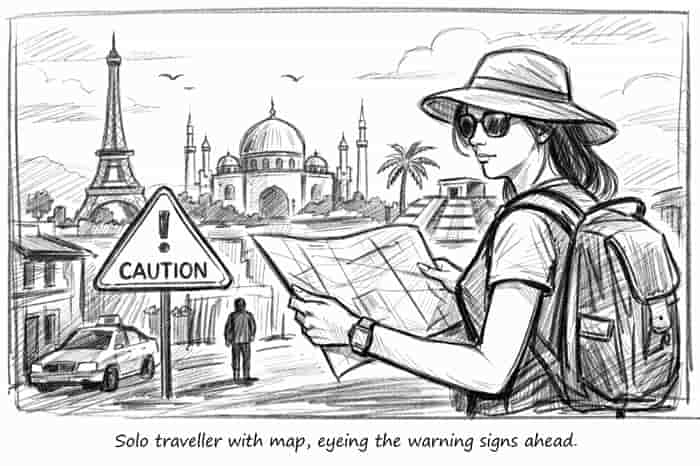
There’s a quiet shift happening in the world of solo travel.
Not a retreat, far from it, but a subtle recalibration. Travellers are still packing their bags, booking flights and setting off on their own adventures. They’re simply doing so with a sharper eye on safety than perhaps they did a decade ago.
New findings from the Global Rescue Winter 2026 Traveller Sentiment and Safety Survey suggest that while confidence among solo travellers remains strong, caution now travels alongside the passport.
According to the survey, 67 per cent of travellers say they usually feel safe travelling alone in most destinations, a reassuring figure for an industry that has watched solo travel grow steadily over the past decade.
Another 19 per cent say they sometimes feel safe, while six per cent report rarely feeling safe and another six per cent say they do not feel safe travelling alone at all.
Those numbers tell an interesting story. Travellers remain willing to explore the world on their own, but they are clearly thinking more carefully about where they go and how they behave once they arrive.
Americans are more confident than others
Dig a little deeper, and a noticeable divide emerges between American travellers and the rest of the world.
Among US respondents, confidence runs high. Seventy-six per cent say they usually feel safe travelling alone, compared with just 46 per cent of non-US travellers.
International travellers appear more measured in their outlook. Around 31 per cent say they only sometimes feel safe travelling alone, while 11 per cent say they rarely feel safe. Almost nine per cent of non-US travellers say they do not feel safe travelling solo at all, compared with just five per cent of Americans.
For Dan Richards, CEO of Global Rescue, that difference reflects how travellers from different regions view risk.
“Travelers may feel confident overall, but that confidence is not universal and it varies significantly by region,” Richards said. “Non-US travelers, in particular, appear more cautious and less assured when navigating destinations alone.”
Street smarts replacing blind optimism
If today’s solo travellers share one common trait, it is situational awareness.
A striking 81 per cent of survey respondents say they stay constantly aware of their surroundings when travelling alone, making it the most common safety precaution.
Beyond that, travellers are adopting a range of simple but practical habits.
More than half, 57 per cent, say they dress conservatively to blend into local surroundings. Nearly 45 per cent rely on reputable drivers or taxis, avoiding the gamble of unfamiliar transport options.
Accommodation choices also reflect a growing focus on security. About one-third of travellers deliberately choose hotels with staffed lobbies or round-the-clock security, while 23 per cent opt for properties with elevator key-card access.
In other words, travellers aren’t panicking, they’re planning.
Interestingly, non-US travellers appear to take an even more layered approach. They are more likely to carry portable door locks or stoppers, use personal alarms and prioritise hotels with stronger security features.
Destinations travellers are quietly avoiding
The survey also reveals a trend the travel industry watches closely: destinations travellers choose not to visit.
Overall, 51 per cent of travellers say they have avoided certain countries due to safety concerns when travelling alone.
Among non-US travellers, that number climbs sharply to 64 per cent, compared with 47 per cent of US travellers.
The destinations most commonly cited by respondents include Mexico and parts of the Middle East, regions where security concerns or geopolitical tensions continue to influence travel decisions.
According to Richards, these choices are less about fear and more about risk management.
“These behaviors show that travelers are not ignoring risk they are actively managing it,” he said. “Avoiding destinations, selecting secure lodging and adjusting daily habits are all part of a broader effort to reduce exposure and maintain personal safety.”
Confidence remains with clearer eyes
None of this suggests solo travel is slowing down.
If anything, the opposite appears true. Travellers are still eager to explore independently, but they are doing so with more preparation, better information and a greater awareness of personal safety.
For travel advisors, tour operators and destination marketers, the message is simple: security reassurance now forms part of the travel decision.
Travellers want adventure, but they also want confidence that someone has thought about the details.
And in the modern travel landscape, a destination that feels safe may well be the one that wins the booking.
Further information on the survey can be found at https://www.globalrescue.com.
by Jill Walsh – (c) 2026.
Read Time: 3 minutes.
About the Writer.
 Jill Walsh has always kept a pen close and a suitcase closer. She started out on media releases, then learned the trade properly by escorting press trips around the world, discovering which stories travel well and which need a sharper edit.
Before long, she wasn’t just promoting destinations, she was representing them, translating civic ambition and local pride into words people actually wanted to read. These days, semi-retired and happily so, Jill has traded departure boards for deadlines, joining old friend and colleague Stephen at Global Travel Media on a casual basis.
Her patch is the business end of wanderlust: balance sheets, route maps, tender wins and the numbers that quietly decide where travellers go. She writes with dry humour, clean prose and an old-school respect for facts, a steady voice when the market starts shouting.











