

When geopolitical tremors ripple through global aviation, the industry’s quiet problem-solvers suddenly become indispensable.
Over the past week, one such operator, Air Charter Service, has been working around the clock to help travellers and corporate teams leave the Middle East safely, orchestrating more than 70 evacuation flights since regional tensions began escalating on 28 February.
For a sector that prides itself on precision and calm under pressure, the response has been swift, coordinated and by aviation standards remarkably nimble.
At the centre of the effort is Chris Leach, Chairman of Air Charter Service, whose team had barely returned from Dubai when events began to escalate.
“Our leadership team had been in Dubai the week prior, until Friday evening, and no sooner had we landed back in the UK, than we had to initiate our emergency response plan,” Leach said.
What followed was a familiar exercise in aviation crisis management, rapid assessment of airspace conditions, operational airports and the safest routes out of a volatile region.
A Rapid Response in the First 24 Hours
One of the company’s first priorities was not corporate clients or government contracts, but its own people.
Air Charter Service staff who had been in the region, whether working or travelling, needed to be moved quickly.
“This involved pulling all the information together on the available airports, airspace, and what we were able to do. One of our main initial priorities was to evacuate the ACS staff from around the world who were still in the region on both business and also on holiday,” Leach explained.
Within a day, the company had relocated employees across the border into Oman.
“Within 24 hours we had got everyone over the border and into Oman, from where they flew out of Muscat and caught connecting flights home to the UK, California, China and Australia.”
The speed of the operation highlights the advantage of specialist charter brokers: flexibility. When commercial networks falter or routes close, charters can pivot quickly.
Muscat and Riyadh Become Evacuation Gateways
As airspace restrictions shifted across the region, two airports emerged as early evacuation hubs: Muscat in Oman and Riyadh in Saudi Arabia.
“At first most of our charter flights were for people who just wanted to get out of the immediate vicinity as quickly as possible by private jet,” Leach said.
“With Omani and Saudi airspace having remained open since the hostilities began, we identified Muscat and Riyadh to be the best airports for evacuations early on in the crisis.”
Oman quickly became the preferred option.
“Oman was more popular initially, due to the visa requirements of Saudi and the extra distance to the border crossing.”
To ensure operations ran smoothly, Air Charter Service positioned a senior team member at Muscat International Airport.
“We stationed one of our Dubai team at Muscat airport, in order to oversee our charters and make sure everything ran as smoothly as possible.”
In the first few days alone, the company arranged more than 20 private-jet departures from Muscat.
Many passengers were heading to Istanbul, one of the world’s busiest aviation crossroads and an ideal hub for onward international connections.
Larger Aircraft Step In as Crisis Deepens
As the situation evolved, the demand shifted from private jets to larger aircraft capable of moving entire groups.
The new clients: multinational corporations and government agencies seeking to relocate staff and citizens from the region.
On Sunday evening, Air Charter Service organised a dedicated evacuation flight of its own.
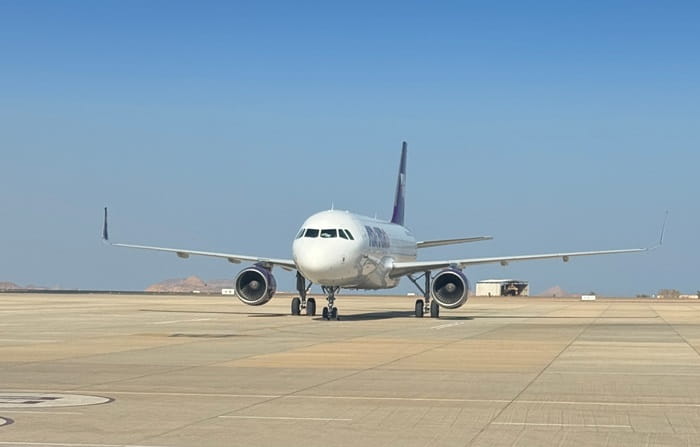
“On Sunday evening we put on our own flight a 180-seat A320-200 from Muscat to Athens for individuals and small groups wanting to leave.”
For travellers caught in a rapidly shifting security environment, that flight represented something rare in a crisis: certainty.
Dubai’s Reopening Signals A Turning Point
A key development came when UAE airspace reopened, allowing charter operators to resume departures from Dubai.
Air Charter Service immediately expanded operations to Al Maktoum International Airport and the nearby airport in Fujairah.
“Once the UAE airspace reopened, we started using Dubai’s Al Maktoum Airport and nearby Fujairah, which is a huge step in the right direction,” Leach said.
The reopening also triggered a different type of demand from residents returning home.
“With them opening, we’re also now helping Dubai residents wanting to return to their homes – either because they had left the region last week or were simply away at the time of the original attacks.”
Crisis Response Is Part of Aviation’s DNA
For charter specialists, responding to global disruption is not unusual.
From political unrest to natural disasters, the sector has quietly supported evacuation efforts for decades.
Air Charter Service, founded in 1990, operates a global network of offices and aircraft partners that can deploy aircraft almost anywhere at short notice.
According to Leach, the company’s experience proved invaluable during the latest crisis.
“We have a long history of reacting in similar emergency situations, and I believe that we have arranged more charters for this than any other company of our type over the past week or so.”
Behind those operations sits a global team coordinating logistics, aviation permits, crew availability and ground handling often with only hours’ notice.
“I’m incredibly proud of our global team, who have joined forces to make sure these flights happen and that people got to where they need to be,” Leach said.
He also acknowledged the role of partner airlines willing to operate in the region.
“We’re hugely grateful to the airlines that have helped with the evacuations and have been willing to fly into the region to aid our customers.”
Aviation Faces Ongoing Ripple Effects
While evacuation flights provide immediate relief for travellers, the wider aviation industry is likely to feel the aftershocks for some time.
Airspace closures, disrupted routes and heightened travel risk assessments all place additional pressure on airlines and corporate travel managers.
Leach believes the implications will stretch well beyond the current crisis.
“We sincerely hope that the hostilities end soon – it is a very worrying time for all involved,” he said.
“Whatever the timeframe we do feel that the knock on effects to the aviation and travel industry will last for some time yet.”
For now, however, Air Charter Service’s aircraft continue to lift off quietly, ferrying travellers away from uncertainty and proving once again that in aviation’s most turbulent moments, flexibility can be the industry’s greatest asset.
For further information, visit: https://www.aircharterservice.com.
by Jason Smith – (c) 2026.
Read Time: 4 minutes.
About the Writer.
 Jason Smith was educated in terminals, taxis and hotel corridors, the sort of schooling no classroom could hope to provide. Half American, half Asian, he grew up inside the quiet machinery of tourism, watching his family send strangers into the world long before he travelled himself.
Bangkok came first, then the Asian Institute of Hospitality & Management, followed by a career stitched together across Singapore, Malaysia and Vietnam. Each city left a mark. Thailand eventually claimed him, along with a corner office, as Director of Sales for one of the country’s leading hotel groups.
Then the world paused. Borders closed, skies emptied, and Jason returned to America carrying time, memory and a lifetime of stories.
Now at Global Travel Media, he writes the human side of travel check-ins, departures and everything between with warmth, clarity and an instinct for connection.











