

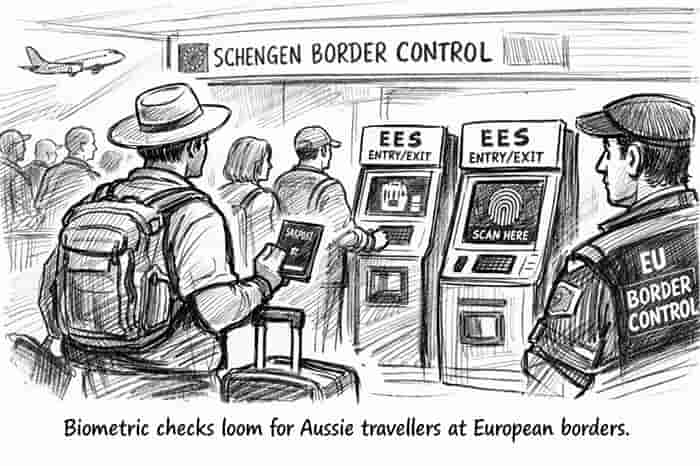
Anyone heading to Europe from Australia this autumn may want to exercise a little patience at passport control.
From 10 April, the European Union will introduce its long-anticipated Entry/Exit System (EES) across airports in the Schengen Area, replacing the familiar ritual of passport stamps with a fully digital biometric registration process.
In short, the days of a quick thump of ink in the passport are numbered. Instead, travellers arriving from outside the European Union, including Australians, Britons, Americans and Canadians, will be asked to provide fingerprints and a facial scan on their first entry into the bloc under the new system.
It’s a move designed to modernise border management and tighten security. But like most technological upgrades rolled out across an entire continent, the early days could come with a few wrinkles.
According to Vykintas Maknickas, CEO of global eSIM provider Saily, passengers should prepare for a slightly slower arrival experience during the transition.
“While the scheme is designed to modernise border controls and tighten security, the early days of the rollout could bring delays, especially at busy hubs such as Paris, Rome, Barcelona and Amsterdam,” Maknickas said.
What travellers will notice
From April, airport border control across the Schengen zone will begin transitioning to the new digital system.
In practical terms, this means:
-
Passport stamps will gradually disappear
-
First-time travellers under the system must register their biometric data
-
Many airports will introduce self-service kiosks
-
Border checks may take longer while systems bed in
For seasoned travellers used to gliding through immigration in major European hubs, that extra step could be noticeable, particularly during peak arrival windows when multiple long-haul flights land within minutes of one another.
And timing, as it happens, is everything.
Why the timing matters
April marks the unofficial start of Europe’s high travel season.
City breaks bloom alongside the spring sunshine, and airports from Amsterdam Schiphol to Rome Fiumicino begin to hum with travellers chasing Easter holidays and long-weekend escapes.
Add a brand-new border system into that mix, and queues can form quickly.
Maknickas says the key is simply allowing a little more breathing room.
“Whenever a new airport system launches, there’s a natural adjustment period,” he explained. “Spring is one of the busiest times for short-haul travel into Europe. Travellers should allow extra time at arrival and be prepared for slightly slower border checks, particularly if it’s their first visit under the new system. When procedures change, small delays can create stress, especially in unfamiliar airports.”
Who needs to register?
The Entry/Exit System applies to non-EU nationals travelling to the Schengen Area for short stays, including visitors from:
-
Australia
-
United Kingdom
-
United States
-
Canada
Travellers holding EU passports will continue to pass through border control without needing to register biometric details under the new program.
Practical tips for travellers
For Australians planning a European adventure this year, a little preparation can make the process smoother.
Maknickas suggests travellers:
-
Allow extra time on arrival, particularly for tight flight connections
-
Keep passports ready and open at the border control
-
Follow airport signage carefully, as some terminals will introduce dedicated EES lanes
-
Ensure mobile connectivity on arrival for digital boarding passes and travel updates
Many airports are expected to install automated kiosks to speed up the registration process, though these may take some time to operate smoothly across the network.
A long-term upgrade
The EU maintains that the new system will ultimately streamline border management by digitally recording entries and exits across the Schengen zone, improving both efficiency and security.
In theory, once travellers have completed their first biometric registration, future entries should become faster and more automated.
But as every frequent flyer knows, the early days of any airport innovation can feel a little like a dress rehearsal.
For now, the advice is refreshingly old-fashioned: arrive early, follow the signs and keep your passport handy.
Europe will still be there when you clear immigration.
by Sandra Jones – (c) 2026.
Read Time: 2 minutes.
About the Writer.
 Sandra has spent a working lifetime quietly rescuing journeys, one itinerary, one anxious caller, one impossible connection at a time. Years in Australia’s finest travel agencies taught her the art of calm, how to find a flight in a fog of cancellations, how to soothe a traveller when luggage wanders, how to turn nine frantic days in Europe into something resembling sense. Qualified, seasoned, endlessly patient, she learned that good travel advice is part logistics, part listening.
But the storyteller in her was always waiting its turn. Writing offered a new map, a way to turn experience into reflection, detail into delight. At Global Travel Media, Sandra now writes the truths only insiders know: the mishaps, the laughter, the grace found between gates and goodbyes. She reminds us that travel, for all its fuss, is still one of life’s better ideas.











