

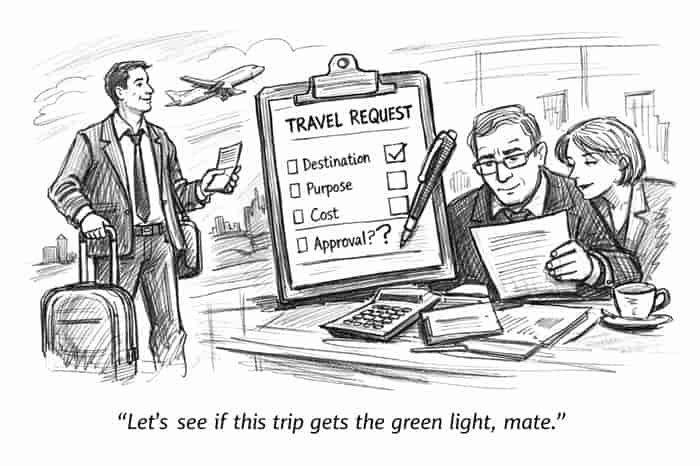
Corporate travel in Australia is enjoying a quiet but unmistakable comeback.
Airports are busier again. Corporate lounges are filling with laptop-toting road warriors. And those familiar Monday morning flights between Sydney, Melbourne and Brisbane are starting to look remarkably like they did before the world hit pause.
But while the planes are filling up, something else is happening behind the scenes.
Finance teams are tightening the screws.
The long-standing tradition of letting employees book trips first and justify them later is slowly being replaced with a more disciplined approach, one that asks the awkward questions before the boarding pass is issued.
According to travel and expense technology provider SAP Concur, pre-travel authorisation is emerging as the next major governance priority for Australian companies navigating the rebound in business travel.
The travel rebound is real
The numbers alone explain why.
Jonathan Beeby, managing director, enterprise at SAP Concur, says travel activity across Australia has accelerated noticeably over the past year.
“SAP Concur data shows that flight bookings in Australia increased almost 10 per cent in 2025 compared to 2024,” Beeby said.
“In the same period, March 2025 recorded the highest velocity, with corporate bookings surging more than 44 per cent compared to March 2024, reflecting a sharp rebound in corporate travel demand.”
That surge reflects something many in the industry have sensed for months.
Video calls may still dominate the working week, but when deals need closing, projects need reviewing, or relationships need rebuilding, Australians still get on a plane.
Face-to-face business remains stubbornly effective.
Yet with that revival comes a new challenge for corporate governance.
Expense audits after the trip? Increasingly outdated
For years, the compliance model for corporate travel was straightforward.
An employee booked a trip. The costs were incurred. Then the finance team examined the receipts and confirmed that everything fell comfortably within company policy.
If something slipped outside the rules, it could be flagged later.
The problem, of course, was obvious.
By that stage, the money had already been spent.
“In an audit sense, reviewing expense claims after travel has taken place offers little ability for correction,” Beeby said.
“Non-compliance may be identified, but the financial commitment has already been made.”
In today’s governance environment, where boards and auditors are increasingly sensitive to risk, that explanation is wearing thin.
Australian organisations are now under pressure to demonstrate preventative controls, not just retrospective oversight.
Enter pre-travel authorisation
The shift many companies are now exploring is deceptively simple.
Move the decision earlier.
Rather than asking whether travel complied with policy after the fact, organisations are asking whether the trip makes sense before it is booked.
Beeby says the change is gathering momentum among finance leaders.
“Finance, procurement and audit leaders are now asking a more fundamental question: is retrospective compliance enough, or should organisations embed stronger controls earlier in the travel lifecycle?” he said.
“For many, the answer is shifting decisively toward pre-travel authorisation.”
Under this model, employees submit a travel request outlining the purpose of the trip, expected costs and any potential policy exceptions.
Only once approval is granted does the booking move ahead.
It is hardly revolutionary that approvals have existed for years, but what is changing is the process’s structure and visibility.
Travel becomes a managed decision, not a reimbursement exercise
Technology platforms are increasingly linking travel requests directly with booking systems and expense tools.
Solutions such as Concur Request connect approval workflows with downstream booking activity, ensuring decisions made at the start of the journey remain visible throughout.
That produces something finance teams love: a clear audit trail.
Instead of reconstructing events after a trip has occurred, organisations can see exactly who authorised the travel, when approval was given, and what justification supported it.
For auditors and boards, that clarity is becoming increasingly important.
Visibility: the missing piece in travel budgets
Beyond governance, there is another practical benefit.
Most organisations struggle to forecast travel spending accurately.
Travel demand is often tied to projects, client work and seasonal events. Yet the financial impact frequently appears weeks later when expense claims finally land in the system.
By then, it is history, not planning.
Pre-travel approval changes that equation by capturing estimated costs before the trip even begins.
“Capturing estimated travel costs upfront shifts this dynamic,” Beeby said.
“Finance teams gain insight into upcoming plans and can manage budgets proactively.”
In Australia, a country where distance guarantees frequent flying, visibility can make a meaningful difference.
Airfares between capital cities fluctuate dramatically depending on timing. Hotel rates can jump overnight during conferences or major events.
Early insight allows managers to ask a simple question: Does the trip deliver value?
Not the bureaucratic nightmare employees fear
Whenever approval processes come up, employees tend to imagine red tape.
Yet organisations implementing pre-travel controls are discovering something slightly unexpected.
Travellers often prefer it.
Expense disputes after a trip can be awkward for everyone involved. A rejected reimbursement weeks later rarely improves anyone’s mood.
Clarifying expectations before travel begins removes that friction.
In practice, many companies apply the approval process, selectively focusing scrutiny on international trips, premium flights or unusual accommodation while keeping routine domestic travel simple.
A cultural shift in travel policy
The broader change may be philosophical.
For years, corporate travel policy was treated as a rulebook.
Break the rules, and finance would catch it later.
Today, many organisations are reframing those policies as decision-making frameworks.
The aim is not simply to enforce compliance but to give managers and employees the information needed to make sensible travel choices.
That approach also strengthens post-trip auditing rather than replacing it.
“This does not remove the need for post-travel audit,” Beeby said.
“When pre-approved estimates can be compared with actual expenses, organisations gain deeper insight into forecasting accuracy, policy effectiveness and travel behaviour.”
The future of corporate travel governance
The resurgence of business travel is welcome news for airlines, hotels and the broader travel sector.
But for finance leaders, it also presents a reminder that travel remains one of the largest discretionary expenses in many organisations.
Controlling that spend after the journey has finished is increasingly viewed as yesterday’s solution.
The smarter move and one gaining traction across Australian boardrooms is to make the decision before the journey begins.
Because in corporate travel, as in life, a little planning often saves a great deal of explaining later.
by Christine Nguyen – (c) 2026.
Read Time: 5 minutes.
About the Writer.
 Christine’s story is one of quiet courage, told without fuss and lived with remarkable grace. She arrived in Australia as a young refugee from Vietnam, carrying little more than hope, family, and a curiosity that refused to be extinguished. Sydney became home, built patiently, brick by careful brick.
She studied Tourism at TAFE and soon found her place in inbound travel, working with one of the city’s leading destination companies. Christine loved showing visitors the Australia that lives beyond postcards, warmer, truer, and far more interesting.
When the sea began to whisper, and life asked for a gentler rhythm, she listened. Designing brochures, writing blogs, she discovered storytelling waiting quietly inside her.
Today, at Global Travel Media, Christine writes with warmth and wisdom, softly and persuasively reminding us why travel still matters.











