

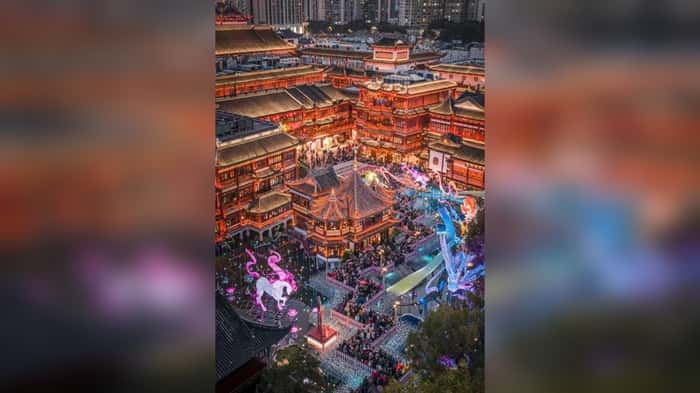
If ever there was a city built for a comeback, it’s Shanghai.
Not loud. Not showy. Just quietly confident, the way global cities tend to be when they know exactly what they are.
This year’s Spring Festival holiday felt less like a rebound and more like a reminder. A reminder that Shanghai doesn’t just host events. It stages them.
And travellers, it seems, noticed.
Over the nine-day Lunar New Year break, the city welcomed 21.6 million visitors, up 8.36 per cent year-on-year. Respectable. Solid. But not the real story.
The real story was the spending.
Tourism consumption hit 25.6 billion yuan, a jump of more than 20 per cent, and that tells you everything you need to know. Visitors weren’t just passing through. They were leaning in.
Less sightseeing, more storytelling
Shanghai has always understood something many cities forget: people don’t travel for landmarks anymore. They travel for feeling.
So instead of dusting off the usual checklist attractions, the city rolled out more than 2,500 cultural and tourism experiences, lantern trails, concerts, curated precincts, and night-time activations stitched together into something that felt cohesive rather than crowded.
It worked.
Hotel occupancy nudged above 50 per cent, a modest lift on paper but meaningful in context. Spring Festival has traditionally been a domestic homecoming season, not a classic hotel boom window.
Yet here was Shanghai quietly bending the rules.
The rise of the “urban New Year”
Perhaps the most telling shift was behavioural rather than statistical.
More travellers are choosing to spend Chinese New Year away from their hometowns, swapping family compounds for city skylines. And Shanghai is positioning itself as the place where that idea makes sense.
Authorities curated more than 130 themed routes spanning culture, food, heritage and shopping, many of which were pushed via livestream commerce, a very modern twist on what used to be glossy brochures.
Even more interesting was the inbound mix. Smaller European markets like Greece and Slovenia reportedly doubled, drawn by the layered appeal of Jiangnan heritage wrapped in Shanghai modernity.
Tiny numbers globally, sure. But trends rarely arrive fully formed. They whisper first.
Old Shanghai, new energy
What Shanghai does better than most is balance nostalgia with momentum.
Historic enclaves like Panlong Ancient Town and Zhangyuan Garden leaned into that beautifully, hosting garden parties and heritage fairs that felt less staged and more lived-in. The kind of places where visitors slow down without being told to.
Elsewhere, the city added a contemporary pulse. Concerts, large, headline-style performances, became part of the Spring Festival equation for the first time, pulling younger crowds into the mix and extending the city’s after-dark appeal.
And then there were the lanterns.
Shanghai has never been shy about light, but this year’s displays felt less decorative and more cinematic. Yuyuan Garden once again stole the spotlight, glowing with that unmistakable mix of tradition and theatre.
Culture you can taste
Of course, Shanghai has always known where memory really lives on the plate.
Across the city, intangible heritage fairs and culinary showcases brought old techniques back into public view. Not in a museum sense, but in a way that felt accessible, edible, alive.
Luxury hotels joined in too, layering heritage storytelling into their stays. Not just beds and buffets, but experiences are the currency modern travellers seem happiest to spend.
And yes, soup dumplings still did their job. Some traditions don’t need reinvention.
A signal, not a spike
The temptation is to read numbers like these as a post-pandemic bounce.
That would be missing the point.
What Shanghai appears to be building is something more durable: a version of urban tourism that blends culture, commerce and lived experience into one seamless offering.
Not forced. Not overproduced. Just intelligently layered.
Officials are already talking about deeper integration between culture and tourism, more product innovation, and more reasons to linger.
If they pull it off, Shanghai won’t just benefit. It will influence.
Because in travel, confidence is contagious. And right now, Shanghai looks very comfortable in its own skin.
by Maysa Punchanit – (c) 2026.
Read time: 4 minutes.
About the Writer.
 Maysa Punchanit has never waited for life to become easy. She’s far too practical for that. Instead, she’s built her path the way many strong women do, step by step, job by job, learning something useful everywhere she’s been.
Her working life has taken her through hospitality, sales, beauty therapy and the fast-moving world of social media, where she partnered with some of Thailand’s best-known companies. Along the way, she discovered a steady voice for blogging, warm, direct and grounded in real experience rather than marketing spin.
Being a single mother sharpened her resolve rather than slowing her stride. If anything, it gave her purpose.
Now with Destination Thailand News and Global Travel Media, Maysa arrives not as a newcomer, but as someone quietly battle-tested, resilient, capable and ready for the next chapter.











