

There was a time not all that long ago when Etihad Airways felt like a story still searching for its ending.
The ambition was never in doubt. The execution, at times, was. Restructuring headlines, strategic resets, and a long rebuild. Those who’ve watched the Middle East carriers closely will remember it well.
Fast forward to now, and the narrative has shifted decisively.
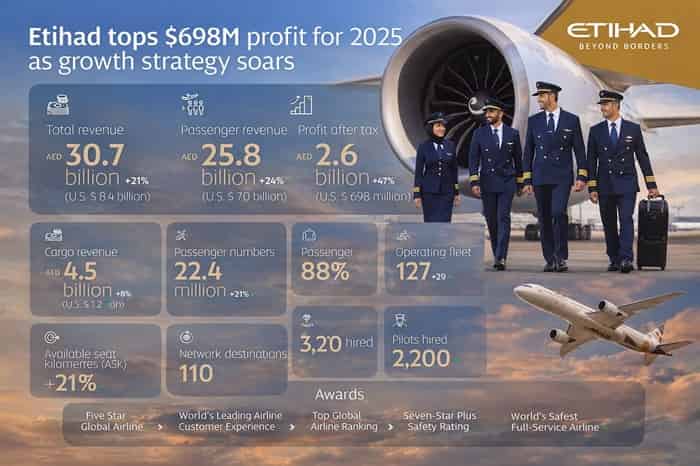
Etihad has posted a record profit of AED 2.6 billion (US$698 million) for 2025, the strongest financial performance in its history and its fourth consecutive year in the black. In airline terms, that’s not just a good year. That’s validation.
And perhaps more importantly, it feels earned.
A result built on discipline, not noise
Airlines can post big numbers in boom years. What separates the serious operators is how they get there.
Etihad’s latest results suggest a carrier that has found its rhythm. Passenger numbers climbed 21 per cent to 22.4 million, revenue rose to AED 30.7 billion, and margins landed comfortably ahead of the industry curve.
The 8.4 per cent profit margin might not mean much outside aviation circles, but insiders will recognise it immediately. That’s more than double the global airline average. In a business where single-digit margins are considered healthy, it speaks volumes.
More telling still is the balance sheet confidence behind it. Strong operating cash flow enabled the airline to fund its own growth while still deleveraging a luxury many carriers would envy.
Credit agencies noticed too. A second consecutive Fitch upgrade late last year nudged Etihad into rarefied territory among global peers.
Quietly, steadily, credibility has returned.
Growth, but the measured kind
What stands out in Etihad’s numbers isn’t just scale, it’s control.
Capacity rose in lockstep with demand, with load factors nudging past 88 per cent. Passenger revenue surged 24 per cent, supported by stronger yields and a network that’s clearly been sharpened rather than simply expanded.
Cargo also played its part, ticking up to AED 4.5 billion. The airline’s growing strength on China–Middle East lanes, particularly through its tie-up with SF Express, has given it a useful hedge against the passenger cycle.
It’s not glamorous, cargo. But it’s often where smart aviation strategy quietly reveals itself.
Fleet growth that actually makes sense
Etihad added 29 aircraft in 2025, pushing its fleet to 127, the largest in its history.
That kind of growth once might have raised eyebrows. This time, it feels different. More deliberate. More grounded.
New-generation aircraft like the A321LR and A350 are doing the heavy lifting, allowing the airline to stretch long-haul economics and maintain premium product consistency.
The network followed suit, expanding to 110 destinations with new points across Europe, Asia and beyond. Cities like Prague, Warsaw and Atlanta aren’t vanity additions; they’re inbound levers, feeding Abu Dhabi’s broader tourism machine.
And that’s the key. Nothing here feels random anymore.
Abu Dhabi is at the centre of the story
Etihad’s trajectory has always been intertwined with the emirate it calls home. That relationship is now more visible than ever.
Point-to-point traffic to Abu Dhabi climbed to 5.5 million passengers, while stopover numbers more than doubled year-on-year. Each additional route, each frequency bump, feeds a larger ambition positioning Abu Dhabi as a destination rather than merely a transit point.
Etihad’s chairman, His Excellency Mohammed Ali Al Shorafa, framed it plainly, pointing to the airline’s role in advancing tourism, connectivity and economic diversification.
For those watching the Gulf aviation chessboard, the alignment is unmistakable.
The experience factor
Growth is easy to announce and harder to deliver without fraying the edges. Etihad has leaned heavily into product to make sure that doesn’t happen.
The A321LR’s fully flat beds, refreshed premium cabins and incremental lounge upgrades are all part of a broader push to tighten the end-to-end journey. Even the digital layer website, app, and brand refresh has been quietly modernised.
The payoff shows up in customer sentiment. Net Promoter Scores climbed again in 2025, backed by a trophy cabinet that now includes more than 25 international awards.
Recognition is nice. Consistency is better. Etihad seems increasingly focused on the latter.
People behind the turnaround
Behind every airline result is a workforce story, and Etihad’s is worth noting.
More than 3,000 new hires joined during the year, with frontline roles leading the charge. Cabin crew, pilots, and operational depth are all essential ingredients for sustainable expansion.
At the same time, internal promotions surged, signalling that the company was beginning to grow its own leadership bench rather than buying it in.
It’s a subtle shift, but an important one. Airlines mature when their culture catches up with their ambition.
A CEO with momentum
Chief executive Antonoaldo Neves described 2025 as a defining year, and it’s hard to argue otherwise.
What’s striking isn’t just the results, but the tone. Less chest-thumping, more quiet confidence. The sense of an airline that knows exactly where it’s headed.
With fresh aircraft orders already in the pipeline and a strengthened financial footing, Etihad now finds itself in an unfamiliar position compared with a decade ago: stability.
And in aviation, stability is currency.
Why this moment matters
Zoom out, and Etihad’s record year tells a bigger story about aviation’s shifting centre of gravity.
Gulf carriers are no longer simply the industry’s disruptors. Increasingly, they’re its standard-bearers: financially disciplined, strategically patient and deeply integrated into national economic agendas.
For travel professionals across Australia and the wider Asia-Pacific, that shift has real implications. Network certainty, product consistency and stronger partnerships tend to follow financial health.
And right now, Etihad looks very healthy indeed.
The road ahead
Aviation has a habit of humbling even the strongest performers. Cycles turn, fuel spikes, geopolitics intrude. Nothing is ever guaranteed.
But Etihad enters its next chapter from a position that once seemed distant: strength without swagger.
The airline that spent years rebuilding is now writing a different kind of headline, one grounded less in ambition and more in assurance.
And if 2025 is any indication, the next phase of Etihad’s journey may not be about proving itself at all.
It may simply be about delivering, year after year.
Which, in this business, is the most convincing story of all.
by Alison Jenkins – (c) 2026.
Read time: 7 minutes.
About the Writer.
 Alison Jenkins has lived most of her working life in the slipstream of aviation, where timetables matter, and people matter more. In airline sales, she built a reputation the old-fashioned way: by knowing her clients, her routes, and never missing the human detail.
Quick with a smile, quicker with a solution, she made deals with warmth and kept her edge intact.
Trade shows, FAMILS, airport lounges and hotel lobbies became her second address. And somewhere along the way, notebook in hand, she began writing the journeys rather than selling them. Her reports grew lively, observant, full of the small truths only travellers notice.
That was the moment it dawned on her: she wasn’t simply travelling. She belonged in its stories.











