

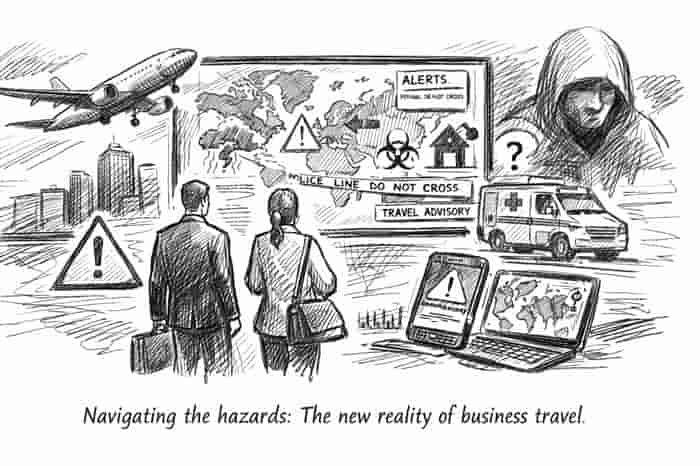
There was a time when travel risk sat quietly in the background, a checkbox, a policy line, something buried deep in corporate travel manuals.
Those days are gone.
Now it’s front and centre, often arriving before the boarding call.
Which is why BCD Travel’s latest move feels less like innovation and more like adaptation. The global travel management heavyweight has teamed up with travel intelligence firm Riskline, and the timing speaks for itself.
The world has become noisier. Less predictable. Harder to read.
And corporate travel hasn’t escaped that shift.
A travel buyer survey BCD ran in December 2025 revealed what many already suspected: half of respondents said their travellers had faced a risk incident in the past year serious enough to trigger travel risk management. Not hypotheticals. Real moments. Real disruptions.
Just as telling was what came next, communication gaps. Not knowing fast enough. Not knowing clearly enough.
That’s the space this partnership is trying to fill.
Making sense of the noise
At face value, the deal blends BCD’s travel management infrastructure with Riskline’s intelligence engine. But strip away the language, and it comes down to something simpler: better awareness, sooner.
Riskline pulls insight from more than 100,000 sources across multiple languages, combining human analysts with AI and open-source intelligence. The idea is to cut through the static and surface what actually matters.
Not everything. Just the right things.
Alerts and destination intelligence will roll out in seven languages, with a reported accuracy of 99.8%. Around the clock, analysts stationed across 22 countries keep watch on civil unrest, political shifts, health scares, natural disasters, the whole unpredictable mix modern travel has learned to live with.
A decade ago, that might have sounded excessive. Today, it sounds realistic.
Duty of care grows up
What’s changed isn’t just the volume of risk; it’s the expectation around it.
Duty of care has matured. Quietly but firmly.
It’s no longer just about reacting when something goes wrong. It’s about anticipation. Context. Reassurance. The sense that someone is paying attention before travellers even realise they should.
The BCD–Riskline tie-up leans into that shift, expanding insights beyond traditional red flags. Visa rules, health entry quirks, safety nuances for different traveller profiles, and the smaller details that increasingly shape whether a trip feels smooth or stressful.
For travel managers, that kind of clarity isn’t a luxury. It’s oxygen.
“In an increasingly volatile global travel environment, risk mitigation and management are top priorities for BCD. We continue to invest in the people, intelligence and technology that strengthen our ability to support customers in meaningful and innovative ways,” said Jorge Mesa, senior director, Travel Risk Management at BCD.
“Riskline allows us to turn risk intelligence into engaging insights that mitigate risk and drive confidence with travelers and program stakeholders. This approach prioritizes both operational resilience and traveler wellbeing.”
Riskline CEO Suzanne Sangiovese was equally direct.
“Travel risk management today requires both speed and substance,” she said. “We are excited to partner with BCD and to co-deliver a modern suite of risk management solutions that the industry ecosystem needs. Together, we are focused on helping organizations and travelers navigate an increasingly complex risk landscape with confidence.”
The bigger shift underneath
Step back, and this feels like part of a broader recalibration.
Corporate travel is becoming less about logistics and more about assurance. Less transactional, more emotional.
Travellers want confidence. Companies want certainty. Both are becoming increasingly difficult to deliver.
That’s why intelligence, the good kind, the useful kind, is fast becoming the real differentiator in travel management.
Not louder dashboards. No more alerts. Just clearer signals when it matters.
The BCD–Riskline partnership won’t eliminate uncertainty. Nothing will. But it does acknowledge a simple truth: the industry is slowly accepting:
The journey isn’t just about getting there anymore.
It’s about knowing what’s waiting when you do.
And in today’s travel landscape, that knowledge might just be the most valuable upgrade of all.
by Anne Keam – (c) 2026.
Read Time: 3 minutes.
About the Writer.
 Anne Keam’s story begins in Queensland, on a grain farm in the state’s wide western reaches, where the days were long and the lessons simple: work hard, look after your own, and don’t make a fuss. Those early years left their mark.
She later studied Arts at the University of Queensland, before doing what felt natural at the time, heading back home to the family property. But the world was calling. Anne packed a backpack and went looking, spending years on the road and finding herself most alive in South America. She wrote everything down along the way. Those notebooks, full of dust, colour and curiosity, eventually became her blog, a quiet, personal record of seeing the world and learning from it.











