

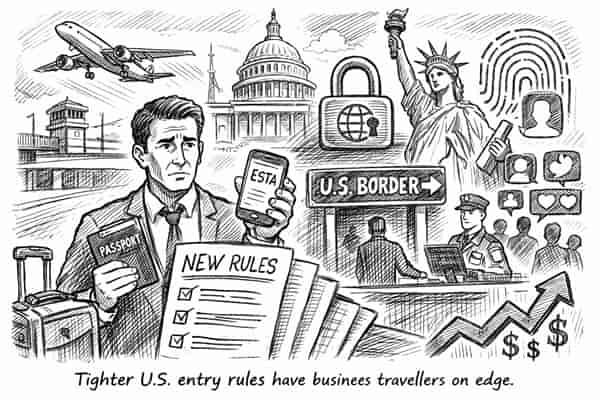
In the delicate theatre of global mobility where commerce, diplomacy and corporate ambition frequently share the same boarding pass, even the smallest regulatory tremor can echo across continents.
So when the Global Business Travel Association (GBTA) formally stepped forward this week with a cautionary note on proposed changes to the United States’ Electronic System for Travel Authorisation (ESTA), the industry listened.
Carefully.
Measured, yet unmistakably firm, the association has urged U.S. Customs and Border Protection (CBP) to embrace what it calls a “balanced and practical approach” — one that safeguards borders without quietly boarding up the doors to international business.
After all, in a sector worth an estimated US$1.57 trillion, balance is not merely desirable — it is essential economic hygiene.
Security Without Suffocation
“Security and efficient business travel are not mutually exclusive,” said Suzanne Neufang, CEO of GBTA, in comments accompanying the submission.
“While GBTA strongly supports efforts to protect U.S. borders and enhance traveller security, the proposed changes pose significant risks and could undermine the benefits that business travel brings to organisations who send their employees on international trips to the U.S. and the American destinations who welcome them.
“A balanced approach will strengthen national security while ensuring that the U.S. remains an accessible, desired and competitive meeting and conference destination for global business.”
Diplomatic words — but beneath them sits a very real commercial concern.
Because in today’s hyper-connected economy, friction is the sworn enemy of growth.
What Exactly Is at Stake?
Business travel has long functioned as the quiet engine room of the global economy. Deals are rarely sealed over email alone; innovation still prefers a handshake.
GBTA members directly manage more than US$363 billion in annual travel spend. Within the United States itself, business travel generated US$484 billion in economic impact and supported roughly six million jobs, according to GBTA data.
Numbers like these do not whisper; they resonate.
Yet the proposed ESTA revisions risk introducing administrative burdens that could slow corporate travel to a crawl.
Among the flagged concerns:
-
Expanded requirements to disclose years of social media history, phone numbers, email addresses, detailed family information and potentially biometric data.
-
Possible conflicts with international privacy regimes, notably strict European data protection mandates governing transparency and cross-border safeguards.
-
A mobile-only application platform that may collide with corporate cybersecurity policies while excluding travellers without compatible devices.
-
Longer approval timelines, higher error risk and reduced predictability are the corporate travel manager’s equivalent of weather delays.
-
And perhaps most troubling: the possibility that companies simply take their meetings elsewhere.
Because in global business, convenience often wins the contract.
Industry Anxiety Is Rising Quickly
Fresh GBTA polling from January 2026 paints a picture that is unsettling.
Surveying 571 travel professionals across 40 countries, the association found 78% are concerned about the proposed changes. Nearly two-thirds anticipate greater difficulty managing travel programs, while 63% expect higher costs associated with sending employees to the U.S.
Privacy, too, looms large.
Among European respondents, 67% indicated employees would prefer not to travel to the United States if extensive personal disclosures become mandatory, a statistic that should give destination marketers pause.
Perhaps more telling still are the behavioural shifts already being contemplated:
-
43% say their organisations are more likely to stage meetings outside the U.S.
-
29% foresee a near-term drop in business travel volumes.
-
25% predict longer-term declines.
-
19% are preparing to revise corporate travel policies to limit U.S. trips altogether.
If realised, those figures could reshape global meeting geography with surprising speed.
Competitiveness Is a Fragile Advantage
For decades, the United States has enjoyed an almost gravitational pull for international conferences, investment forums and corporate gatherings.
Accessibility helped build that reputation.
But reputations, like airline loyalty, can shift when the journey becomes unnecessarily complicated.
Destinations across Asia-Pacific and Europe are already investing heavily in frictionless entry systems, digital visas and streamlined border technology. Should ESTA drift toward complexity, the competitive gap could narrow or worse, invert.
And the global meetings industry is nothing if not pragmatic.
If executives can convene in Singapore, Barcelona, or Sydney with fewer hurdles, many will do so.
The Privacy Tightrope
One of the more nuanced challenges lies in reconciling expanded U.S. data requests with international privacy frameworks.
European Union regulations, for instance, impose stringent restrictions on the collection and transfer of personal data. Multinational corporations must navigate these rules carefully; compliance is not optional.
Should ESTA requirements stray into regulatory conflict, corporate legal departments, famously cautious creatures, may simply advise against travel.
Not out of protest, but prudence.
A Moment Calling for Calibration
Importantly, GBTA is not arguing against security. Far from it.
Rather, the association is advocating calibration, a thoughtful balance between vigilance and velocity.
In practical terms, that might mean refining data requirements, offering flexible application channels beyond mobile-only systems, and ensuring processing timelines remain predictable enough for corporate travel planning.
Because unpredictability is the one thing business travellers truly cannot schedule.
The Larger Economic Narrative
Viewed through a broader lens, this debate is less about the forms and fields in an application and more about the economic posture.
Business travel catalyses trade, accelerates investment and fuels collaboration. When executives move, economies tend to follow.
Restrict that movement, even inadvertently, and momentum can fade.
The United States remains one of the world’s most compelling commercial arenas. Yet maintaining that allure increasingly demands policy settings that welcome enterprise while protecting national interests.
It is, in every sense, a strategic balancing act.
For now, the industry waits to see whether regulators lean toward rigidity or refinement.
One suspects the outcome will influence not only travel flows but boardroom decisions worldwide.
And in a sector built on connection, the message is clear: keep the doors secure, certainly, but keep them open.
by Charmaine Lu – (c) 2026.
Read Time: 5 minutes.
About the Writer.
 Charmaine has always carried a quiet kind of courage. She grew up in Shanghai, a city that never slows, yet found her own balance there, studying accounting for discipline and the arts for beauty. She needed both, and she knew it.
When she arrived in Sydney in the 1980s, she brought little more than a degree, a suitcase and the resolve to begin again. The harbour breeze felt like permission. She met Stephen, and together they built a life that bridged two cultures, a family, a home, and plenty of laughter.
Work was never just work. Long before search engines ruled the day, Charmaine was helping businesses be found by telling stories people wanted to read. That remains her quiet gift.
Her life isn’t a résumé. It’s grace under change structure and creativity, held together by a generous heart.











