

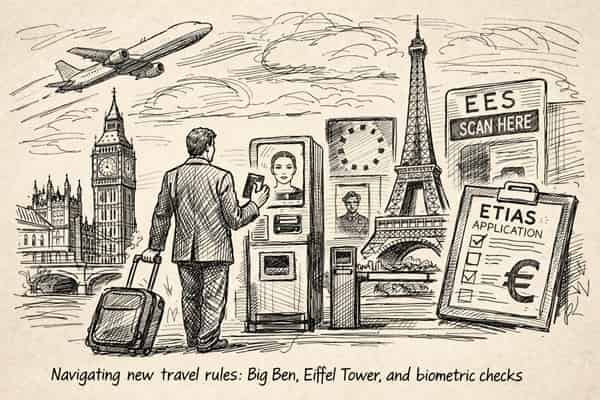
If ever there were proof that commerce waits for no bureaucratic flourish, it is this: Australian business travellers are packing their bags for Europe and the United Kingdom in greater numbers than ever and doing so with admirable composure despite a thicket of new entry rules that would make even the most seasoned road warrior pause mid-itinerary.
Fresh data from Corporate Traveller Australia, the SME arm of Flight Centre Travel Group, reveals bookings to the UK rose nearly 14 per cent in the second half of 2025 compared with the same period the year prior. This uptick coincided with governments across Europe tightening border processes, introducing digital authorisations, and expanding biometric screening.
In short, the gates may be more sophisticated, but they are far from closed.
Tom Walley, Global Managing Director of Corporate Traveller, puts it plainly:
“This is one of a number of modifications that have either just been introduced or are being rolled out in the coming months. The data tells us something important: businesses recognise that travel to these regions remains essential.”
It is a sentiment that echoes across boardrooms nationwide. Deals still demand handshakes, partnerships still thrive on face-to-face rapport, and video calls for all their efficiency rarely seal a negotiation with quite the same conviction.
Complexity rises, but confidence holds
Australian passport holders now contend with three distinct systems when heading westward:
-
The UK’s Electronic Travel Authorisation (ETA)
-
Europe’s Entry/Exit System (EES)
-
The forthcoming European Travel Information and Authorisation System (ETIAS)
At first glance, it reads like alphabet soup for the compliance department. Notably, the barriers are more educational than technological.
Corporate Traveller’s latest survey of travel managers found 54 per cent identified traveller education, not the systems themselves, as the greatest challenge.
Walley again:
“Entry requirements are becoming more complex, and they’re evolving constantly. Companies that partner with a travel management company have someone keeping track of every update, ensuring travellers aren’t caught out, and with the ETA similar to the ESTA in the USA, travellers should be well-equipped to navigate the changes.”
That comparison is no accident. Much as the American ESTA quickly became routine, the ETA appears destined to follow the same path, another small digital checkpoint in the modern traveller’s journey.
A world increasingly comfortable with biometrics
There is further reassurance in broader passenger sentiment. According to the International Air Transport Association’s Global Passenger Survey, a striking 74 per cent of travellers are willing to use biometric technology at airports, with Asia-Pacific passengers leading adoption.
For an industry once wary of automation, this signals a quiet cultural shift: travellers are not resisting the future; they are queuing for it.
(For further insight, see IATA’s research: https://www.iata.org)
What Australian business travellers must know
Here, prudence is the traveller’s best companion.
UK ETA becomes mandatory for boarding
Australians have been eligible to apply for the UK ETA since January 2025. However, from 25 February 2026, it becomes mandatory for boarding, with airlines legally obliged to verify approval before departure.
Costing £16 and valid for two years, with multiple entries, the ETA applies to short visits across tourism, business, and transit.
Travellers holding a UK visa or those with rights to live, work or study are exempt. Dual British or Irish citizens must travel on the appropriate passport to prove citizenship.
Official details can be found via the UK Government: https://www.gov.uk.
The grace period that accompanied the rollout is ending. Enforcement will not be theatrical, but it will be firm.
Europe shifts to biometric borders
October 2025 marked the launch of the Entry/Exit System, replacing passport stamps with digital identity checks.
First-time travellers should allow an additional three to seven minutes for facial scans and fingerprint capture. Subsequent entries, mercifully, are expected to move more swiftly.
Looking ahead, the ETIAS program, slated for late 2026, will require Australians to obtain online pre-travel approval before entering Schengen countries. At €20 and valid for three years, it aims to screen visa-exempt visitors before wheels-up.
More information is available from the European Union at https://travel-europe.europa.eu.
Beyond Europe: a patchwork of policy shifts
Elsewhere, governments are recalibrating entry settings with equal vigour:
-
China has extended its 30-day visa-free entry for Australians through 31 December 2026.
-
South Korea has waived the K-ETA requirement until the same date and now requires a digital arrival card.
-
The United States has tightened biometric collection and expanded ESTA disclosure requirements to include five years of social media history and a decade of contact records.
-
Thailand has doubled its visa-free stay to 60 days and introduced the Thailand Digital Arrival Card, which must be completed within three days before arrival.
For frequent flyers, it is less a single rulebook than a constantly revised anthology.
The quiet rise of the travel management company
Perhaps the most telling outcome of this regulatory renaissance is the renewed relevance of professional travel advisors.
Where once corporate travel teams focused largely on fares and schedules, today they function as navigators through a regulatory maze.
Walley notes:
“Entry and exit conditions can change at short notice. Having a reliable travel partner keeps travellers safe and informed, so they’re across the latest developments before they board a plane.”
It is advice rooted in old-school travel wisdom: preparation prevents panic, and it is newly relevant in a digitised border era.
Corporate Traveller also urges businesses to verify visa requirements directly via government websites and remain vigilant against scam platforms that prey on regulatory confusion.
The enduring value of business travel
Strip away the policy layers and one truth remains refreshingly unchanged: global commerce still runs on human connection.
Australian firms appear to understand this instinctively. Rather than retreat, they are adapting by building compliance into travel programs, educating staff, and leveraging expert partners.
One might even argue that the new rules add a certain gravitas to international travel. After all, journeys worth taking have rarely been effortless.
And so, despite biometric gates, digital permits and expanding disclosure forms, the corporate traveller marches on, laptop in hand, boarding pass ready, proving that while the mechanics of travel evolve, its purpose endures.
In the grand tradition of business itself, resilience is not merely admirable; it is expected.
by Charmaine Lu – (c) 2026.
Read Time: 5 minutes.
About the Writer.
 Charmaine has always carried a quiet kind of courage. She grew up in Shanghai, a city that never slows, yet found her own balance there, studying accounting for discipline and the arts for beauty. She needed both, and she knew it.
When she arrived in Sydney in the 1980s, she brought little more than a degree, a suitcase and the resolve to begin again. The harbour breeze felt like permission. She met Stephen, and together they built a life that bridged two cultures, a family, a home, and plenty of laughter.
Work was never just work. Long before search engines ruled the day, Charmaine was helping businesses be found by telling stories people wanted to read. That remains her quiet gift.
Her life isn’t a résumé. It’s grace under change structure and creativity, held together by a generous heart.











