

If the European cruise industry were a long voyage north, the Baltic would now be sailing with a fair wind. Across Copenhagen, Malmö and Visby, the 2025 cruise season has delivered exactly what port planners hoped for: solid performance, steady growth and enough momentum to make 2026 look not just promising, but quietly impressive.
In an industry still learning how to balance scale, sustainability and spending power, the Nordic cruise market is doing what it has long done best: evolving without shouting about it.
Copenhagen, the region’s undisputed heavyweight, clocked 316 cruise calls in 2025, welcoming almost 866,500 passengers. That figure landed squarely on expectations, with a helpful boost from additional calls linked to ship repositioning from other regions. In plain terms, when cruise lines reshuffled their decks, Copenhagen was the port they trusted to pick up the slack.
That trust looks set to continue.
For 2026, passenger numbers are forecast to edge up to around 880,000, supported by a consolidated 312 cruise calls. On the surface, that might look like marginal growth. In reality, the quality of those calls tells a more interesting story.
Turnaround calls, where ships begin and end itineraries, change passengers, and effectively double their economic footprint, are on the rise. From 111 in 2025, Copenhagen expects 122 turnaround calls in 2026, a 10 per cent increase. More turnarounds mean more hotel nights, more meals, more shopping, and more time spent doing what visitors do best: spending money.
It’s the sort of growth city economists prefer: fewer peaks, more depth.
There’s also a quiet stretching of the season underway. Cruise calls outside the traditional summer window are increasing, with overnight stays holding steady and colder months playing a growing role in the annual calendar. From October 2025 through to April 2026, cruise calls across the destinations are expected to jump by more than 35 per cent, rising from 64 to 88.
That matters. A longer season smooths demand, supports year-round jobs and helps ports justify infrastructure investments that don’t hibernate when summer ends.
Visby, perched on Sweden’s Gotland island and beloved by cruise passengers for its medieval charm, has delivered a similarly steady performance. The 2025 season closed with 100 calls and 160,500 passengers, right on target. For 2026, projections remain comfortably familiar: 105 calls and about 165,000 passengers, with continued expansion at the shoulders of the season rather than dramatic spikes.
It’s a measured approach that suits a destination defined by heritage rather than hype.
Malmö, meanwhile, is the quiet achiever turning heads. After a modest 2025 season of just three calls and 1,670 passengers, the city is poised for a breakout year in 2026. Seventeen calls are scheduled, including 10 turnaround calls, which are expected to bring an estimated 8,800 guests through the port.
For a city better known for innovation than itineraries, it’s a significant vote of confidence. Malmö is emerging not just as a stopover, but as a starting point, a subtle but important distinction in cruise economics.
Adding further weight to the outlook are 20 maiden calls scheduled across the destinations in 2026, a record for the port group. New ships mean new deployments, new itineraries and, often, new passengers discovering the region for the first time.
Then there’s shore power, the unsung hero of modern cruising.
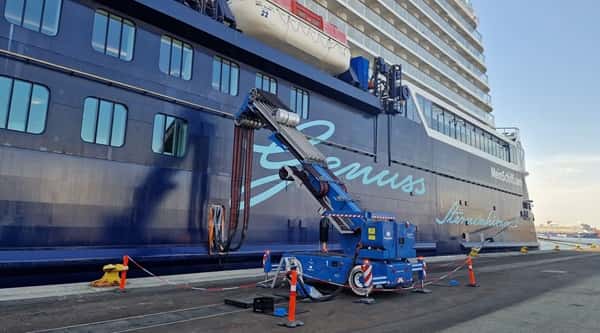
Copenhagen’s shore power facility, developed by By & Havn and opened in summer 2025, is among the largest of its kind in Europe. The technology allows ships to switch off their auxiliary engines while docked, sharply reducing noise and emissions. In its first year, 88 ship calls connected to shore power. In 2026, that figure is expected to more than double to 183 calls.
Put another way, nearly 79 per cent of cruise guests arriving in Copenhagen next year will do so on ships plugged into shore power.
That’s not accidental.
“We set for a strong year again in 2026 with solid numbers, more maiden and turn-around calls, and continuing to see more ships during the colder months. CMP’s shore power facility is well dimensioned to meet existing demand and the expected growth in connectivity. Our pricing incentives will continue to support shore power usage. The high share of cruise guests arriving on shore power connected ships in 2026 is a testament to the joint efforts and commitment of the city, the Cruise Denmark – Copenhagen and Beyond network, the port, and our valuable cruise line partners to accelerate shore power adoption,” says Luis De Carvalho, Commercial Cruise Director, Copenhagen Malmö Port.
CMP is backing words with policy. Ships that connect to shore power receive rebates on port fees, while electricity is charged on a consumption basis at spot market rates, keeping costs competitive. With shore power set to become mandatory by law in 2030, the region is not racing the clock; it’s comfortably ahead of it.
Full power capacity will be reached in 2028, but the current infrastructure is already well matched to demand. That alignment, rare in large-scale port projects, reflects careful planning rather than optimistic guesswork.
Taken together, the figures point to a Nordic cruise market that is neither chasing volume at all costs nor resting on past success. Instead, it’s extending seasons, deepening economic impact, welcoming new ships and embracing sustainability all without losing sight of what makes the region attractive in the first place.
For cruise lines, passengers and port cities alike, that’s a course worth staying on.
by Susan Ng – (c) 2026.
Read Time: 4 minutes.
About the Writer.
 With the polish of an international hotel professional and the instincts of a born storyteller, Susan Ng learned hospitality where it truly lives behind reception desks, in banquet halls, beside linen carts. She understands that excellence isn’t announced; it’s felt, in the small, quiet gestures that linger long after checkout.
Away from the bustle, her curiosity found a new front desk: the blank page. Her blog, candid and gently wry, drew readers who recognised truth when they saw it. She wrote about grace and imperfection with the steady eye of someone who had lived both.
Today, at Global Travel Media, Susan brings that same warmth and insight to her stories. Expect writing that is polished, generous, and reassuring, like the perfect welcome after a long journey.











