


Airlines talk a lot about partnerships. Most amount to little more than polite handshakes, a few shared flight numbers and a promise to “explore opportunities”.
This one is different.
Malaysia Airlines and Singapore Airlines have formally locked in a joint business partnership that goes well beyond codeshares and marketing speak, and, quietly, it reshapes one of the busiest and most commercially important air corridors in the region.
With regulatory approvals now in place from both governments, the two flag carriers will begin aligning schedules, fares and corporate travel arrangements on services between Malaysia and Singapore. Over time, that alignment may extend to revenue-sharing flights and jointly developed fare products, the sort of structural cooperation airlines only attempt when they trust each other not to blink.
For travellers, the benefits are refreshingly practical. Better-timed connections. More flexibility. Less friction moving between two countries that already operate as economic siblings.
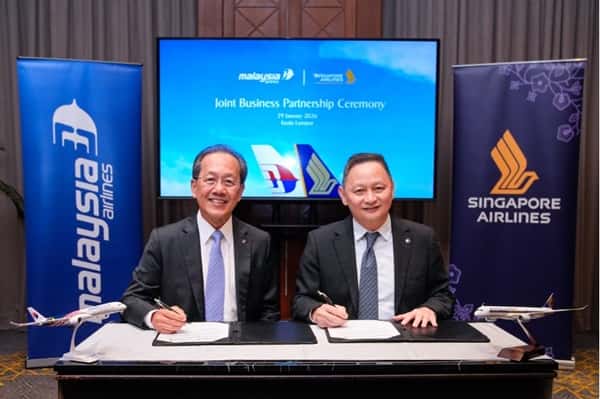
Datuk Captain Izham bin Ismail, Group Managing Director, Malaysia Aviation Group (left) and Mr Goh Choon Phong, Chief Executive Officer, Singapore Airlines (right), at the signing of the Joint Business Partnership in Kuala Lumpur, Malaysia on 29 January 2026.
For Malaysia Airlines, it is also a statement of intent.
Datuk Captain Izham bin Ismail, group managing director of Malaysia Aviation Group, described the agreement as a critical step in the airline’s long-term turnaround strategy and a signal that the carrier is now thinking beyond recovery.
“This collaboration brings together complementary frequencies and aligned schedules, enabling deeper connectivity between Malaysia and Singapore,” Izham said. “Over time, it reinforces Malaysia Airlines’ competitive position by enhancing scale, relevance, and network resilience across key markets.”
That language may sound corporate, but the subtext is clear enough: Malaysia Airlines is done rebuilding. Now it wants leverage.
Singapore Airlines, for its part, rarely rushes into anything and almost never without a clear commercial logic. Chief executive Goh Choon Phong framed the partnership as a rare example of genuine mutual benefit.
“I would like to thank the authorities in both Singapore and Malaysia, whose approvals pave the way for this deeper strategic partnership,” Goh said. “Our win-win collaboration strengthens both carriers’ operations, while delivering enhanced value to customers across our combined networks.”
He also touched on something airlines often forget to say out loud: this route isn’t just about aircraft utilisation. It’s about people.
The Singapore–Malaysia air bridge supports deep trade ties, frequent business travel, and one of the densest patterns of family movement in Asia. Strengthen the airlines, and you strengthen the flow.
The deal builds on foundations laid back in 2019, when the two carriers first agreed to work more closely. Since then, codesharing has expanded steadily. Singapore Airlines now places its code on Malaysia Airlines flights not only between Kuala Lumpur and Singapore, but on services to London and across Malaysia’s domestic network. Malaysia Airlines does the same on Singapore Airlines’ long-haul routes into Europe and Africa.
Earlier this year, the relationship edged closer again when both airlines allowed frequent flyer members to earn points across selected flights, a small change that regular travellers notice immediately.
What matters most, though, is what this partnership represents in an industry that often confuses scale with strength.
This is not about chasing growth for growth’s sake. It’s about coordination. About two legacy carriers recognising that on certain routes, competition is less valuable than cooperation, and that resilience now matters more than bravado.
It’s a grown-up move. And aviation could use more of them.
by Soo James – (c) 2026.
Read Time: 3 minutes.
About the Writer.
 There’s nothing rehearsed about Soo James, and that’s precisely the point. Malaysian by heritage, Sydney by schooling, she arrived at UNSW to study Arts, then took a left turn into IT, not out of ambition, but curiosity. Somewhere among systems and schedules, she worked out what really held her attention: people, language, and the quiet spaces between them.
Writing followed naturally. Travel and lifestyle gave her room to observe, to listen, to notice the details others rush past. Soo writes the way good travellers move, watching the room before admiring the view, catching the gesture before chasing the headline.
At Global Travel Media, her stories don’t shout or sell. They linger. They slow you down, open a door, and gently suggest there’s more to see if you’re willing to look.











