

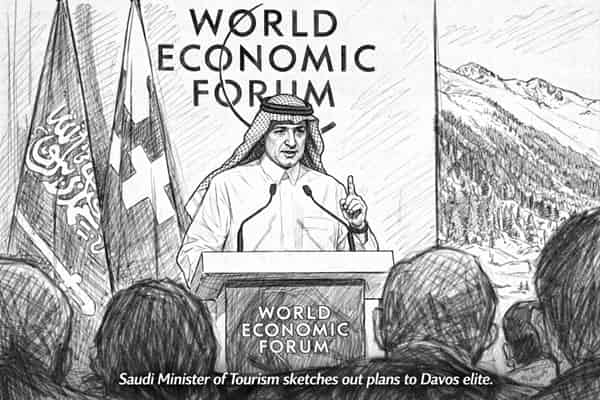
By any measure, Davos is a town built on symbolism. Snow-dusted chalets, discreet meetings behind frosted glass, and a parade of world leaders promising to fix what the last parade could not. This year, amid the familiar handwringing about geopolitics and growth, Saudi Arabia’s tourism minister arrived with a proposition that cut through the alpine fog: tourism is no longer a leisure industry. It is infrastructure.
At the World Economic Forum Annual Meeting 2026, His Excellency Ahmed Al-Khateeb did not talk about brochures or beach resorts. He talked systems, productivity and resilience, the language of treasurers, not travel agents.
“With an estimated two billion international arrivals by 2030, the question for leaders is not whether tourism will grow, but whether it will scale responsibly,” Al-Khateeb told delegates. “When tourism is designed as economic, social, and cultural infrastructure, it becomes a powerful engine for diversification, resilience, and long-term value, not simply movement across borders.”
It was a statement carefully calibrated for a room obsessed with roads, ports and digital pipes. Tourism, the minister argued, deserves a seat at that table.
From an optional extra to an economic engine
For decades, tourism has lived in the margins of economic planning, a useful revenue stream in good years, an easy cut in bad ones. Al-Khateeb’s message was blunt: that mindset is now obsolete.
Globally, travel and tourism accounts for around 10 per cent of world GDP and supports more than 357 million jobs. That is not a cottage industry; it is one of the largest employers on the planet. Yet, as the minister noted, it remains “too often absent from infrastructure, trade and industrial policy”, despite being a US$10 trillion global economy.
His remedy is simple in theory, demanding in practice: treat tourism the way governments treat energy grids or transport corridors as long-term productive capital.
In a fragmented world, he argued, tourism does more than move people. It creates jobs across regions, attracts patient capital, and, in tense geopolitical moments, keeps conversations alive when formal channels falter.
“In some instances tourism helps to sustain dialogue when formal channels are under strain,” he said. “It builds understanding, trust and connection. Led responsibly, it can act as a stabilising force and a multiplier for peace globally.”
Saudi Arabia’s grand experiment
If this sounds ambitious, Saudi Arabia has the data to back it.
Under Vision 2030, tourism has been recast from cultural footnote to economic pillar. In 2025, the Kingdom recorded 30 million inbound visitors. By 2030, the target is 150 million. That is not growth; it is a wholesale rewiring of a national economy.
Saudi Arabia is now the world’s single largest investor in tourism, with capital flowing across destinations, aviation, digital platforms and human capital. Tourism contributes close to five per cent of direct GDP and employs more than one million people, figures more commonly associated with mining or manufacturing.
The minister pointed to AlUla, Diriyah and the Red Sea projects as proof of concept: master-planned destinations built around safety, sustainability, governance and quality of life. The emphasis, he insisted, is not spectacle but systems.
The reward has been investor confidence and long-term capital, the holy grail of infrastructure planning.
Beyond Tourism, beyond rhetoric
In Davos, Saudi Arabia also showcased its collaboration with the World Economic Forum on the Beyond Tourism initiative, an attempt to drag tourism out of the marketing silo and into the policy engine room.
The agenda is broad: align capital, policy and innovation across sustainability, inclusion, resilience and investment. In plainer terms, stop talking about visitor numbers and start talking about productivity.
The Kingdom has also leaned heavily into execution. Through TOURISE, a global platform designed to convert ambition into delivery, Saudi Arabia has convened almost 10,000 leaders from more than 100 countries and helped catalyse more than US$113 billion in tourism-related investment. The next global gathering is scheduled for March 2027.
This is not tourism as branding. It is tourism as a balance-sheet strategy.
A global brief, not a national one
Perhaps the most striking element of Al-Khateeb’s Davos pitch was its outward gaze. This was not a sales pitch for Saudi Arabia alone.
“One of our biggest challenges is not just looking at ourselves, but other countries and how we can help,” he said. “There are 80 per cent of countries around the world that do not get enough tourists, particularly in places like Africa and Latin America. We want to strengthen relationships with these places to help them build their own tourism sectors and economies, for global benefit.”
It is an argument likely to resonate in regions rich in culture but poor in capital. If tourism is infrastructure, then access to it becomes a development issue, not a lifestyle choice.
The Davos stage, Saudi style
The Kingdom’s presence at Davos was hard to miss. Saudi House returned for a second year, hosting more than 20 sessions across six themes, from human capability to investment and collaboration. The launch of NextOn, a series of talks by global thought leaders, signalled a country eager to shape the conversation rather than merely attend it.
Behind the choreography lies a calculated play for influence: position tourism as the connective tissue between growth, diplomacy and social stability.
It is a persuasive narrative, delivered with the confidence of a nation accustomed to building big.
Why it matters
For Australia, a country where tourism employs hundreds of thousands and underwrites regional economies, the message lands close to home. We still talk about tourism as seasonal, cyclical, dispensable. Yet the same forces Al-Khateeb describes are visible here: capital-hungry regions, workforce shortages, fragile international ties.
If tourism is infrastructure, it deserves infrastructure thinking: long-term planning, integrated policy and serious capital.
Davos, famously, is not short on ideas. What distinguished Saudi Arabia’s pitch was not novelty but insistence. Tourism, Al-Khateeb argued, is already shaping the global economy. The only question is whether governments are prepared to lead it, or continue treating it as a pleasant side-effect of prosperity.
In a forum addicted to the future, it was a refreshingly practical proposition: build tourism deliberately, inclusively, and for the long haul, like you build nations.
by Michelle Warner – (c) 2026.
Read Time: 6 minutes.
About the Writer.
 Michelle Warner has always carried stories the way others carry passports lightly, faithfully, and with purpose. She learned her craft in newsrooms, shaping sentences with care, before swapping deadlines for departures as a flight attendant with some of the world’s great airlines. Years aloft sharpened her eye for character and deepened her fondness for the small, dignified rituals of travel, the quiet kindness of strangers, the poetry of arrival, the patience learned between time zones.
Now grounded by choice, Michelle has come home to writing with the same calm authority she once brought to turbulent cabins. Her prose blends an editor’s discipline with a traveller’s wonder, tinged with humour and reverence for the golden age of travel. Each piece feels like a handwritten boarding pass, gracious, observant, and unmistakably alive.











