

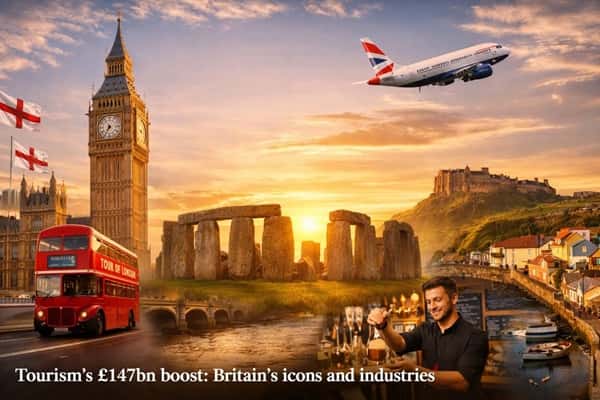
By any reasonable measure, Britain’s tourism industry has stopped being a pleasant sideshow and become a full-blooded economic engine.
A major new report from VisitBritain and VisitEngland, released this week, delivers a figure that commands attention: £147 billion a year. That is what tourism now contributes annually to the United Kingdom, including both direct spending and the wider supply chain. Roughly five per cent of the entire national economy, quietly earned by hotel keys, museum tickets, seaside chips and long-haul arrivals.
In plain terms, tourism is now bigger than the insurance and pensions sectors combined and employs more people than those sectors and financial services combined. For an economy still feeling its way through post-pandemic recovery and geopolitical uncertainty, that is no small statement.
The report, Economic Value of Tourism in the United Kingdom, goes further. In 2024 alone, tourism generated £52 billion in tax revenue, more than half of the NHS in England’s wages bill. That single statistic may explain why ministers are suddenly paying attention to what was once politely labelled “soft power”.
And then there is employment. Tourism now supports 2.4 million jobs, nearly one in every fifteen across the country. Not just in London, either. At least 5% of jobs in every nation and region depend on visitors. From Cornish coastlines to Scottish glens, the tills are ringing far beyond the capital.
There is also a generational dividend. Tourism remains one of Britain’s great first employers, a training ground for young workers, a gateway to skills, a ladder into the labour market. By 2030, the sector is forecast to create another 175,000 jobs.
For an industry once dismissed as seasonal and fragile, that is a remarkably durable footprint.
A sector growing faster than the economy
Perhaps the most striking finding lies ahead. By 2030, total tourism activity is expected to reach £161 billion in today’s prices, a real-terms increase of 9.3 per cent. That comfortably outpaces the projected growth of the broader UK economy at 8.8 per cent.
Inbound tourism will do much of the heavy lifting. Between 2024 and 2030, international visitor spending is forecast to rise by 32 per cent, injecting an extra £9.4 billion into the economy.
Tourism Minister Stephanie Peacock did not disguise the political opportunity.
“From rich culture and historical landmarks to beautiful landscapes and coastal communities, the UK is one of the best and most visited holiday destinations in the world,” she said.
“Without the incredible workforce behind the tourism industry, it wouldn’t be the powerhouse that it is today.
“The economic contribution of the tourism sector is clear, and the Government is ambitious about ensuring it can continue to grow. That is why we are committed to publishing a joint growth plan with the sector in the spring.”
In Whitehall terms, that is code for “this is now a serious industry”.
Coastal Britain, bruised but not beaten
Yet the report is not all champagne and visitor centres.
VisitBritain and VisitEngland’s chief executive, Patricia Yates, offered a candid assessment of the industry’s fault lines.
“This research underscores tourism’s importance as one of the UK’s most valuable industries,” she said, “driving economic growth for every nation and region and supporting our high streets, hospitality businesses, cultural institutions and our communities.
“The billions in tax revenues generated by tourism also shows how spending by domestic and international visitors contributes to services that benefit everyone.”
Then came the warning.
“There are, however, challenges. The decline in domestic holidays has hit coastal destinations particularly hard, as consumers wrestle with cost-of-living pressures and businesses face higher costs.
“Longer-term international forecasts meanwhile show the UK is starting to lose its competitive position globally and inbound visits remain London-centric.”
In short, too many Britons are holidaying abroad, and too many overseas visitors never venture beyond Zone 1.
The numbers tell the story. Eighty-four per cent of domestic overnight tourism spending already occurs outside London. Yet even a modest behavioural shift could reshape the economy. Converting just 10 per cent of what Britons currently spend overseas into holidays at home would deliver an £8 billion annual boost.
It is no coincidence, then, that VisitEngland is preparing a pilot domestic marketing campaign targeting the North West’s coastal destinations ahead of summer. Blackpool, Morecambe and their neighbours may yet enjoy a renaissance.
America, Asia and the Gulf: the next wave
The future of inbound tourism, meanwhile, is increasingly international and strategic.
The United States remains Britain’s most valuable market, forecast to contribute £7.6 billion in 2026 and to account for more than £1 in every £5 of inbound visitor spending. Americans, it seems, still cannot resist castles, pubs and royal pageantry.
Beyond the Atlantic, growth will come faster. Travel from China and India is predicted to rise by 12 per cent annually to 2030. The long-anticipated Asian middle class is finally arriving, and Britain wants its share.
Then there is the Gulf. Already, the UK captures 30 per cent of all Western European trips from Qatar, Saudi Arabia and the United Arab Emirates, some of the world’s highest-spending travellers. For luxury hotels, heritage retail and premium experiences, that market is nothing short of golden.
A quiet pillar of national prosperity
Perhaps the most revealing insight of all is how deeply tourism now underpins everyday Britain.
High streets, pubs, museums, theatres, regional airports, and rural inns all sit on visitor spending. The report confirms what many communities already know: tourism is no longer discretionary. It is structural.
VisitBritain’s findings are now being fed directly into government policy, fulfilling the agency’s statutory role as adviser to ministers. That alone marks a change in tone. Tourism, once treated as a cultural garnish, now sits squarely in the economic cabinet.
And rightly so.
An industry that generates £147 billion, funds half the NHS wage bill, employs millions and outgrows the wider economy deserves more than polite applause. It deserves strategy, investment and long-term stewardship.
For Britain, the message is unmistakable. Tourism is not merely about holidays.
It is about jobs, tax, regional revival and national competitiveness.
And, increasingly, about the future shape of the economy itself.
by Alison Jenkins – (c) 2026.
Read Time: 5 minutes.
About the Writer.
 Alison Jenkins has spent much of her career at thirty thousand feet or at least close to it. Having worked in several sales roles with several airlines, she built a reputation for knowing her clients and flight schedules. Quick with a smile and sharper still with a deal, she became one of those rare people who could charm passengers and partners without losing her professional edge.
Trade shows and FAMILS were all part of the territory, and Alison became a regular on the circuit, with suitcases, smiles, and a notepad never far from reach. Somewhere between airport lounges and hotel lobbies, she discovered she loved telling the stories behind the journeys. Her post-FAMILS reports, meant for internal newsletters, began to take on a life of their own, lively, observant, and unmistakably hers.
That’s when Alison realised, she wasn’t just selling travel, she was meant to write about it.











