There was a time not all that long ago when a long weekend meant pyjamas, gardening gloves and perhaps the ambitious rearrangement of a linen cupboard.
In 2026, that notion has been quietly but firmly retired.
Across Australia, Asia and Europe, the humble long weekend has been rebranded. No longer a recovery period, it has become a precision-engineered mini holiday: four days, two flights, one hotel, a concert ticket and just enough leave saved to keep the boss happy and the soul restored.
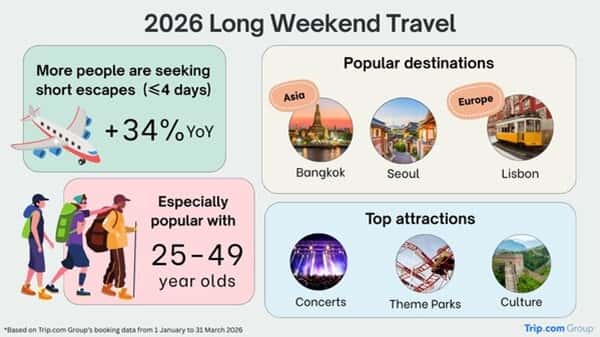
The numbers tell the story plainly. Trip.com Group reports a 34 per cent year-on-year surge in bookings for short trips of four days or fewer, with Europe leading the charge. The most enthusiastic participants are working adults aged 25 to 49, the demographic once most guilty of hoarding annual leave and never quite using it.
Now, they are spending it carefully, cleverly and often spectacularly.
The Rise of the Strategic Escape
This is not laziness. It is logistics.
Public holidays have become the traveller’s chessboard. Good Friday, Hari Raya, Children’s Day each now represent an opportunity to convert one or two leave days into a fully-fledged international escape.
The new travel arithmetic is simple: minimum time off, maximum memory created.
In Asia, short-break favourites include Bangkok, Hong Kong, Seoul and Taipei cities designed for speed, flavour and spectacle. In Europe, the long-weekend crown belongs to Barcelona, Lisbon, London and Paris, places that reward even the briefest flirtation.
Domestic travel, meanwhile, remains the quiet hero. Chinese travellers favour Chengdu, Thais remain loyal to Bangkok, and Filipinos continue to book Caticlan in droves. Short distances, familiar comforts, fewer visas, fewer surprises.
In an era of volatile schedules and crowded calendars, certainty has become a luxury.
Concert Tickets With Boarding Passes Attached
Perhaps the most telling trend is not where people are going but why.
Entertainment tourism, once a niche pursuit, has become a full-blown movement. Concerts now drive flight bookings as reliably as beaches once did.
Chinese and Filipino travellers are flying in for Blackpink’s World Tour ‘Deadline’ in Hong Kong and SEVENTEEN’s Singapore shows. Singaporeans, meanwhile, are snapping up tickets and hotel rooms for Mayday’s #5525 Live Tour in Kuala Lumpur.
The concert is no longer an event within a holiday. It is the holiday.
The rhythm is familiar: land Friday, scream Saturday, brunch Sunday, back at the desk Monday with a hoarse voice and an enviable Instagram feed.
Economists might call it demand clustering. Travellers call it living.
Planning at the Speed of Impulse
Of course, short holidays require long efficiency.
Enter the era of algorithmic travel planning.
Trip.com Group’s Trip.Planner now builds personalised itineraries, flights, hotels, attractions and dining in under a minute. Preferences can be as granular as solo travel, adventure-seeking or blissfully horizontal.
For an industry once dependent on brochures and phone calls, this is nothing short of revolutionary.
Trip.Planner’s companion tools, Trip. Best and Trip Moments now curate nightlife rankings, family attractions and first-hand travel tips with the confidence of a seasoned concierge minus the bow tie.
The result is not automation replacing inspiration, but acceleration enhancing spontaneity.
In 2026, impulse no longer means chaos. It means curated chaos.
Three Long Weekends, Three Personalities
To illustrate the shift, Trip.Planner has curated three long-weekend itineraries, each reflecting a distinct modern traveller archetype.
For the Fun-Loving: Bangkok
Every friendship group has that one chat thread that never quite becomes a trip. Bangkok, it seems, is now the city that finally gets it over the line.
For Singaporeans eyeing the Hari Raya break, Bangkok offers nightlife density unmatched anywhere in the region, cuisine that rewards recklessness, and activities that politely ignore bedtime.
Trip.Best’s nightlife rankings now list everything from rooftop bars to subterranean clubs. Trending concerts and new restaurant openings slide seamlessly into itineraries. Trip Moments supplies the finishing touches, hidden cocktail lounges, secret noodle stalls, that one temple tourists never quite find.
Bangkok, in short, remains gloriously incapable of disappointing.
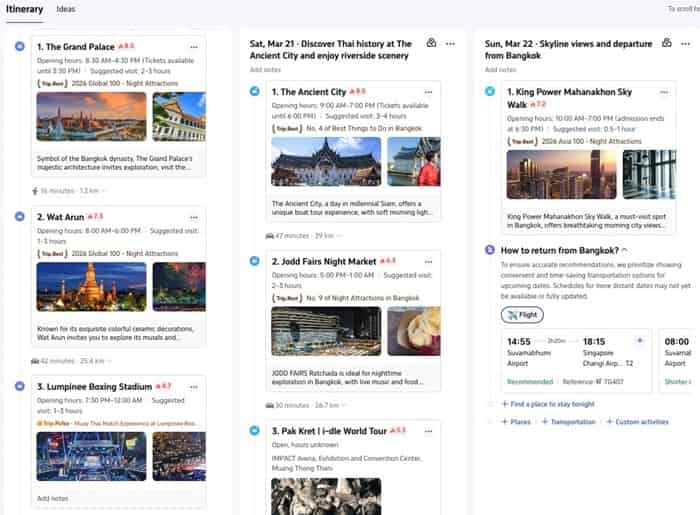
A sample Trip.Plan an itinerary for a three-day trip to Bangkok with friends.
For the Family-Friendly: Chengdu
Children’s Day in South Korea has become the unlikely catalyst for one of Asia’s most popular four-day family escapes.
Chengdu, home to its famously obliging pandas, now ranks among the region’s most booked short-break destinations. Beyond the bamboo forests lie family-oriented museums, sprawling parks and cuisine adventurous enough to impress parents without traumatising children.
Trip.Best’s data-backed rankings now flag family-friendly attractions and hotels, while budget forecasting tools remove the last remaining source of parental anxiety.
The pandas, of course, do most of the heavy lifting.
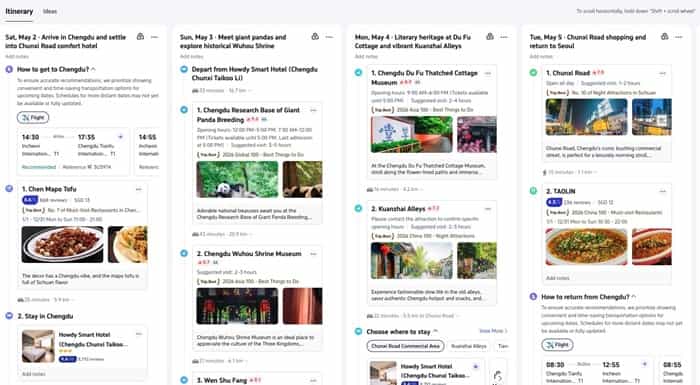
A sample Trip.Planner itinerary of a four-day trip to Chengdu with family.
For the Quiet: Nice
Not all long weekends demand applause.
For the solo traveller escaping the British Good Friday, Nice offers something rarer than nightlife: silence.
The Mediterranean light, coastal walks and gentle cafés provide the ideal counterweight to modern schedules. It is the kind of break that does not announce itself loudly on social media and is therefore all the more effective.
Here, Trip.Planner’s export options matter. Itineraries become spreadsheets, images saved to phones, routes memorised. Planning becomes an act of self-preservation.
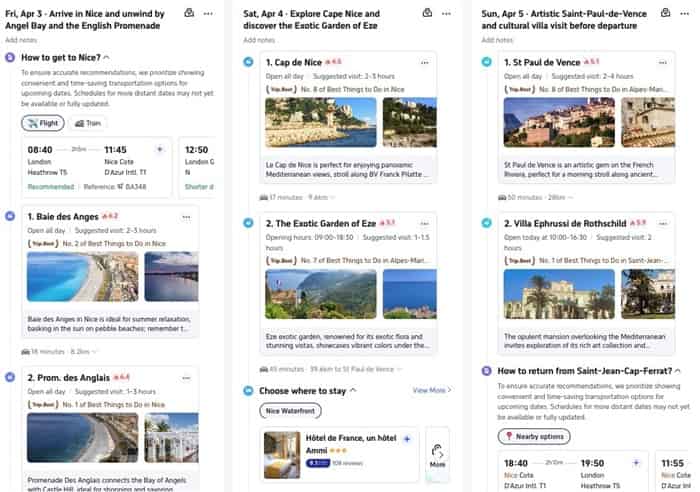
A sample Trip.Planner itinerary of a three-day solo trip to Nice for a nature escape.
Why Short Is the New Smart
Behind the romance lies a hard commercial truth.
Short breaks reduce risk.
They are easier to reschedule, cheaper to insure, simpler to justify at work and quicker to recover from physically. In a post-pandemic world still wary of long absences and sudden disruptions, brevity feels prudent.
Airlines benefit from high-yield, last-minute traffic. Hotels enjoy higher weekend occupancy. Cities see tourism spread more evenly throughout the year.
Even employers quietly approve. Four days away rarely disrupts a quarter.
In a labour market where burnout is both common and costly, the strategic long weekend may prove the most civilised compromise yet invented.
The Future Fits Into Four Days
Trip.com Group’s booking data, drawn from 1 January to 31 March 2026, suggests the trend is no passing fancy. Growth remains strongest in Europe, but Asia’s acceleration is sharper.
As hybrid work persists and border formalities stabilise, the appetite for compact adventure is likely to intensify.
Long weekends are no longer accidental. They are planned, priced and plotted months in advance.
The modern traveller no longer asks, “Where can I go this year?”
They ask, “What can I do with four days?”
And increasingly, the answer is: rather a lot.