

There comes a point in every airline’s life when scale stops being impressive, and judgment starts to matter more.
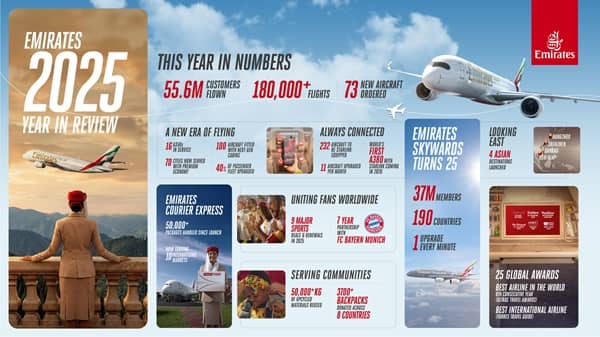
For Emirates, that moment arrived quietly in 2025, the year it turned 40, moved 55.6 million passengers, flew nearly 180,000 services, and resisted the temptation to shout too loudly about any of it.
That restraint, in an industry addicted to trumpet-blowing, may be the most telling statistic of all.
Yes, Emirates still circles the globe more often than most of its competitors combined. Yes, it ordered another 73 aircraft. And yes, it remains the world’s largest international airline by a margin that makes rivals wince. But the real story of Emirates in 2025 wasn’t expansion. It was the refinement of the realisation that flying “better” no longer means flying louder.
The A350: Less Theatre, More Sense
The arrival of the Airbus A350 in January didn’t come with fireworks. Emirates’ first service to Edinburgh slipped into the timetable with the quiet confidence of an airline that knows its regulars will notice the difference without being told.
They did.
The A350 is not flashy in the A380 sense. It is calmer. Quieter. Better lit. It absorbs long hours in the air with less drama, which is precisely why it now serves 18 cities across Europe, West Asia, the Middle East and Australia. Montreal joins the list in early 2026.
The aircraft doesn’t try to impress. It simply does the job properly, a theme Emirates returned to repeatedly throughout the year.
Asia, Without the Chest-Beating
Where some airlines talk endlessly about Asia, Emirates got on with it.
Non-stop daily services to Shenzhen and Hangzhou strengthened its mainland China footprint, while Danang and Siem Reap quietly joined the map via Bangkok. The message was clear: as business and tourism confidence returns across East Asia, Emirates intends to be present, not performative.
This was network planning without theatre. And it worked.
Premium Economy Grows Up
Premium Economy, once the aviation equivalent of a novelty act, grew teeth in 2025.
Emirates expanded the cabin across more than 100 aircraft, including retrofitted A380S and Boeing 777s, until nearly 70 cities were served by a product that now accounts for roughly 40 per cent of the fleet.
The appeal is obvious. Travellers want comfort, not indulgence, space, not spectacle. Emirates reads the room and the booking data correctly.
Wi-Fi That Finally Keeps Its Promise
Airlines have been promising “fast Wi-Fi” for over a decade. Passengers learned not to believe them.
Then came Starlink.
In November, Emirates announced it would roll out Starlink connectivity across 232 aircraft, beginning with its 777 fleet and extending to the A380 — making it the first airline to fit the superjumbo with genuinely high-speed internet.
By the end of next year, more than 123 aircraft will offer complimentary, ultra-fast connectivity. Streaming will work. Emails will be sent. The internet, improbably, will behave like the internet.
That alone will win Emirates more goodwill than any lounge refurbishment ever could.
Sport, Still the Shortcut to the Heart
Emirates’ relationship with global sport remains unabashed and effective.
A seven-year partnership with FC Bayern Munich returned the airline to the Bundesliga spotlight, while a contract extension with World Rugby through 2035 marked the longest sponsorship in Emirates’ history.
Deals with European club rugby, elite football, tennis, cycling and basketball. The strategy is familiar, but still works: attach the airline to moments people already care about.
Packages, Minus the Detour
One of the year’s quieter successes was Emirates Courier Express, which ignored decades of logistics orthodoxy by flying parcels directly on passenger aircraft.
The result? Over 50,000 packages delivered across 10 markets, including Australia, with an average delivery time of just three days. No labyrinth of hubs. No unnecessary hand-offs.
Sometimes innovation is simply removing steps.
Skywards, Still the Glue
At 25, Emirates Skywards is old enough to have outlived several loyalty competitors and clever sufficient to avoid tinkering with what works.
With 37 million members globally and 78,000 new sign-ups every week, it remains one of aviation’s most valuable loyalty platforms. Members now redeem more than 800 flight rewards daily and score an upgrade every minute.
That’s not marketing. That’s a habit.
Accessibility Without Applause
Perhaps the most quietly significant development of the year was Emirates becoming the world’s first Autism Certified Airline™, training more than 30,000 staff and rolling out travel rehearsal programs across 17 cities.
It also introduced sensory-friendly onboard products, expanded closed-captioned and audio-described entertainment, and began planning wheelchair-accessible chauffeur services.
No grandstanding. Just competence.
The Luxury of Getting Out of the Way
The year ended with Emirates polishing its premium offering, a private First Class check-in at Dubai, refined onboard service, Michelin-standard hospitality training, and collecting another shelf of awards.
At 40, Emirates appears to understand something many airlines don’t: the future of flying better isn’t about spectacle.
It’s about knowing when to step back and let the experience speak for itself.
by Sandra Jones – (c) 2026.
Read Time: 6 minutes.
About the Writer.
 Sandra has spent much of her working life untangling the world for others, one itinerary, one dream, one frazzled traveller at a time. With years spent in some of Australia’s best-known travel agencies, she’s the calm voice on the line when flights go missing, luggage takes its own holiday, or someone decides to “see Europe properly” in nine days.
A qualified travel consultant with a knack for making sense of chaos, Sandra fine-tuned her skills through a specialised advisory course, the sort that teaches both knowledge and patience in equal measure. But the storyteller in her was never far away. A later foray into writing gave her the perfect excuse to blend that industry wisdom with her gift for words.
Now, through Global Travel Media, Sandra shares the small truths of travel, its frustrations, laughter, and quiet moments that make every journey worth the fuss.











