

There are few moments in modern travel as reliably joyless as hotel check-in. You’ve crossed continents, wrestled a passport through immigration, stood obediently on baggage claim, and finally arrived only to be asked, yet again, for the same documents you’ve handed over a dozen times already.
Dubai, never one to romanticise inconvenience, has finally decided this ritual belongs in the museum.
The city has launched a one-time, contactless hotel check-in system that does exactly what it promises: lets guests skip the front desk altogether. No queues. No clipboards. No apologetic smiles from staff who know this dance is as tired as you are.
Once your details are registered, that’s it. Forever or at least until your passport expires.
The announcement came from Sheikh Hamdan bin Mohammed bin Rashid Al Maktoum, but this isn’t one of those ideas that exists to make a headline. It exists because Dubai noticed something the rest of the world still pretends not to see: repeat travellers don’t need to be reintroduced to the system every time they arrive.
And in Dubai, repeat travellers matter. Almost a quarter of the city’s visitors fall into that category, returning not for novelty but for familiarity appropriately done.
Less theatre, more sense
Here’s how it works without the marketing gloss.
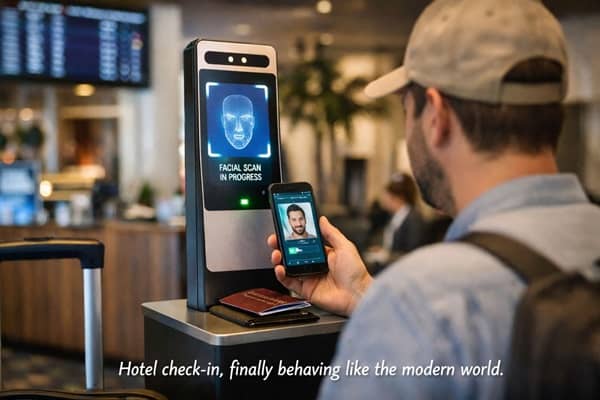
Guests upload their identification and biometric details once, securely, via their phone. That data remains valid for future stays. On arrival, a quick facial authentication is all that’s required. You walk in. You walk through. You go upstairs.
Reception desks don’t vanish, but they stop being choke points. Staff stop processing paper and start doing what hospitality is meant to be about—actual hospitality.
The system has been developed by the Dubai Department of Economy and Tourism and can be plugged directly into existing hotel apps or websites. No expensive rebuilds. No technological tantrums. Just a quieter, faster arrival.
It also dovetails neatly with Dubai’s broader Dubai Economic Agenda D33, which is less about flashy futurism and more about operational discipline at scale. Digital transformation, in this case, means fewer bottlenecks and more breathing room.
Sheikh Hamdan put it diplomatically, noting the city’s ambition to create “a smart, seamless, and secure urban environment”. Translation: travel should stop wasting people’s time.
Dubai’s quiet advantage
Dubai has form here. At Dubai International Airport, biometric smart tunnels already move passengers through passport control in seconds: no queues, no stamping theatre, no raised eyebrows.
The hotel check-in system completes the journey.
What’s striking is how unremarkable it all feels, and that’s precisely the point. The best travel innovations don’t announce themselves. They remove themselves.
DET Director General Helal Saeed Almarri called the rollout a “pivotal moment” for the hospitality sector, but the real pivot is psychological. Dubai is designing its systems around the assumption that guests already know what they’re doing.
It’s a subtle shift. And a smart one.
Scale demands discipline
Dubai’s hospitality machine is not small. The city now counts 820 hotels and hotel apartments, ranging from palatial to pointedly practical. In the first ten months of 2025, it welcomed 15.7 million international overnight visitors, generating 36.7 million room nights.
At that scale, inefficiency multiplies quickly. A five-minute delay, repeated millions of times, becomes a structural flaw.
This technology doesn’t just save guests time; it saves the system from itself.
And it’s not stopping at hotels. The same digital identity framework could extend to car rentals, attractions and other visitor touchpoints, smoothing the entire stay into something closer to a continuous experience than a series of checkpoints.
For a city that sells ease as much as excess, it makes perfect sense.
The bigger picture
There’s no sermon here about the future of travel. No breathless talk of disruption. Just a city quietly admitting that some things have outlived their usefulness.
The hotel queue was one of them.
Dubai hasn’t reinvented hospitality. It has simply removed the parts nobody liked.
And travellers, exhausted and grateful, will notice.
by Soo James – (c) 2026.
Read Time: 4 minutes.
About the Writer.
 There’s nothing predictable about Soo James, and that’s precisely her charm. Of Malaysian descent, she set down academic roots at the University of New South Wales, majoring in Arts, before veering off into the unlikeliest of places: IT. It mightn’t sound romantic, but somewhere between data strings and deadlines, Soo found a fascination with how people and words connect.
What began as a curiosity soon turned into a craft. Over time, her writing slipped effortlessly into travel blogs and lifestyle features, each piece marked by her dry wit and a mind that notices the small, telling details others might miss. She writes with a traveller’s eye and a local’s heart, grounded, observant, and quietly amused by the world’s contradictions. Today, at Global Travel Media, Soo’s words do what travel should always do: take readers somewhere new, even if only for a few minutes.











