

Just after sunset on a ranch outside Alice Springs, Australia, the inky blackness of the night sky drapes across the Outback.
The planets appear first: Mercury, Mars, and Jupiter. And then, as if someone is turning on a light, the stars flicker to life. There’s Castor and Pollux, the Southern Cross, and in the distance, a vast Milky Way.
“It is a unique spot,” says Jacob Muller, a guide at Earth Sanctuary Star Tour.
He’s not talking about the stars, although they’re remarkable to anyone visiting from the Northern Hemisphere.
Here, geodesic domes, an alternative to conventional angular buildings, dot the landscape. These structures exemplify energy-efficient design for heating and cooling. Earth Sanctuary is one of the Northern Territory’s first carbon-neutral venues.
All across the Australian Outback, people are thinking about what it means to be sustainable — and the answer is not what you would expect. Indeed, there are plenty of green initiatives, such as the sanctuary’s domes, ambitious recycling projects, and its famous solar cities.
But out in the Australian desert, sustainability can also mean ensuring tourists return next year. Or even something that preserves an ancient way of life.
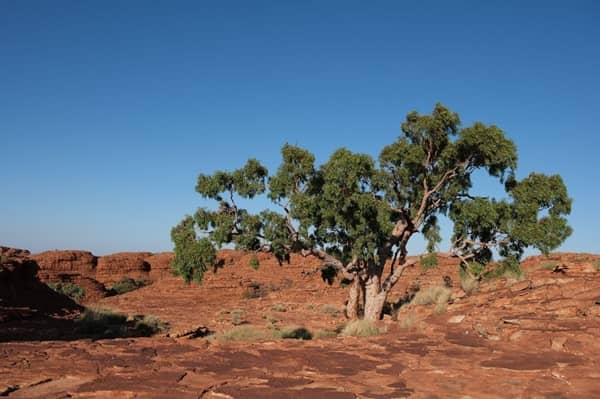
The Australian Outback is a place of almost unbelievable extremes — blazing hot summers and below-freezing winters. The landscape is like something from a minimalist painting: Red cliffs and blue sky. It is an unforgiving environment, yet at the same time, a nurturing place where you can feel a deep connection to the land at the right moment. That happens when you’re under a starry sky in Alice Springs or when surrounded by sheer red cliffs at Watarrka National Park. Or it can happen at an art gallery as you admire the dot paintings of indigenous artists.
But to understand sustainability in Australia’s red centre, you have to begin with its First Nations.
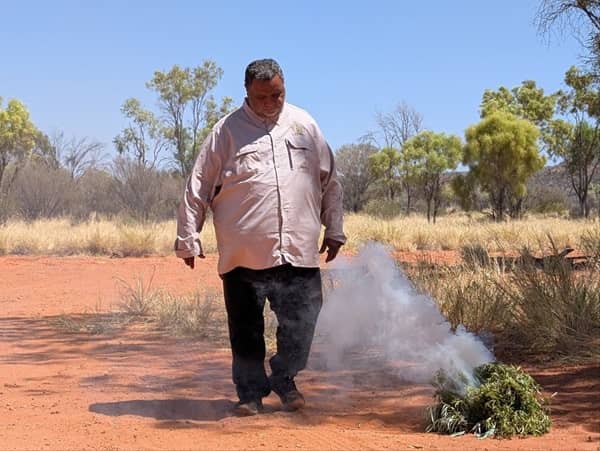
Peter Abbott, the director and cultural leader at Karrke Aboriginal Cultural Experience, lights a fire to welcome guests to an Aboriginal village in Australia’s Northern Territory—photo by Christopher Elliott.
An Aboriginal perspective of sustainability
At the Karrke Aboriginal Cultural Experience near Kings Canyon, you learn about sustainability from Australia’s Aboriginal people.
Peter Abbott, the director and cultural leader, shares a tapestry of desert culture. It’s a show-and-tell of Aboriginal food, jewellery, weapons and, of course, its world-famous art.
“Every dot painting tells a story,” Abbott explains, underscoring the significance of art as a narrative medium.
Central to this cultural exchange is the concept of sustainability. For Aboriginal people, it embodies a delicate balance between preserving their traditional way of life and participating in sustainable tourism. This equilibrium requires navigating the complexities of sharing ancestral knowledge while safeguarding their cultural heritage.
Everything from carving a boomerang to treating a cold with traditional medicine is handed down from one generation to the next through stories. Most of these skills are not meant for outsiders. Sustainability straddles a line between respecting the culture and being part of the modern world — and it is not always an easy line to walk.
Felicity Green, director of the Araluen Arts Centre in Alice Springs, says one way to promote the cultural traditions is through the arts. There are three art galleries at the centre in Alice Springs. The Arts Centre features essential works by celebrated indigenous watercolourist Albert Namatjira. His impressionistic paintings of the Australian Outback are considered a national treasure, she says. Green has helped build a network that supports First Nations artists in this region.
“I think the arts have a really, really big part to play in sustainability,” she adds.
The arts are also front and centre in Kings Canyon. At Discovery Holiday Parks, U.K. artist Bruce Munro has set up unique pieces of art called Light Towers. The display comes to life after nightfall with an array of light and sound intended to bring focus to Australia’s Outback.
The sustainability theme there is prominent. As the sun sets, the towers shift colour to the operatic soundscape by composer Orlando Gough. It is all meant to showcase the fragile desert landscape and its often marginalised First Peoples.
But nothing draws your attention to sustainability like the rock.
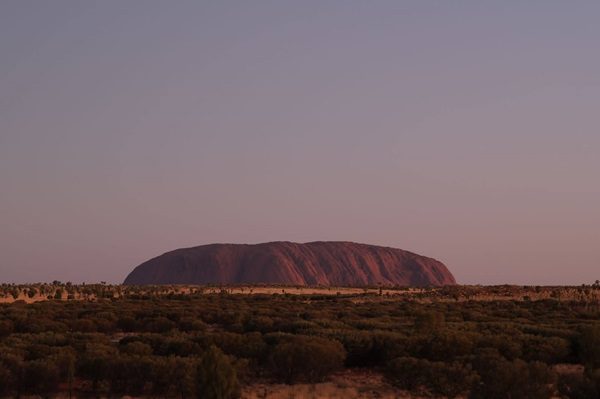
Uluru, a monolith in the Australian Outback, at sunset. Photo by Aren Elliott
Uluru: A symbol of sustainability
Uluru is the Northern Territory’s crown jewel. The colossal red rock emerges from the desert expanse, commanding attention with its imposing presence.
Pete Thunder, a tour guide with SEIT Outback Tours, says the walks around the monolith help visitors understand the importance of maintaining and protecting the area’s resources.
For the local Pitjantjatjara people, Uluru transcends its physical form. It’s the embodiment of a sacred space, steeped in cultural and spiritual importance.
“All the markings on the rock wall are attached to the creation story,” Thunder explains, highlighting the deep-rooted connection between the landscape and ancestral narratives.
Here, sustainability means honouring this profound sensitivity. Tourists must adhere to designated paths and are not allowed to take pictures of Uluru from certain angles because of its religious importance to the Aboriginal people.
It isn’t always easy. From time to time, visitors take unauthorised photos or deface Uluru’s rock art. That ramps up tensions between tourists and the indigenous population and casts doubt on whether proper balance — indeed, true sustainability — is possible.
Here, too, the arts are lending a hand. A multimillion-dollar drone show for visitors staying in a nearby tourist village tells one of the Aboriginal creation stories.
Wintjiri Wiru is an ancient tale told through modern technology, including choreographed drones, lasers and projections that illuminate the night sky.
The story itself is fascinating, involving a traditional ceremony, a snubbed invitation from another tribe, and a shape-shifting evil spirit. The performance helps people understand the way First Nations see the world. Nature itself has a story to tell, if you are ready to listen.
The hope is that this story will continue long after the drones have landed and the tourists have left. It is really the ultimate tourism sustainability story — and one whose ending has yet to be written.
by Christopher Elliott – (c) 2025
Read Time: 5 minutes.
About the Writer
 Christopher Elliott is an author, consumer advocate, and journalist. He founded Elliott Advocacy, a nonprofit organisation that helps solve consumer problems.
He publishes Elliott Confidential, a travel newsletter, and the Elliott Report, a news site about customer service. If you need help with a consumer problem, you can reach him here or email him at [email protected].
===================================











