

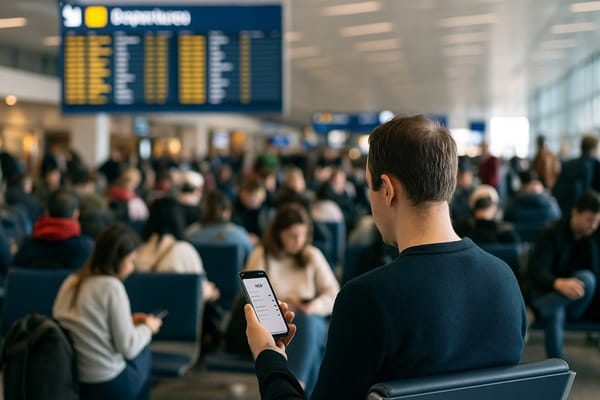
If misery loves company, cybercriminals adore crowded airports.
As the holiday travel season gathers pace, terminals from Sydney to Schiphol are filling with stressed travellers clutching phones, scanning departure boards and desperately hunting for free Wi-Fi. It’s the perfect storm, and the hackers know it.
The International Air Transport Association (IATA) has delivered a sobering statistic: air traffic control delays in Europe have surged by 114 per cent over the past decade. The pattern is not confined to Europe. Weather disruptions, staff shortages and fragile infrastructure have turned airport waiting areas into pressure cookers worldwide, and pressure makes people careless.
Long delays mean more time online. And more time online, particularly on unsecured public networks, makes travellers low-hanging fruit for cybercrime.
Cybersecurity specialists are warning that this year’s travel chaos is shaping up as a bumper season for digital pickpockets.
Travellers Are Flying – Despite the Risks
Despite rising living costs, people are refusing to ground their travel plans.
A recent Deloitte survey shows that US consumers are more eager to travel than they have been in years. In Europe, 82 per cent of travellers are increasing their travel budgets, according to the European Travel Commission, even if the overall spend per trip is slightly lower than last year.
Passenger numbers are climbing and so are the risks.
The UK’s National Cyber Security Centre recently reported that highly significant cybersecurity incidents rose by 50 per cent, marking the third consecutive annual increase. Meanwhile, Fortinet observed a 42 per cent rise in compromised credentials being sold online, a clear indicator that stolen login details are big business.
Add overcrowded terminals, free Wi-Fi networks and distracted travellers into the mix, and cybercriminals are spoilt for choice.
Public Wi-Fi: Convenient, Cheap – and Dangerous
Airport Wi-Fi has become the modern equivalent of a public phone booth, except far less secure.
Many public networks are unencrypted. Some don’t even require a password. That means anyone with basic tools and malicious intent can see which websites users visit, intercept data, or hijack online sessions.
Australia has already seen how easily this can happen. In a widely reported case, a man was jailed after setting up a fake Wi-Fi network on a domestic flight and harvesting passengers’ login details, according to the Australian Federal Police.
Experts say this sort of “look-alike” Wi-Fi network, often labelled as something like Free Airport Wi-Fi, is becoming increasingly common in busy travel hubs.
And most of these attacks, they warn, never make it onto police blotters.
“Travellers Don’t Realise They’ve Been Watched”
Konstantin Levinzon, co-founder of Planet VPN, one of the world’s largest free VPN providers, says public Wi-Fi attacks often go unnoticed.
“Public Wi-Fi, whether in an airport, hotel, or restaurant, is often unencrypted and sometimes doesn’t even require a password. This makes it easy for bad actors to see what sites users visit or even hijack their sessions,” Levinzon says.
He warns that AI-powered tools are accelerating cybercrime, allowing criminals to launch attacks faster and on a larger scale.
“Users should be especially cautious this year, as the latest AI tools allow cybercriminals to accelerate their attacks, including those targeting Wi-Fi networks.”
Google itself has gone so far as to advise users not to use public Wi-Fi at all. That’s sensible advice, but not always practical when you’re stuck airside for six hours with a flat battery and an urgent email to send.
The good news? Travellers don’t have to unplug entirely. But they do need to change their habits.
Three Simple Steps to Stay Safe on Public Wi-Fi
1. Use a VPN – and Choose Wisely
A Virtual Private Network (VPN) is the first line of defence. It encrypts internet traffic, creating a secure tunnel between your device and the web.
“On public Wi-Fi, your activity can be visible to anyone with the right tools, but once the VPN is on, your data travels inside the tunnel,” Levinzon explains.
“People on the same network only see scrambled traffic, not your personal information.”
Importantly, Levinzon notes that a well-designed free VPN can offer the same core protection as a paid service, provided it does not store logs, collect email addresses or harvest user data.
Travellers should carefully check a provider’s privacy policy. If you’re not paying with money, make sure you’re not paying with your data.
2. Lock Down Your Device Before You Fly
Public networks are shared digital spaces. Travellers should assume everyone on the network is a potential threat.
That means:
-
Disabling automatic connections to open Wi-Fi networks
-
Turning off file and printer sharing on laptops
-
Installing software and security updates before departure
These steps take minutes but dramatically reduce exposure to attack.
3. Treat Public Wi-Fi as “Read-Only”
Even with safeguards, public Wi-Fi carries inherent risk.
“Use public Wi-Fi for searching the web or replying to an email, but avoid making transactions,” Levinzon advises.
“The same rules should apply not only during holiday travel, but also in our daily lives.”
No banking. No online shopping. No password changes.
Travellers should also use strong, unique passwords and enable two-factor authentication wherever possible. It’s not glamorous, but it works.
The Bottom Line
Airports may sell duty-free whisky and designer handbags, but the most valuable commodity in the terminal is your personal data.
As travel volumes rise and delays become routine, cybercriminals are exploiting the chaos with industrial efficiency. The threats are real, the techniques are simple, and the consequences can linger long after you’ve collected your luggage.
A little digital discipline and a healthy dose of scepticism — can ensure the only thing you bring home from your next trip is a sunburn and a souvenir.
by Michelle Warner – (c) 2025
Read Time: 5 minutes.
About the Writer
 Michelle Warner is a storyteller with jet fuel in her veins — the sort of woman who could turn a long-haul delay into a lesson in patience and prose. She began her career in media publications, learning the craft of sharp sentences and honest storytelling, before trading deadlines for departures as a flight attendant with several major airlines. Years spent at thirty thousand feet gave her a keen eye for human nature and a deep affection for the grace and grit of travellers everywhere.
Now happily grounded, Michelle has returned to her first love, writing, with the same composure she once brought to a turbulent cabin. Her work combines an editor’s precision with a traveller’s curiosity, weaving vivid scenes and subtle humour into stories that honour the golden age of travel writing. Every line is a small act of civility, polished, poised, and unmistakably human.











