

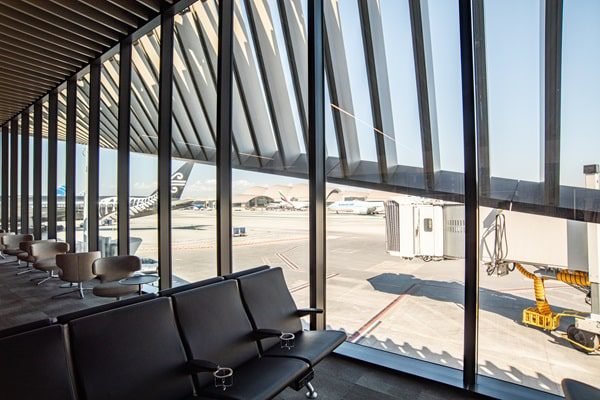
If you thought Los Angeles International Airport (LAX) couldn’t get any more chaotic, brace yourself. The city’s most famous sprawling airport is about to take another swing at modernisation, this time by tearing down an entire terminal.
Los Angeles World Airports (LAWA) confirmed the complete demolition of Terminal 5. A brand-new facility is set to rise from the rubble in time for the 2028 Olympic and Paralympic Games.
A New Era – With a Dash of Chaos
From October 21, once operating out of Terminal 5, airlines began relocating in phases, with a complete closure taking effect on October 28. In airport terms, that’s tomorrow morning’s coffee.
“As we take this important step toward transforming LAX, the closure of Terminal 5 marks a pivotal moment in our journey to deliver a world-class airport experience,” said Doug Webster, Chief Airport Operations and Maintenance Officer at LAWA.
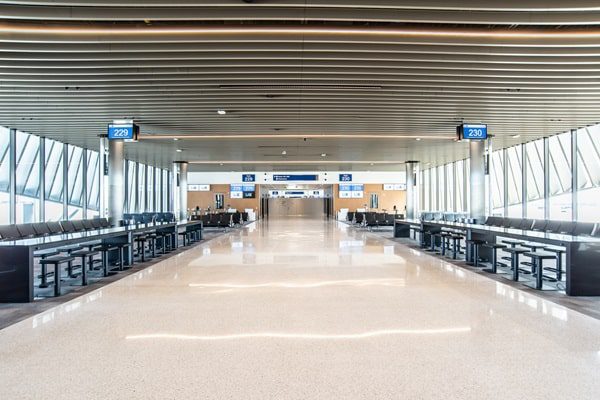
MSC South – Courtesy of Los Angeles World Airports.
Webster’s statement carried the optimism only an airport executive can muster when announcing the removal of a terminal that millions still use. “Our goal is to minimise disruption during this transition,” he added, noting that LAWA is “working closely with our airline partners to ensure continued operations and smooth travel for our passengers.”
Shifting the Deck Chairs
In practical terms, the closure means airlines are shuffling gates like a frantic deck of cards:
-
JetBlue shifts to Terminal 1 from October 21
-
Spirit Airlines moves into Terminal 2 from October 22
-
American Airlines consolidates into Terminal 4 on October 28
Travellers may want to check their boarding passes twice or risk ending up in the wrong postcode.
MSC South: The Airport’s Shiny New Toy
To help absorb the disruption, LAWA unveiled the Midfield Satellite Concourse South (MSC South), an impressive 150,000-square-foot extension of the West Gates at Tom Bradley International Terminal.
The concourse officially opened on October 21, adding eight new gates to LAX’s footprint and a glimpse of what’s to come for the airport’s broader $30 billion Capital Improvement Program.
Delivered on time and on budget, MSC South was built using the Offsite Construction and Relocation (OCR) technique. This modern engineering marvel allows entire terminal sections to be fabricated elsewhere, then trucked in and assembled like a high-stakes IKEA project.
The same technique will speed up the new Terminal 5, a practical decision given that LAX is the world’s third-busiest airport, serving more than 70 million passengers annually.
The Big Picture: LAX 2028
When the new Terminal 5 opens just before the 2028 Games, it will join a growing list of LAX upgrades, including new roadways, expanded parking, and digital wayfinding systems, the airport equivalent of putting lipstick on a vast, busy pig.
LAWA insists that this is part of a broader plan to create a “world-class airport experience” for guests and employees. That vision forms the backbone of the city’s Olympic promise to welcome the world not with gridlock but with something approaching efficiency.
LAX’s ambitious transformation also comes as airports globally push for smarter, greener operations. From modular terminals to AI-driven baggage systems, the future of aviation hubs looks decidedly different from the clunky concourses of decades past.
A Landmark Rebuild
In truth, this redevelopment isn’t just about the Olympics, it’s about modernising an airport built for an era when the word jet-setter was still exotic. By the time visitors arrive in 2028, they’ll find a sleeker, faster, and marginally less confusing LAX, though the jury’s still out on the parking situation.
For updates, weary travellers and terminal spotters alike can visit flylax.com for maps, relocation notices, and construction updates, preferably before they board.
By Jason Smith – (c) 2025
Read Time: 4 minutes
About the Writer
 Jason Smith has the kind of story you can’t fake, built on long flights, new cities, and that unmistakable hum of hotel life that gets under your skin and never quite leaves. Half American, half Asian, he grew up surrounded by the steady rhythm of the tourism trade in the U.S., where his family helped others see the world long before he did.
Eager to carve out his own path, Jason packed his bags for Bangkok and the Asian Institute of Hospitality & Management, where he majored in Hotel Management and found a career and a calling. From there came years on the road, Singapore, Malaysia, Vietnam, each stop adding another thread to his craft.
He made his mark in Thailand, eventually becoming Director of Sales for one of the country’s leading hotel chains. Then came COVID-19: borders closed, flights grounded, and a new chapter began.
Back home in America, Jason turned his knack for connection into words, joining Global Travel Media to tell the stories behind the check-ins written with the same warmth and honesty that have always defined him.











