

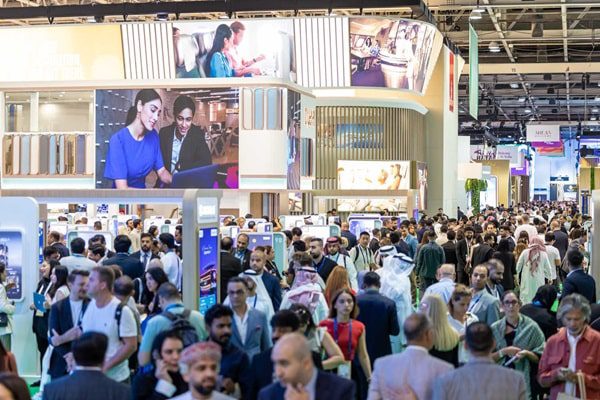
When the world’s most influential travel minds gather in Dubai next May, they will not only trade business cards but also sketch the shape of luxury’s next decade.
The Arabian Travel Market (ATM) 2026, running from 4–7 May at the Dubai World Trade Centre, will spotlight a theme rewriting the idea of high-end travel: “Travel 2040 – Driving New Frontiers Through Innovation and Technology.”
The shift is striking for an industry that has traditionally measured luxury by square footage and champagne labels. Today’s wealthy traveller isn’t merely booking a suite but curating an identity. And the Middle East, long accustomed to doing things on a grand scale, is quietly positioning itself as the world’s most ambitious testbed for that evolution.
A new breed of luxury
“Luxury travel remains one of ATM’s strongest growth pillars, but ultra-luxury is emerging as the next frontier,” says Danielle Curtis, Exhibition Director ME for Arabian Travel Market.
It’s a statement that reflects a noticeable pivot across the region. Opulence alone is passé; purpose, privacy, and personalisation now command the premium. According to Fortune Business Insights, the global luxury travel market, worth US$2.7 trillion in 2025, is forecast to surge to US$4.8 trillion by 2032, propelled by travellers who want indulgent and intentional experiences.
At ATM 2026, this redefinition will take physical shape in the ATM Ultra Luxury Lounge, a new invitation-only environment designed to connect elite buyers with the world’s most prestigious travel brands.
Where high value meets higher expectations
Curtis says the Lounge is not just another networking space, but a deliberate response to the region’s increasingly sophisticated audience.

Danielle Curtis-Exhibition Director ME ATM.
“To meet growing demand, we’ve created the ATM Ultra Luxury Lounge an exclusive space designed to connect ultra-luxury brands with buyers serving high-net-worth travellers,” she says. “It elevates the ATM experience through curated, high-value networking and collaboration opportunities.”
Think fewer brochures and more handshake diplomacy. The Lounge will bring together a curated selection of private jet operators, superyacht designers, bespoke tour specialists, and high-end hospitality groups, showcasing the expanding intersection between travel, lifestyle, and technology.
Research by Creative Zone projects the private jet market alone will reach US$943 million by 2029, fuelled by growing demand for privacy and control. The wealthy increasingly opt for itineraries that bypass queues and compromise their journeys as bespoke as the watches on their wrists.
Regional ambition, global influence
Nowhere is that ambition more visible than in the Middle East’s pipeline of luxury developments. Projects such as Saudi Arabia’s Red Sea resorts, Dubai’s upcoming Cheval Blanc on Naïa Island, and Abu Dhabi’s private island Bvlgari Resort & Mansions are rewriting the playbook on experiential wealth.
These ventures reflect a region no longer content with importing European luxury standards, simply setting its own. The style is distinctly regional: desert minimalism meets digital precision. The result is a form of luxury that feels both rooted and futuristic.
Numbers behind the nuance
The ATM Travel Trends Report 2025, compiled with Tourism Economics, shows momentum. Outbound regional luxury travel is rising at twice the global average, and travellers from the Middle East spend roughly 50% more per trip than their international peers.
That appetite has turned the Gulf into both a source and a stage for premium tourism. High-end and experiential segments outperform mainstream growth globally, and that trend shows no sign of slowing.
Still, it’s not merely about scale. The modern luxury market’s most striking trait is its conscience. Travellers are increasingly drawn to sustainability, wellness, and authenticity, a far cry from the material excess once synonymous with the category.
Luxury with a conscience
According to luxury DMC Experium, sustainability and wellness are now at the heart of the Middle East’s evolving luxury narrative. The firm’s latest Top 10 Luxury Travel Trends notes that today’s elite travellers seek experiences that “connect them with destinations, communities, and personal well-being.”
Curtis agrees, arguing that the future of luxury belongs to those who can marry indulgence with intention.
“Luxury travel is no longer defined by opulence alone, but by purpose, connection and transformation,” she says. “Today’s discerning travellers are seeking experiences that enrich their wellbeing, reflect their values, and deepen their connection with the world around them.”
In other words, luxury now has a moral compass, and the Middle East is helping to steer it.
Beyond the five-star ceiling
While Mandarin Oriental, Four Seasons, Jumeirah, and One&Only remain staples of the sector, ATM’s focus suggests the next growth phase lies beyond hospitality itself. Increasingly, high-net-worth travellers expect technology, design, and lifestyle to converge seamlessly.
That’s why ATM 2026 is leaning heavily into the future. Alongside the Ultra Luxury Lounge, the show will feature IBTM@ATM, a meetings and incentives platform, and ATM Travel Tech, with its expanded Tech and Innovation Hub. These are not sidelines, they’re the connective tissue of a market that’s learning to think in ecosystems, not silos.
In this space, artificial intelligence isn’t replacing human service; it’s refining it. From biometric boarding to AI-powered trip design, technology is fast becoming the butler you never see but always feel.
Dubai’s continuing evolution
Dubai’s role in this story is as much philosophical as physical. The city’s ability to reinvent itself to host conversations about the future while embodying them has become a global crossroads for travel innovation.
The 33rd edition of ATM will underline that duality. It’s a showcase for what’s been built and what’s being imagined:a luxury industry that aspires to be more innovative and human.
That’s a difficult balance to strike, and perhaps that’s the point. As technology continues to shape even the most intimate corners of the travel experience, ATM 2026 will ask a simple but timely question: Can luxury remain personal in a digital age?
If Dubai’s track record is anything to go by, the answer will come with impeccable service and a view to match.
For more information
Exhibitor enquiries: ATM Exhibitor Enquiry
Event details: wtm.com/atm/en-gb.html
By Stephen Morton – (c) 2025
Read time: 6 minutes
About the Writer
 Stephen Morton has spent nearly five decades shaping how the travel industry works, talks, and sells itself. From the family-run agency of 1976 to today’s digital frontier, Morton has been at the front of the queue, often long before anyone else knew there was a queue.
By the mid-nineties, he dragged Agents Support Systems online while the industry still worshipped the fax machine. In 2001, he launched e-Travel Blackboard (eTB), a daily newsletter that became Australia’s most read industry bulletin and expanded across New Zealand, Asia, the Americas, and into MICE.
In 2009, Global Travel Media came, which went on to scoop multiple international awards such as Best Travel Industry Website and Outstanding Digital Media Service. Later came Destination Thailand News, Global Cruise News, and now, in 2025, GTM Holidays and the forthcoming GTM Mall.
Whether lecturing students or launching titles, Morton has always been ahead of the curve, a travel industry stalwart who has turned instinct into impact.











