

In a century increasingly defined by squabbles over trade, tech, and territory, it’s literally refreshing to see the world unite over ice. Not the sort clinking in a Friday-night glass, but the kind that holds the planet’s memory.
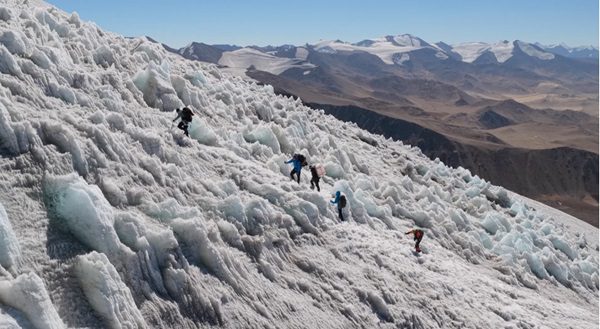
High in Tajikistan’s Pamir Mountains, a 13-member expedition has begun drilling deep into the Kon Chukurbashi ice cap, at a lung-sapping 5,800 metres above sea level, their mission: to extract two ancient ice cores before the glaciers surrender to time and temperature.
The Swiss-funded PAMIR Project, working with Tajik scientists and a roster of global universities, aims to reach the bedrock 105 metres down and rescue what researchers politely call “climate intelligence”. In simpler terms: the story of Earth, frozen in chapters of snow.
From Alps to Asia, a Consortium of Purpose
Led by the University of Fribourg and supported by the Swiss Polar Institute, the PAMIR Project is more than a scientific adventure; it’s a masterclass in international cooperation. Partners span the Tajik Academy of Sciences, Zurich University, Nagoya and Hokkaido Universities, and Ohio State University, a who’s who of ice and intellect.
The initiative feeds into the Ice Memory Foundation, a coalition of European research heavyweights CNRS, IRD, Université Grenoble Alpes, Ca’ Foscari University of Venice, CNR, and PSI, determined to safeguard climate records for centuries.
One of the Pamir cores will join an archive so remote it sounds fictional: the Concordia Station in Antarctica, jointly run by France and Italy. At minus-50 degrees, the sample will rest in an “ice library” beside cores from the Alps, Andes, and Himalayas, a time capsule for future scientists.
Science, Diplomacy and the New Capital of Credibility
Behind the frost and field tents lies a quiet triumph of diplomacy. Tajikistan, long better known for mountain passes than policy summits, is now at the centre of global scientific prestige.
For Switzerland, whose meticulous neutrality has long been an export, the PAMIR Project offers another brand of influence: climate leadership without slogans. For the United Nations, the timing is impeccable, and the effort launches just as the UN Cryospheric Decade 2025 begins, spotlighting the planet’s melting extremes.
French Ambassador for the Poles, Olivier Poivre d’Arvor, captured the symbolism neatly:
“We can all be proud—France and Tajikistan together—that at the launch of this UN Decade of Action for Cryospheric Sciences, such an emblematic cooperation is taking shape.”
It’s the partnership that makes foreign ministries beam because it works.
A Billion-Dollar Question: What’s It Worth?
The price tag of polar research rarely makes investors swoon, yet the returns are profound.
A single metre of ancient ice contains data points that can recalibrate climate models, guide water-security strategies and, ultimately, influence billion-dollar policy decisions.
That’s why Dr Evan Miles, field leader from the University of Fribourg and Switzerland’s WSL Institute, calls the mission a rescue operation:
“We’re salvaging a library on fire. Each layer records snowfall, dust, and chemistry stretching back centuries. Once the ice melts, the information vanishes forever.”
It’s difficult to put a market value on “forever”, but if knowledge is power, these frozen archives amount to blue-chip stock in humanity’s future.
Business by Other Means
To the pragmatic eye of an AFR reader, the PAMIR Project resembles a well-run multinational enterprise. It has investors (Swiss Polar Institute), local partnerships (Tajik Academy of Sciences), an international workforce, a risk-laden logistics chain, and a tangible asset.
The project’s governance mirrors a consortium model more familiar to corporate boardrooms than mountain camps: pooled expertise, diversified funding, and a long-term return measured in data rather than dividends.
Its “product” is climate intelligence, the raw material underpinning environmental forecasting, insurance models, and sustainable investment frameworks. In a market increasingly driven by ESG accountability, this is science as infrastructure evidence you can bank on.
Logistics at the Edge of Reason
At nearly six kilometres above sea level, the expedition operates where air thins, machinery wheezes, and coffee freezes before the mug cools. Establishing high-altitude camps took weeks of acclimatisation. Every bolt and cable had to be flown or hauled up precarious tracks resembling Mars’s surface.
The ice-coring equipment is custom-engineered to drill vertically while keeping samples sterile and intact, a feat requiring patience, precision, and lungs built like bellows.
Each extracted core is logged, sealed, and stored at sub-zero temperatures before beginning an odyssey worthy of a logistics textbook: from the Pamirs to Dushanbe, onward to Europe, and ultimately, by refrigerated container, to Antarctica.
It’s an undertaking that would make Amazon Logistics blush and reminds us that climate cooperation, like e-commerce, depends on supply chains that deliver.
The Value of Preservation
What happens after the drilling is almost as important as the act itself.
At Concordia Station, the ice will outlast the scientists who retrieved it, perhaps by centuries. Future researchers with unimagined instruments can read today’s atmosphere in exquisite detail.
That’s the genius of the Ice Memory Foundation. It’s not merely collecting frozen water; it’s preserving human foresight.
As Professor Thomas F. Stocker of the University of Bern put it:
“We must protect the data that enable us to make science-based decisions—to guide our societies and adapt to global change. This is a responsibility we all share.”
Stocker’s statement could double as an investor prospectus for civilisation itself.
Lessons for Policy and Profit
Governments love to talk about “future generations”; the Ice Memory project actually plans for them. Safeguarding unrepeatable climate data offers policymakers a buffer against guesswork.
For businesses, this archive represents a rare class of insurance knowledge resilience. The more we know about the climate’s past behaviour, the better we price risk, protect assets, and design infrastructure that will survive what’s coming next.
In a decade when greenwashing is out and green metrics are in, datasets drawn from this expedition could shape regulatory frameworks, carbon-credit valuations, and even sovereign-risk assessments.
It’s science feeding directly into balance sheets.
A Template for Global Cooperation
Perhaps the greatest triumph of the Pamir mission is what it represents: a functioning model of international collaboration at a time when multilateralism seems permanently on ice.
There is no posturing or vetoes, just scientists from five nations sharing oxygen and objectives.
If the G20 needs a refresher on productive teamwork, it might start here, 5,800 metres up, where politics can’t breathe.
In many ways, this effort is the spiritual successor to the significant Antarctic treaties of the 1950s, when nations miraculously agreed that science should trump sovereignty. The PAMIR Project revives that ideal with twenty-first-century tools and a sense of urgency.
A Legacy Etched in Ice
When those slender cylinders of ice finally reach Antarctica, they’ll contain a record of monsoons, dust storms, volcanic winters, and industrial revolutions. Each air bubble is a whisper from history.
To read them is to read ourselves our ingenuity, our folly, our fingerprints on the planet. And in that, perhaps, lies the actual return on investment: understanding.
So while markets fluctuate and ministers change, the ice remembers. If nations can cooperate long enough to preserve that memory, there’s hope that humanity can learn from it.
By Bridget Gomez
BIO
 Bridget has never been one to sit still. Of Portuguese heritage, she first trained as a nurse. She threw herself into work at the Commonwealth Veteran Affairs Repatriation Hospital, tending to old soldiers with stories almost as colourful as her own would become. It was rewarding, steady work — but wanderlust has a louder voice than routine.
So, she swapped starched uniforms for a backpack and set off on a twelve-month gallop around the globe. Along the way, she scribbled in journals, capturing the dust, the laughter, the odd missed train, and the occasional glass of wine too many. Those notebooks soon became a travel blog, her way of reliving and sharing the journeys with anyone willing to read.
Eventually, Bridget stumbled across Global Travel Media and, in her words, “the rest is history.” Now she writes with the same mix of heart and mischief that fuelled her travels.













