

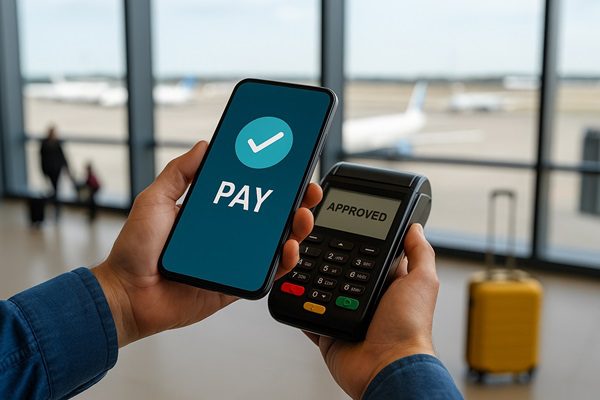
It’s 2025, and if you’re still fumbling for your plastic card at a check-in desk or squinting at payment gateways built in the Jurassic era of e-commerce, I have some troubling news: you’re not only behind the times—you’re losing passengers, and fast.
Travel payments, that once humble back-office function (the cash register’s unglamorous cousin), have taken the spotlight in this year’s reshuffle of travel priorities. And it’s about time. Because, as any seasoned traveller or weary travel agent will tell you, nothing brings a dream holiday crashing down faster than a clunky checkout process or the dreaded “payment declined” screen at 11:47 pm.
The Wallet Wars Have Begun
According to the latest from FinMont—a name now popping up in travel-fintech conversations like baggage fees in economy class—nearly 10% of under-34 travellers abandon bookings if their mobile wallet of choice isn’t available. That’s right, no Apple Pay? No sale.
And these aren’t idle threats. Mobile wallet usage in travel jumped a complete 30% last year. Thirty. Per. Cent. More than a third of all travel bookings in 2024 were done on mobile. That’s not a trend—it’s a tectonic shift. And if your payment gateway doesn’t support a simple thumbprint transaction? You may as well be asking travellers to fax their credit card details.
As the survey delicately puts it, we are in the era of “seamless, on-the-go digital spending”—though I’d argue it’s more like a digital stampede. And the herd is headed one way: frictionless, fast, and preferably done before the Uber arrives.
Buy Now, Fly Later
Enter BNPL—Buy Now, Pay Later. Or, as many travellers see it, “Book Now, Budget Never.” Travel operators, it seems, have discovered what fashion retailers learned long ago: customers spend more when they think less about money upfront.
FinMont’s figures show that over 10% of travellers would up their travel budgets if offered BNPL. Providers like Klarna are fast becoming household names—not for handbags or homewares, but for helping you stretch that Parisian escape or Tokyo stopover just a bit further.
It’s not just about spreading payments—it’s about psychology. A zero-interest, no-worries checkout makes even a $4,000 safari feel like a cheeky indulgence rather than a bank account blunder. And in an age of rising costs and shrinking patience, flexibility isn’t just a perk—it’s the price of entry.
Reward Me or Regret Me
There was a time when loyalty programs meant stashing away frequent flyer points like precious heirlooms. Today, loyalty is a slippery beast. But you might catch it if you can tie rewards to payments—instant discounts, cashback, or even bonus miles.
Roughly 14% of travellers rebook with companies that offer worthwhile loyalty benefits. That’s not an insignificant number. That’s a base. A following. A fan club—if you get the payments right.
Behind the Scenes: A Costly Production
Now, while customers tap and swipe to tropical getaways, let’s peek behind the curtain. What we find isn’t pretty.
Edgar, Dunn & Company (whose name sounds like it belongs on a 19th-century bank vault) reports that airlines spend over US$20.3 billion annually on payments. Yes, billion—with a ‘B’. That accounts for 2.2% of airline revenue and a jaw-dropping 78% of the industry’s net profit.
The real kicker? Most of this cost isn’t from fraud or flaky customers. It’s from the arcane infrastructure—the tangled mess of systems, currencies, and settlements that airlines have been dragging behind them like a Samsonite with three busted wheels.
No wonder 41% of travel companies, according to IATA, say payment management is their biggest financial headache—not staffing, not fuel, not volcanic ash clouds, but payments.
FinMont: The New Maestro in the Pit
Enter stage left: payment orchestration platforms. And no, that’s not a jazz quartet—it’s the tech travel companies are now betting on to fix this mess.
FinMont, for instance, is building a unified infrastructure to connect payment gateways, fraud protection, FX, back-office systems—the whole shebang. Using AI, it finds the cheapest, safest route for every transaction, like Google Maps for your money.
This means fewer declined transactions, lower fees, and—perhaps most critically—insight—visibility into where the money’s going and why it’s vanishing faster than a flat white in Sydney.
Suby Valluri, FinMont’s chief executive (and no stranger to ruffling a few traditional feathers), puts it bluntly:
“The payment experience is no longer just a backend function; it’s central to how customers perceive and engage with travel brands… By simplifying complexity, reducing costs, and enabling flexibility, we’re helping the travel industry deliver better experiences and unlock new revenue opportunities.”
Translation: if you’re still treating payments as an afterthought, you’re flying blind—and probably into turbulence.
A Call to (Transactional) Arms
So, where to from here?
-
Upgrade the toolkit. If your system still asks travellers to enter card numbers manually, consider it a relic.
-
Embrace wallets and BNPL. Give the people what they want—easy, instant, controlled spending.
-
Tie in loyalty. Make every payment a reason to return.
-
Kill complexity. Payment orchestration isn’t a trend—it’s a requirement.
Because in 2025, every tap or click is not just a transaction—it’s an interaction. A chance to win loyalty. An opportunity to gain insight. And above all, a chance to make the checkout process something travellers don’t dread.
By Yves Thomas











