

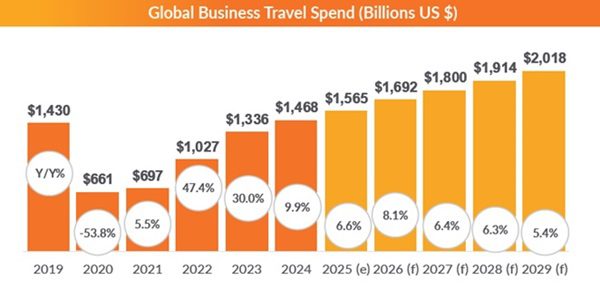
Despite the kind of geopolitical wobble that could make even the hardiest travel manager reach for a double espresso, global business travel spending is barreling ahead—projected to reach a staggering US$1.57 trillion in 2025, according to the latest five-year outlook from the Global Business Travel Association (GBTA). That’s right—trillion with a “T”.
Yes, the road may be lined with trade potholes and bureaucratic speed bumps, but if there’s one thing this sector knows, it’s how to pack resilience, a crisp shirt, and a portable charger.
The GBTA’s annual Business Travel Index (BTI) Outlook, released during its marquee convention in Denver and backed by Visa, paints a picture of cautious optimism—with a few dark clouds over the Pacific and across the European trading desks.
While 2024 saw global business travel spending reach US$1.47 trillion—just a whisker below forecasts—2025’s anticipated 6.6% year-on-year increase represents a solid climb, albeit a more tempered one than the double-digit surges of the post-COVID rebound.
Trade Tensions and Economic Wobbles? Still Flying
The report doesn’t sugarcoat the outlook. It notes that “trade policy uncertainty” (a polite way of saying governments are still squabbling over who gets to sell what, where, and how) is biting into projections. The 2025 growth figure was revised down from an earlier 10.4% to 6.6%, and 2026’s outlook was similarly nudged—from 9.2% to 8.1%.
Despite the slower momentum, Suzanne Neufang, GBTA’s sharp-eyed CEO, sees no need to panic. “The outlook is steady—but the road ahead is more complex,” she noted, pointing to inflation, supply chain shifts, and policy limbo as major plot twists in this year’s travel narrative.
And the long game? Global business travel spending is still expected to smash through the US$2 trillion ceiling by 2029—albeit a year later than previously forecast.
America Reclaims the Crown, China Not Far Behind
Geographically, the big players continue to strut their stuff. The United States is forecast to retake the global top spot in business travel spending, clocking in at a projected US$395.4 billion for 2025. China, which has lorded over the top spot since 2023, comes a close second at US$373.1 billion.
Together, the two juggernauts account for 58% of the top 15 business travel markets—effectively writing the playbook for the rest of the globe.
Germany, Japan, and the UK round out the top five, though rising stars are generating buzz. India, South Korea, and Turkey are among the fastest-growing business travel spenders. At the same time, Spain and the Netherlands appear to be tightening their belts, forecasting either tepid growth or a mild contraction.
Sectors on the Move: Winners and Worries
Not all industries are sipping Champagne in the lounge. Manufacturing and Wholesale Trade—those most exposed to trade disputes—face a nervous few quarters ahead. These sectors, which account for nearly one-third of global business travel spending, are at the mercy of tariffs, trade agreements, and shipping hiccups.
Meanwhile, the service economy is on a celebratory trajectory. Professional Services and Arts & Entertainment have outperformed their pre-pandemic benchmarks, with some spending categories soaring more than 20%.
Looking to the horizon, mining, information and communication are tipped to post the strongest growth in travel spending. At the same time, agriculture, weighed down by shrinking export opportunities, might stay closer to home for a while.
Traveller Sentiment: Still Packed and Ready
In what will bring joy to airlines, hotels, and perhaps the odd suitcase manufacturer, GBTA’s global survey of 7,300 business travellers reveals that corporate travel isn’t just back—it’s booming in the hearts of those doing it.
A reassuring 86% of respondents said business travel was “worthwhile”, with training and conferences cited as the top reasons for taking to the skies or rails.
Other highlights:
-
Trip count: 74% took between one and five business trips in the past year.
-
Trip frequency: 80% of people now travel for work as much or more than they did before 2019.
-
The average spend per trip was US$1,128, up from US$834 in the 2024 survey.
-
AI and expense tools: 67% are using expense systems, and Asia Pacific leads the way in AI travel booking enthusiasm, with a remarkable 78% adoption.
-
Payment preferences: 69% of travellers have corporate cards, and 64% globally (and 72% in Asia Pacific) have embraced mobile wallets.
Edward Galvin, Visa’s North America head of B2B commercial payments, added a digital twist: “As corporate travellers increasingly expect seamless, mobile-first payment experiences, we’re enabling this shift with secure, flexible digital tools that modernise how expenses are handled.”
Complexity and Confidence: Two Sides of the Same Ticket
While the world may be spinning faster than ever—with supply chain overhauls, regional instability, and boardroom reckonings—the enduring need for face-to-face connection, deal-making, and industry networking continues to underpin business travel’s forward march.
As GBTA’s report shows, there’s no shortage of hurdles ahead, but the industry’s adaptability is its jet fuel.
The question is no longer whether business travel is returning—it’s how we’ll steer it into the next era. A humble business trip may be more vital than ever in a world that craves real connection and concrete action.











