

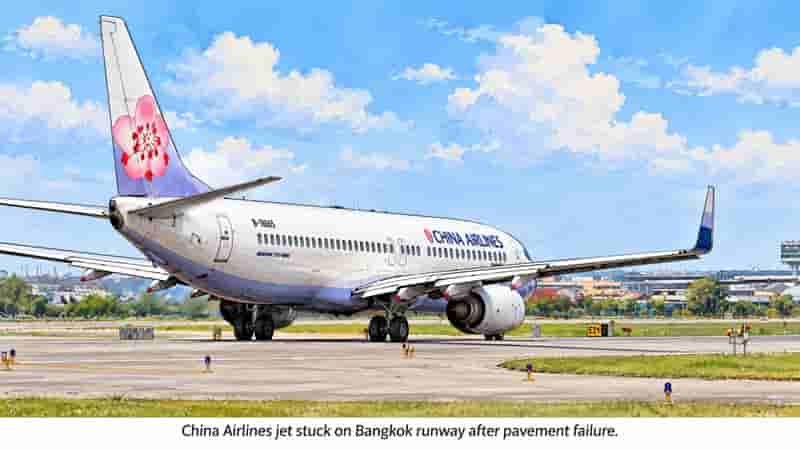
A China Airlines aircraft became trapped in damaged pavement at Bangkok’s Suvarnabhumi Airport, disrupting five flights and prompting fresh questions about the condition of one of Asia’s busiest aviation gateways.
A China Airlines Boeing 737-800 became stuck in damaged pavement at Bangkok’s Suvarnabhumi Airport on Wednesday evening, leaving 116 passengers facing an unexpected night in Thailand and raising awkward questions about the condition of one of Asia’s busiest aviation gateways.
Flight CI840 was preparing to depart for Kaohsiung, Taiwan, when its main landing gear sank into the surface near the threshold of runway 02R at about 7.25 pm on 28 October.
The aircraft, registered B-18665, had approached the runway via taxiway E21. It could go no further. For an airline expecting to get passengers into the air, the ground had become the problem.
No injuries were reported, but the incident affected five departing flights and prompted Thailand’s aviation regulator to order wider inspections of the airport’s movement areas.
Passengers Face an Unplanned Overnight Stay
Airport staff began removing passengers at 9.02 pm and had returned all 116 to the terminal by 9.16 pm, according to Suvarnabhumi Airport’s account. Eight crew members were also aboard.
Firefighters, rescue personnel and maintenance teams worked to free the jet. The aircraft was removed from the affected area at approximately 11.10 pm. Initial checks found no obvious damage, although China Airlines undertook a further inspection.
The airline subsequently confirmed that the aircraft was safe. The service was postponed until 29 October, both because of the damaged airport surface and night-time restrictions at Kaohsiung. Passengers were provided with accommodation, meals and transport.
What should have been a straightforward flight home had become a rather expensive lesson in the importance of sound foundations.
Four Other Departures Caught in the Queue
The aircraft’s position created a second problem. Four following departures could not continue along the intended taxiway route and had to be moved back individually before proceeding by alternative routes.
They included Thai Vietjet’s service to Phuket, Thai Airways flights to Islamabad and Mumbai, and a China Southern Airlines flight to Guangzhou.
Thailand’s Transport Ministry said five flights were affected in total, with delays of around two hours for the other services. The tally involved four airline operators, not five.
Airport staff and air traffic controllers rearranged movements to keep traffic flowing. It was a localised failure, but one that quickly became everybody’s scheduling problem.
Rainfall Explanation, Engineering Questions Remain
Suvarnabhumi Airport attributed the damaged surface to unusually heavy rain, accumulated water, and rising groundwater levels. Officials said these conditions affected pavement in parts of the runway and taxiway system, with the aircraft’s weight contributing to the failure at the affected point.
That is the airport’s preliminary explanation, not a completed independent engineering finding.
Transport Minister Phiphat Ratchakitprakarn said authorities were examining pavement strength and the underlying cause. The Civil Aviation Authority of Thailand instructed Airports of Thailand to inspect runways, taxiways and aircraft parking areas, particularly locations considered vulnerable.
The regulator also recommended non-destructive testing equipment to look for weaknesses beneath the surface.
Distinguishing a damaged patch of pavement from a wider structural problem matters. At present, there is no basis to claim that the entire runway collapsed or that the airport’s operating surfaces are generally unsafe.
When Did the Runway Reopen?
Two accounts published on 29 October gave different reopening times. Suvarnabhumi Airport said runway 02R/20L was back in use from 6.30 am after repairs. Reporting by The Nation, citing the Transport Ministry, referred to an approximately 6 pm target for clearing the affected section near taxiway E21, subject to additional surface-density checks.
The reports may describe different stages of reopening, but the discrepancy remains unresolved. Presenting either time as an uncontested account of all restrictions being lifted would be misleading.
The airport and ministry agree that repairs were undertaken and air traffic was managed around the affected area.
Why Australian Travellers Should Pay Attention
Bangkok is an important destination and transit point for Australian passengers. The China Airlines incident did not involve an Australian service, and there is no evidence that it has caused continuing airport-wide disruption.
Nevertheless, it illustrates how an apparently small defect on the ground can delay multiple flights, complicate aircraft movements and leave passengers needing new travel arrangements.
For travel advisers, it is another reminder that connections depend on more than published departure times. Airports are complex pieces of infrastructure, and their reliability rests as much on the pavement beneath the aircraft as on the technology inside the terminal.
The immediate outcome was reassuring: nobody was injured, passengers were accommodated, and the aircraft was recovered. The more important task now falls to engineers and regulators to determine why the surface failed and whether similar weaknesses exist elsewhere.
Airlines spend much of their time worrying about what happens after take-off. Bangkok has reminded everyone that the ground deserves its share of attention.
By: Kanda Limw – © 2026.
Read Time: 4 minutes.
Author Bio:
 Kanda Limw is one of those rare people every office quietly depends on. She doesn’t fuss or fanfare her way through the day; she simply notices what needs doing and gets on with it, often before anyone else has drawn breath.
Years behind the scenes have taught her that good administration isn’t about control; it’s about care. Diaries align, tensions soften, loose ends disappear. When the day threatens to tilt, Kanda steadies it without drama.
Her reliability feels reassuringly old-fashioned. She listens properly, remembers the small things, and does what she says she will.
Kanda has no appetite for the spotlight. Yet ask anyone who works alongside her, and they’ll tell you when she’s there, everything runs just a little smoother.











