

When a lion joins the morning preparations and a fishing trip hooks something decidedly unexpected, Zambia’s luxury safari industry demonstrates why experienced guides are worth their weight in gold.
At most luxury hotels, an unexpected visitor in the car park might mean a late-arriving guest or a confused delivery driver. At Zambia’s Royal Zambezi Lodge, it can mean a fully grown male lion. And, as one family discovered, a fishing expedition can produce something rather larger than the fish anyone ordered.
Two extraordinary wildlife encounters, recounted in the lodge’s October newsletter, offer a revealing look at what it takes to operate a high-end safari retreat when the wildlife has absolutely no interest in the day’s itinerary.
A guest nobody had booked
The first incident began before sunrise, as guides prepared vehicles for the morning’s departures.
Between 4.30 am and 5.30 am, the work is methodical: checking tyres and fluids, cleaning vehicles, preparing refreshments and ensuring guests can begin their game drives on time.
One morning, a lodge representative identified as Ewan said a guide arrived in the dark to inspect a vehicle.
The tyres appeared satisfactory. The guide’s instincts were less reassured.
There, caught in the headlights about five metres away, stood a male lion.
For a moment, neither moved.
It was hardly the sort of staff encounter covered in a standard hotel induction, although the Zambezi has always been inclined to write its own operating procedures.
The guide retreated slowly into the vehicle and radioed camp:
“We have lions in the car park.”
Not the usual announcement at a morning staff briefing.
What followed was arguably more important than the spectacular sighting.
The account describes staff coordinating by radio, following established responsibilities and keeping guests safe and informed without creating unnecessary alarm. The lodge’s account reports no injuries.
The episode illustrates something that glossy safari brochures rarely capture: the apparently effortless luxury of a wilderness holiday depends upon considerable preparation before breakfast.
The wildlife supplies the drama. The guides must ensure it remains a story rather than an emergency.
The one that got away was a hippo
The second incident unfolded on the Zambezi River, where Vanessa, another storyteller featured in the newsletter, was fishing with her family.
Her son Kurt felt a powerful pull on his line.
With assistance from the lodge’s boatman, the family initially thought the catch might be a large vundu, a formidable freshwater catfish.
Instead, a young hippopotamus surfaced close to the boat, apparently caught on the fishing line.
This was not exactly the catch of the day.
The line was quickly cut, and the boatman manoeuvred the vessel away before the calf’s mother could intervene, according to Vanessa’s account.
What followed was, in her words, “adrenaline-loaded nervous laughter”.
Understandably.
There is an important distinction here. This was not a novel safari activity or an encounter anyone should attempt to recreate.
It was an accidental and potentially dangerous situation, handled by an experienced boatman whose professional judgement proved considerably more valuable than the day’s fishing results.
On the Zambezi, even a quiet family outing occasionally requires a rapid change of subject.
Why the wilderness setting matters
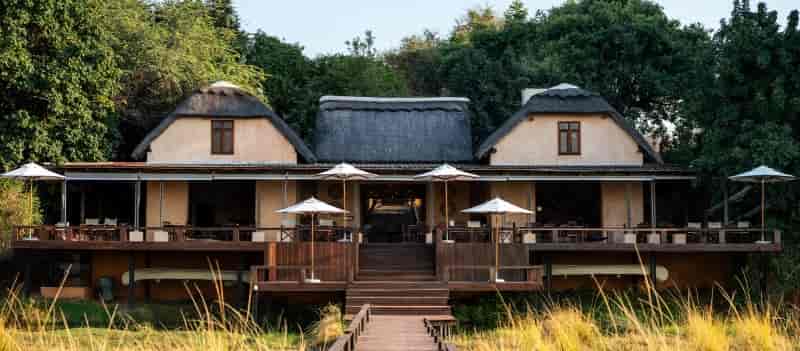
Royal Zambezi Lodge occupies a 200-hectare private property with 3.5 kilometres of river frontage in Zambia’s Chiawa Game Management Area, just outside Lower Zambezi National Park.
Across the river, in Zimbabwe, lies Mana Pools National Park.
It is an extraordinary location, but hardly a sealed resort where nature politely stops at reception.
Guests pay for proximity to genuine wilderness, not a guarantee that wildlife will maintain a respectable distance.
That makes the judgement of experienced local staff every bit as important as the river views.
Zambia Tourism identifies the Lower Zambezi as one of the country’s premier wildlife destinations, home to elephants, hippos, lions, leopards and abundant birdlife.
Game drives, walking safaris and river excursions provide different perspectives on the landscape. The lodge also promotes canoeing, tiger fishing and sunset cruises.
That diversity is an important commercial strength.
Travellers can combine the comforts of a luxury suite with authentic wilderness experiences rather than having to choose between the two.
Yet it also places considerable responsibility on operators to manage the inevitable encounters between people and animals.
The people behind the safari experience
For travel advisers, the message is practical.
Ask about guiding arrangements, guest safety briefings and which activities suit individual travellers. Establish accommodation inclusions and park entry costs before confirming reservations.
The lodge advises that Lower Zambezi National Park entry fees are separate from its advertised accommodation rates.
Wildlife protection is equally important.
Conservation Lower Zambezi works alongside Zambia’s wildlife authorities on anti-poaching operations, environmental education and community programmes.
The region’s long-term tourism appeal depends upon protecting the animals responsible for its extraordinary reputation.
And that brings us back to the lion in the car park and the unexpected hippopotamus fishing expedition.
Neither encounter appeared on a carefully prepared itinerary.
Both demonstrate why the quality of guiding matters as much as accommodation, food or the view from a private deck.
An excellent safari story rarely begins with a perfectly executed timetable.
But it should end with everyone safe, the wildlife respected and a professional team deserving the credit.
At Royal Zambezi Lodge, the lion and the hippo supplied the headlines.
The people who knew what to do supplied the real story.
Useful links;
-
Royal Zambezi Lodge official website – https://www.royalzambezilodge.com.
-
Zambia Tourism – Lower Zambezi National Park – https://www.zambia.travel/lowerzamnp.html.
-
Royal Zambezi Lodge – accommodation rates and park entry fees – https://www.royalzambezilodge.com/direct-booking.
-
Conservation Lower Zambezi – wildlife protection – https://www.zambiatourism.com/about-zambia/conservation/conservation-lower-zambezi.
By: Stephen Peters – © 2026.
Read Time: 4 minutes.
Author Bio:
 Stephen Peters has spent much of his career proving that the straight-and-narrow path is considerably overrated. Armed with a Bachelor’s degree in Technology from the University of Queensland and a Master’s in Management, he first ventured into hospitality, working in and helping open several five-star hotels across Sydney and Asia.
After deciding he had experienced quite enough of five-star hospitality from the operational side of the desk, Stephen returned to technology, working with major US tech companies while based between Australia and Asia.
Then came the ultimate change of scenery. Stephen built his own yacht and, with his family aboard, sailed from Florida through the United States and its Great Lakes before crossing the Pacific to Asia. Several memorable years followed, exploring Indonesian waters before the Peters family eventually returned to Australia with considerably more sea miles, stories and perspective than when they left.











