

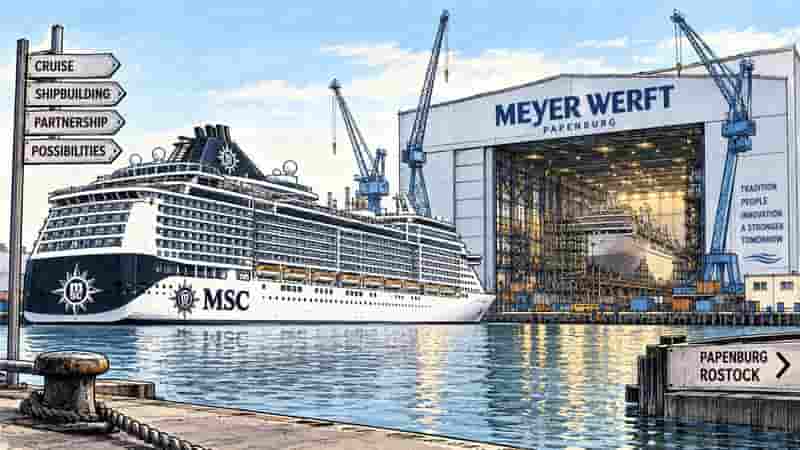
One of the biggest potential deals in modern cruising may be taking shape in Germany, and if it gets across the line, the repercussions could reach far beyond the banks of the River Ems.
MSC Mediterranean Shipping Co. is reportedly in preliminary discussions to acquire the approximately 80% stake in German shipbuilding heavyweight Meyer Werft currently held by Germany’s federal government and the state of Lower Saxony.
For now, however, underline the word preliminary.
No sale has been announced. No final decision has been made. Other potential buyers could still emerge, and the negotiations could end without a transaction.
Even so, the prospect alone is enough to command the cruise industry’s attention.
This would be considerably more than another corporate acquisition. MSC is one of the world’s largest maritime groups and the parent of MSC Cruises, while Meyer Werft is one of Europe’s leading cruise shipbuilders.
Putting the two under common ownership suddenly turns the traditional relationship between cruise line and shipbuilder into something very different.
From customer to owner?
Meyer Werft’s history stretches back to 1795, when Willm Rolf Meyer founded the shipyard at Papenburg.
Today, the company describes itself as one of the world’s largest and most modern shipyards. Its Papenburg operation employs about 3,200 people, and Meyer Werft says it has built 61 cruise ships.
MSC Cruises is already preparing for what could become an enormous relationship with the German builder.
In December 2025, MSC Cruises and Meyer Werft announced a letter of intent covering four next-generation cruise ships, with options for another two.
Importantly, however, those construction contracts have not yet been publicly confirmed as finalised.
In a joint statement issued on 24 June 2026, MSC Cruises and Meyer Werft said detailed ship-design planning and negotiations to conclude the relevant contracts had reached an advanced stage.
The proposed ships would form a new class known as New Frontier.
Each would be approximately 180,000 gross tonnes and accommodate up to 5,400 passengers, with annual deliveries intended to begin from 2030.
If the four ships and two options ultimately proceed, it would represent an extraordinary construction programme that could consume valuable shipyard capacity well into the next decade.
Now add the possibility that MSC could become the controlling shareholder of the company building them.
That is where this story becomes particularly interesting.
Cruise ships and precious construction slots
Cruise shipbuilding is an unusual business.
A cruise company cannot simply decide on Monday that it would like a 180,000-tonne floating resort and expect somebody to deliver it on Friday.
The number of European shipyards capable of designing and constructing today’s largest and most technically sophisticated passenger ships is limited. Meyer Werft, Italy’s Fincantieri and France’s Chantiers de l’Atlantique are among the industry’s crucial builders.
Construction capacity is therefore extremely valuable.
A cruise company contemplating fleet expansion years into the future requires not only billions of dollars but access to a shipyard capable of turning those billions into ships.
That explains why the possibility of MSC acquiring Meyer Werft deserves considerably more attention than an ordinary merger-and-acquisition story.
Industry observers are already examining whether ownership could give MSC greater influence over future newbuild capacity.
However, no evidence currently shows that an MSC-owned Meyer Werft would restrict competing cruise companies’ access to construction slots, and neither MSC nor Meyer Werft has announced how the yard would operate under any potential new ownership structure.
For now, that remains an industry question rather than an established consequence.
Germany’s €400 million rescue
Another important character in this unfolding story is the German taxpayer.
Meyer Werft’s present ownership structure resulted from the financial rescue agreed in 2024.
Germany’s federal government and Lower Saxony jointly acquired around 80% of Meyer Werft, investing €400 million (€200 million each).
They also planned guarantees of approximately €1 billion each to support financing of existing firm orders and stabilise the business.
The rescue became necessary after Meyer Werft faced severe financial pressure following the COVID-19 pandemic, Russia’s war against Ukraine, sharply rising commodity prices, and the unusual financing structure of cruise ship construction.
Meyer Werft has explained that about 80% of a ship’s construction price is generally paid only upon delivery, requiring the yard to finance much of the construction beforehand.
That model becomes considerably less comfortable when costs rise sharply while older contracts remain fixed.
The government’s involvement, however, was never intended to make Berlin and Lower Saxony permanent cruise shipbuilders.
Meyer Werft explicitly stated in 2024 that the objective was eventually to return the business to private ownership. The Meyer family, which retains just under 20% of the company, was also granted a buy-back right.
A private-sector exit has therefore always been part of the longer-term equation.
What makes MSC particularly interesting is that it would not simply be a financial investor looking for an industrial asset. It is intimately connected to the very market Meyer Werft serves.
Germany unlikely to hold a shipyard fire sale
If MSC does want the government stake, however, it apparently should not expect bargain-basement pricing.
Bloomberg has reported, citing people familiar with the discussions, that German government officials do not want to sell the public holding at a loss against the combined €400 million invested during the 2024 rescue.
No proposed purchase price has been publicly disclosed.
The reported discussions remain at an early stage, and Meyer Werft, MSC and government representatives have not announced a transaction.
German business newspaper Handelsblatt has also reported that talks are occurring but remain at a very early stage, while regional broadcaster NDR has reported that insiders confirmed negotiations.
That provides considerably more substance than an isolated takeover rumour, but it still does not constitute a completed deal.
More than Papenburg
There is another important element.
According to Bloomberg’s reporting, a potential transaction would comprise Meyer Werft’s shipyards at Papenburg, near Germany’s border with the Netherlands, and Rostock, on the Baltic Sea.
That broadens the significance of any transaction beyond the famous covered construction halls at Papenburg.
Meyer Werft’s wider group activities include river passenger vessels and increasingly diversified maritime construction work, while its Rostock operations have expanded into new industrial projects.
MSC would therefore potentially be acquiring an industrial platform rather than simply a production line for its next generation of cruise ships.
Meyer Werft isn’t out of troubled waters yet
The potential acquisition also arrives while Meyer Werft remains deep in restructuring.
Its recently released 2025 consolidated results demonstrate substantial progress but also the scale of the repair job.
Group revenue increased from €1.37 billion in 2024 to €2.83 billion in 2025.
Operating earnings before interest, tax, depreciation and amortisation improved significantly, from negative €527.6 million to negative €251.8 million.
The group’s net loss narrowed from €569.2 million in 2024 to €383.8 million in 2025.
Those numbers require some context.
Meyer Werft says the accounts continue to include expected losses from unprofitable legacy contracts through provisions.
An independent restructuring expert has confirmed compliance with the company’s restructuring roadmap, while committed equity and debt financing cover financing requirements through the agreed restructuring period ending in 2028.
Management expects another significant improvement in EBITDA towards break-even during 2026.
In other words, MSC would potentially be buying much more than an historic name and an impressive order book.
It would also be buying into one of Europe’s most closely watched industrial turnarounds.
Why MSC might be interested
Nevertheless, there is obvious strategic logic worth examining.
MSC has developed into a maritime giant spanning container shipping, logistics and cruising, while MSC Cruises continues investing heavily in fleet growth.
Securing a closer relationship with specialist shipbuilding capacity could potentially provide another level of long-term strategic alignment.
Then there is the New Frontier programme.
If the proposed four-ship programme and two options are converted into final construction contracts, MSC would become an exceptionally important Meyer Werft customer.
Common ownership could potentially allow closer alignment of ship design, construction scheduling and long-term fleet requirements.
But that remains analysis, not an announced MSC strategy.
Neither MSC nor Meyer Werft has publicly confirmed that vertical integration or control over shipbuilding capacity is the objective behind the reported discussions.
That distinction matters.
And what about Meyer Werft’s other customers?
This may ultimately become one of the industry’s most interesting questions.
Meyer Werft has traditionally served numerous cruise companies rather than operating as the captive construction arm of one operator.
Its customer base has included some of the biggest names in cruising, including Disney Cruise Line and companies within Carnival Corporation and Royal Caribbean Group.
If MSC eventually acquired the government’s controlling interest, competitors would naturally want to understand what that meant for future orders, construction priorities, commercial confidentiality and access to valuable capacity.
Depending upon the final structure of any transaction, competition and regulatory considerations could also arise.
None should be prejudged before an actual agreement exists.
For now, they are questions, not conclusions.
A deal that could change cruise shipbuilding
That is precisely why the MSC-Meyer Werft story deserves watching.
An MSC acquisition of the government’s stake would bring together one of the world’s most powerful maritime groups and one of cruising’s most important specialist shipbuilders.
It could provide Germany with the private-sector exit envisaged when taxpayers stepped in to rescue Meyer Werft.
It could give the shipyard an industrial shareholder with substantial maritime resources and potentially enormous requirements for future vessels.
It could also give MSC a much closer relationship with one of the most valuable commodities in modern cruising: the specialist capacity needed to build the next generation of ships.
But considerable distance remains between talking about buying a shipyard and actually owning one.
As of 22 September 2026, the discussions remain preliminary. No transaction has been announced, no purchase price has been disclosed publicly, other potential buyers could still emerge, and the negotiations could ultimately fall through.
There is an old maritime rule about not celebrating before the ship reaches port.
MSC and Meyer Werft are not there yet.
But if this particular vessel does make it safely into harbour, the cruise industry’s shipbuilding map could look decidedly different.
Further information
Meyer Werft’s official company information and history:
Meyer Werft — Company: https://www.meyerwerft.de/en/company/index.jsp
Official MSC Cruises–Meyer Werft update on the proposed New Frontier ships:
Meyer Werft — MSC Cruises Joint Statement: https://www.meyerwerft.de/en/press/press_detail/major_contract_joint_statement_by_msc_cruises_and_meyer_werft.jsp
Official details of Meyer Werft’s 2024 government rescue:
Meyer Werft — Future Secured: https://www.meyerwerft.de/en/press/press_detail/meyer_werft%E2%80%99s_future_secured.jsp
Latest official financial update:
Meyer Werft — 2025 Consolidated Financial Statement: https://www.meyerwerft.de/en/press/press_detail/meyer_werft_announces_key_figures_of_the_2025_consolidated_financial_statement.jsp
By: Stephen Peters – © 2026.
Read Time: 6 minutes.
Author Bio:
 Stephen Peters has spent much of his career proving that the straight-and-narrow path is considerably overrated. Armed with a Bachelor’s degree in Technology from the University of Queensland and a Master’s in Management, he first ventured into hospitality, working in and helping open several five-star hotels across Sydney and Asia.
After deciding he had experienced quite enough of five-star hospitality from the operational side of the desk, Stephen returned to technology, working with major US tech companies while based between Australia and Asia.
Then came the ultimate change of scenery. Stephen built his own yacht and, with his family aboard, sailed from Florida through the United States and its Great Lakes before crossing the Pacific to Asia. Several memorable years followed, exploring Indonesian waters before the Peters family eventually returned to Australia with considerably more sea miles, stories and perspective than when they left.











