

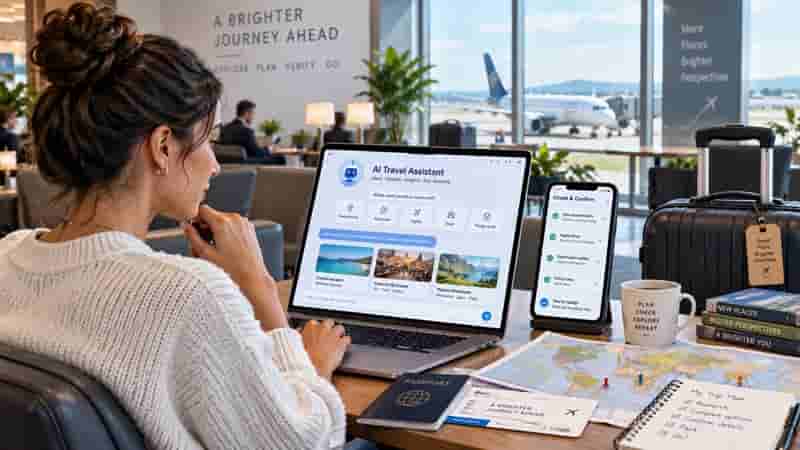
Artificial intelligence has moved from travel novelty to travel companion at remarkable speed, but travellers are still keeping one hand firmly on the wheel.
New findings from the Global Rescue Traveller Sentiment and Safety Survey suggest AI is rapidly becoming part of the international trip-planning toolkit. Some 51 per cent of experienced international travellers now expect to use AI in some form when planning a journey, up sharply from 36 per cent in March. Of those surveyed, 31 per cent intend to use AI to narrow their options, while 20 per cent will mainly turn to it for inspiration.
At the same time, the proportion saying they will not use AI at all has fallen from 36 per cent to 26 per cent. In travel-technology terms, that is less a gentle taxi to the runway than a fairly brisk take-off.
Yet adoption is not the same thing as trust.
Dan Richards, founder and chief executive of The Global Rescue Companies, summed up the mood neatly: travellers are embracing AI “as an assistant, not an authority”. Richards is also a member of the US Travel and Tourism Advisory Board, a federal advisory body to the US Secretary of Commerce.
That distinction matters. AI can suggest destinations, compare hotels, assemble itineraries, translate phrases and sort through a mountain of information before breakfast. What it cannot always do is guarantee that the information it produces is current, complete, or appropriate for a traveller’s particular circumstances.
And international travel is hardly a static business. Visa rules change, airlines alter schedules, airports close, strikes erupt, safety advice is revised, and entry requirements can shift with little warning. A beautifully written AI answer is of limited comfort at an airport check-in desk if the underlying visa information is yesterday’s news.
Travellers Are Checking AI’s Homework
The Global Rescue findings show travellers have noticed.
Nearly 60 per cent of respondents said they trust AI-generated travel information only after checking it against other sources. Just 6 per cent said they mostly trust AI without verification, while no respondent said they completely trusted AI-generated information. Another 25 per cent said they did not trust it at all.
Experience appears to be reinforcing that caution. Twenty-seven per cent of respondents said they had encountered incorrect or outdated AI-generated travel information. Almost one-quarter said they caught the error before travelling, while 3 per cent said inaccurate information had affected their plans.
For Australian travellers, that caution closely matches the advice of the Australian Government’s Smartraveller service. In guidance published in July 2026, Smartraveller described AI as a useful starting point for trip planning but warned that information can be inaccurate, incomplete or out of date.
It specifically advises travellers to verify important details, particularly visas, entry requirements, local laws and safety information against official and trusted sources.
That is hardly an anti-technology message. It is simply old-fashioned travel common sense wearing a new digital hat.
Inspiration Takes Off
There are also intriguing differences in how travellers are putting AI to work.
Non-US travellers appear more inclined to use it for inspiration, with 31 per cent doing so compared with 16 per cent of US-based travellers. Americans remain somewhat more likely to use AI to narrow choices, at 32 per cent compared with 27 per cent among non-US travellers.
Human advice is shifting too.
Earlier in the year, non-US travellers were more likely than Americans to rely mainly on recommendations from people. The latest figures reverse that pattern: 26 per cent of US-based respondents now say they rely mostly on human recommendations, compared with 15 per cent of non-US respondents.
The most decisive result, however, concerns control.
Sixty-one per cent of respondents said they would not allow an AI assistant to make travel decisions automatically, such as rebooking flights or changing an itinerary. Eleven per cent would permit AI to act with their approval, while 20 per cent said it would depend on the circumstances.
Not one respondent said they would hand over travel decisions without human approval.
Travel Advisers Still Have a Seat at the Table
For travel advisers, airlines, hotels and tourism operators, that should be read as an opportunity rather than a threat.
Travellers increasingly appear comfortable using AI to search, shortlist and organise. But when money, disruption, border formalities or personal safety enter the equation, human reassurance and authoritative information retain considerable value.
For travel advisers in particular, the research reminds us that AI may change the homework without necessarily replacing the teacher.
A traveller can ask an AI platform to produce three weeks in Europe, compare airline routings or suggest a beach resort that does not require selling the family silver. But when a passport problem arises, a flight disappears from the departure board or entry regulations change, knowledgeable human assistance suddenly looks rather less old-fashioned.
The implications for travel businesses are equally clear.
Content needs to be accurate, current and easy for both people and AI systems to interpret. Official policies should be plainly stated, key dates kept fresh and booking conditions written without a fog of corporate jargon.
If AI is helping travellers build the shortlist, brands need information worth finding and worth verifying.
AI Plus Human Judgement Looks the Winning Formula
The sensible model, then, is not artificial intelligence versus human expertise. It is artificial intelligence backed by human judgement.
For Australian international travellers, particularly where visas, border regulations and security are concerned, check information through official sources such as Smartraveller, destination governments, airlines and recognised travel-document databases such as the IATA Travel Centre.
The latest findings should also be viewed for what they are: a snapshot of sentiment among experienced international travellers associated with Global Rescue, rather than a census of every leisure traveller worldwide.
Nevertheless, the direction is difficult to miss.
AI is no longer sitting politely in travel’s technology waiting room. It has collected its boarding pass and joined the journey.
Travellers, however, are making it equally clear that it is travelling as an assistant, not the captain.
Use AI to find the possibilities. Use official sources to check the facts. And when an algorithm confidently announces that a visa is unnecessary, perhaps resist the temptation to pack first and investigate later.
The immigration officer is unlikely to be impressed by the prompt.
By: Michelle Warner – © 2026.
Read Time: 4 minutes.
Author Bio:
 Michelle Warner has always carried stories the way others carry passports lightly, faithfully, and with purpose. She learned her craft in newsrooms, shaping sentences with care, before swapping deadlines for departures as a flight attendant with some of the world’s great airlines. Years aloft sharpened her eye for character and deepened her fondness for the small, dignified rituals of travel, the quiet kindness of strangers, the poetry of arrival, the patience learned between time zones.
Now grounded by choice, Michelle has come home to writing with the same calm authority she once brought to turbulent cabins. Her prose blends an editor’s discipline with a traveller’s wonder, tinged with humour and reverence for travel’s golden age. Each piece feels like a handwritten boarding pass, gracious, observant, and unmistakably alive.











