

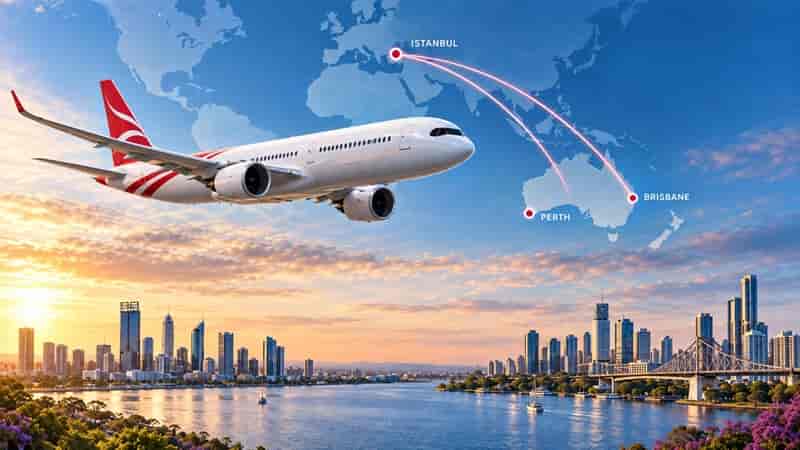
Turkish Airlines has put Brisbane and Perth firmly back on Australia’s aviation radar, with the carrier now evaluating both cities as part of the next stage of its ambitious expansion Down Under.
And this is rather more significant than an airline executive casually pointing at a map over lunch.
The development marks a notable shift from the carrier’s more cautious position last year, when senior management said Sydney and Melbourne would remain its immediate Australian priorities. Latest reporting published on 20 September says Brisbane and Perth are now being evaluated, subject to market demand, aircraft availability and the formidable economics of operating some of the longest passenger flights in the world.
For Australian travellers and particularly travel advisers, that is worth watching.
Turkish Airlines does not merely bring Türkiye into the equation. It puts Istanbul into play as a major alternative gateway to Europe, the Mediterranean, the Balkans, Africa and beyond.
With Australians continuing to demonstrate an impressive willingness to spend large portions of their lives sitting in aircraft seats on their way to Europe, additional direct access to one of aviation’s largest global networks could be a very useful addition indeed.
Sydney comes first, but the map is getting bigger
Turkish Airlines currently serves Sydney and Melbourne using one-stop services between Australia and Istanbul through Asia.
Its longer-term ambition is considerably more muscular.
Non-stop Istanbul–Sydney flights are now targeted for the end of 2027, after slipping from an earlier 2026 timetable, while Melbourne is expected to follow during 2028. The flights depend on the arrival of specially configured Airbus A350-1000 aircraft designed for exceptionally long sectors.
Turkish has ordered 15 A350-1000s. Eight are expected to receive a configuration intended for the airline’s ultra-long Australian missions, with a substantial premium component including 66 Crystal business-class suites.
The airline is also preparing to introduce premium economy on its next generation of long-range A350 aircraft, with the product currently planned from 2028.
Therein lies an important clue.
These flights are not simply exercises in squeezing as many passengers as possible into a very long metal tube and hoping everybody remembers where they parked.
Ultra-long-haul flying is expensive. Payload matters. Fuel matters. Premium demand matters enormously.
Turkish Airlines must therefore find the right combination of corporate travellers, premium leisure passengers, visiting-friends-and-relatives traffic and connecting passengers before allocating scarce long-range aircraft to another Australian city.
Which brings us neatly to Perth.
Perth makes an increasingly strong case
Western Australia is in an international aviation purple patch.
Perth Airport handled more than 18.3 million passengers during the 2025–26 financial year, its busiest year on record. International traffic rose 8.1 per cent to a record 5.55 million passengers.
At the same time, Perth Airport is pursuing a multi-billion-dollar redevelopment program, including an expanded international terminal, new terminal facilities, and parallel runway infrastructure intended to accommodate considerably more aviation growth in the years ahead.
Then there is geography.
Perth sits much closer to Türkiye and Europe than Australia’s eastern seaboard, giving it an obvious advantage for ultra-long-haul operations.
Turkish Airlines has not announced a Perth service, nor has it given the city a commencement date or proposed frequency. But Perth’s booming international traffic, strong Western Australian outbound market and major airport investment make the city’s appearance on the carrier’s evaluation list entirely logical.
It could also offer Western Australian travellers another European gateway without the irritating need to first fly several hours in the wrong direction.
Few things test one’s enthusiasm for a European holiday quite like beginning it by flying east when Europe stubbornly remains west.
Brisbane offers a different prize
Brisbane brings another attraction altogether.
Queensland gives Turkish Airlines access to a large leisure market, substantial visiting-friends-and-relatives traffic and one of Australia’s biggest inbound tourism economies.
A Brisbane–Istanbul service would also give Queensland passengers the option to start their European journey from home rather than positioning through Sydney or Melbourne.
For travel advisers, that is more important than it may first appear.
Every additional international gateway creates new itinerary combinations. Clients travelling to Türkiye, southern Europe, eastern Europe, Scandinavia, the Balkans or Africa could potentially move through Istanbul without adding an Australian domestic sector at either end of the journey.
It also gives agents another major connecting hub to place alongside Singapore, Dubai, Doha, Hong Kong and other established gateways.
Competition, when backed by sensible capacity, has rarely upset the travelling public.
Australia already has room for more Turkish flights
Importantly, bilateral traffic rights should not be the chief obstacle.
Australia and Türkiye agreed in December 2023 to progressively increase permitted capacity to 35 passenger services per week covering Sydney, Western Sydney, Melbourne, Brisbane and Perth.
The updated arrangements also expanded fifth-freedom rights and freight opportunities between the two countries.
That means Turkish Airlines already has considerable regulatory room in which to grow.
The bigger questions are aircraft availability, route economics and whether individual Australian markets can generate enough high-yield demand to justify using valuable long-range aircraft.
And Turkish certainly does not suffer from a shortage of destinations to which those passengers can connect.
The airline holds the Guinness World Records title for flying to the most countries of any airline. Its current corporate material lists a network spanning 133 countries, 351 cities and 358 airports.
That network is the real weapon in Turkish Airlines’ Australian strategy.
A traveller does not necessarily need Istanbul as the final destination. Istanbul becomes the transfer point.
Australian demand appears encouraging
The airline also appears to be finding a receptive Australian audience.
Latest reporting puts average load factors on Turkish Airlines’ existing Australian operations at about 85 per cent, an encouraging figure as management considers further expansion.
It does not automatically mean Brisbane and Perth will receive flights. Airlines have an inconvenient habit of expecting routes to make money, not just attract passengers.
But it helps explain why Turkish Airlines is looking beyond its original Sydney-and-Melbourne foothold.
The carrier is stepping into a market where Emirates, Qatar Airways, Singapore Airlines, Cathay Pacific and other major network airlines have spent years teaching Australians to travel to Europe through large international hubs.
Turkish Airlines’ job is to persuade passengers and their advisers to add Istanbul to that mental route map.
For the trade, the proposition could be particularly attractive for multi-country European itineraries, Mediterranean holidays, Türkiye stopovers and clients travelling into the wide collection of European destinations served from Istanbul.
Adding Brisbane and Perth would make that proposition considerably easier to sell.
Prospects, not promises
However, travel sellers should note an important distinction.
Brisbane and Perth remain prospective destinations.
No launch dates have been announced. No schedules have been filed. No frequencies have been confirmed, and no aircraft have yet been formally assigned to either route.
Aircraft deliveries will be crucial.
Turkish Airlines has already pushed its planned Sydney non-stop service back to late 2027 while it waits for the appropriate A350-1000s.
It is a useful reminder that ultra-long-haul aviation timetables can occasionally demonstrate considerably more flexibility than the passengers using them.
Nevertheless, the broader direction is becoming clear.
Turkish Airlines entered Australia cautiously, establishing one-stop services and developing its market while waiting for aircraft capable of making Istanbul–Australia non-stop flying commercially viable.
Sydney is first in line for the next generation of operations. Melbourne follows.
Now Brisbane and Perth are being assessed for what could come next.
That’s where this story becomes particularly interesting for Australia’s travel industry.
Turkish Airlines is no longer asking whether Australia belongs in its vast global network.
It is increasingly deciding how big its Australian operation should become.
If Brisbane and Perth eventually join Sydney and Melbourne, Turkish Airlines would have the foundations of a formidable four-city Australian network feeding its Istanbul hub.
For Australian travellers, it would mean another serious route to Europe.
For agents, another substantial product to sell.
And for Australia’s already lively international aviation market, another red-tailed contestant preparing to pull up a chair at what is becoming a very crowded and very competitive table.
By: Bridget Gomez – © 2026.
Read Time: 5 minutes.
Author Bio:
 Bridget has never been built for stillness. Of Portuguese heritage, she began as a nurse, tending veterans at the Repatriation Hospital, listening to stories as colourful as the life she was yet to live. It was worthy, steady work, but wanderlust, as always, proved louder than routine.
So, she traded starch for a backpack and disappeared for a year, chasing trains, sunsets and the occasional regrettable glass of wine. She wrote everything down: the dust, the laughter, the missteps, the magic. Those notebooks became a travel blog, then a habit, then a calling.
Eventually she found Global Travel Media, or perhaps it found her.
Today Bridget writes with heart, humour and a dash of mischief, still travelling, just now with words.











