

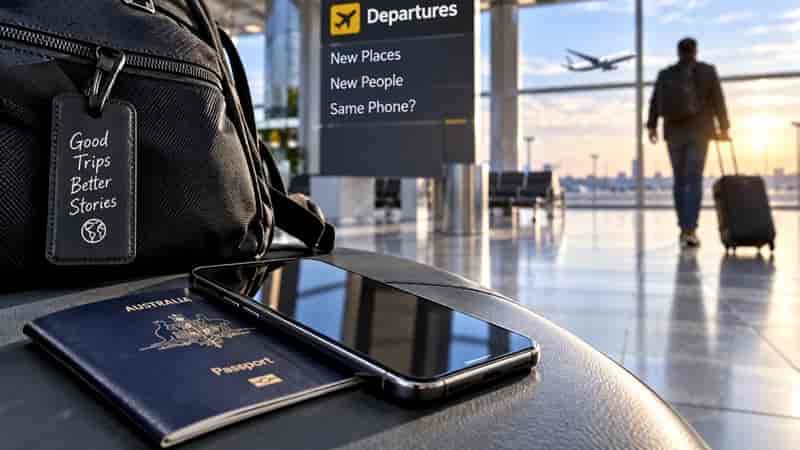
A passport used to be the one item travellers guarded with their lives. Now the smartphone is giving it a serious run for its money.
In a Global Rescue survey, more than one in five seasoned international travellers (21 per cent) said losing or having a phone, laptop, or other device stolen was their biggest travel technology fear.
It is easy to see why. A lost phone is no longer just an expensive nuisance. It can cut off access to boarding passes, hotel bookings, bank apps, maps, airline alerts, emergency contacts and login codes. Much of a trip can vanish with it.
“Today’s traveler carries an entire trip inside a single device,” said Dan Richards, CEO of The Global Rescue Companies and a member of the US Travel and Tourism Advisory Board at the US Department of Commerce. Richards is currently listed as a board member by the US International Trade Administration.
Richards said the impact can go far beyond the cost of a new handset. A traveller may lose access to transport, a hotel, bank accounts and vital calls or messages at the worst possible time.
The latest Global Rescue Traveller Sentiment and Safety Survey also found a clear gap between US-based and non-US-based respondents.
Among US-based travellers, 14 per cent said unsafe public Wi-Fi and “juice jacking” at public charging points were their main technology worry. Only 1 per cent of non-US respondents chose the same risk.
Richards urged travellers to use a VPN, avoid banking on public Wi-Fi and carry their own charger.
For Australians, that advice closely matches official Smartraveller guidance. Smartraveller warns that devices and data can be at risk overseas, with public Wi-Fi, shared computers and Bluetooth among the weak points. It advises travellers to back up key data before they leave, use strong passphrases and multi-factor authentication, turn off automatic wireless connections and use their own charger or power bank.
Other worries also differed by market.
Four per cent of US-based travellers feared that the wrong voltage or plug could damage a device. That compared with 2 per cent of non-US travellers.
Non-US respondents were more concerned about being locked out of bank or work systems because of foreign IP addresses. They were also more worried about device confiscation or digital border searches, at 12 per cent versus 8 per cent among US respondents.
Blocked apps and websites worried 11 per cent of non-US travellers and 9 per cent of US travellers. Failure of two-factor authentication text messages overseas concerned 11 per cent of non-US respondents, compared with 6 per cent of those based in the US.
For travel advisors and their clients, the lesson is simple. Digital preparation now belongs on the pre-trip list beside passports, insurance and visas.
Richards said travellers should back up devices, use secure ways to log in and keep another way to reach key travel details before they fly.
An old lesson still applies: don’t put everything important in one basket even when that basket has a six-inch screen.
Travellers should keep a safe backup of key booking details, emergency numbers and identification information. It also makes sense to have a login method that does not rely only on an SMS sent to a phone overseas.
The smartphone has replaced the folder once stuffed with tickets, hotel vouchers and copied itineraries. It is faster, lighter and much more useful.
But if it goes missing, that battered old folder can suddenly look rather clever.
For more information, visit www.globalrescue.com.
By: Michelle Warner – © 2026.
Read Time: 3 minutes.
Author Bio:
 Michelle Warner has always carried stories the way others carry passports lightly, faithfully, and with purpose. She learned her craft in newsrooms, shaping sentences with care, before swapping deadlines for departures as a flight attendant with some of the world’s great airlines. Years aloft sharpened her eye for character and deepened her fondness for the small, dignified rituals of travel, the quiet kindness of strangers, the poetry of arrival, the patience learned between time zones.
Now grounded by choice, Michelle has come home to writing with the same calm authority she once brought to turbulent cabins. Her prose blends an editor’s discipline with a traveller’s wonder, tinged with humour and reverence for the golden age of travel. Each piece feels like a handwritten boarding pass, gracious, observant, and unmistakably alive.











