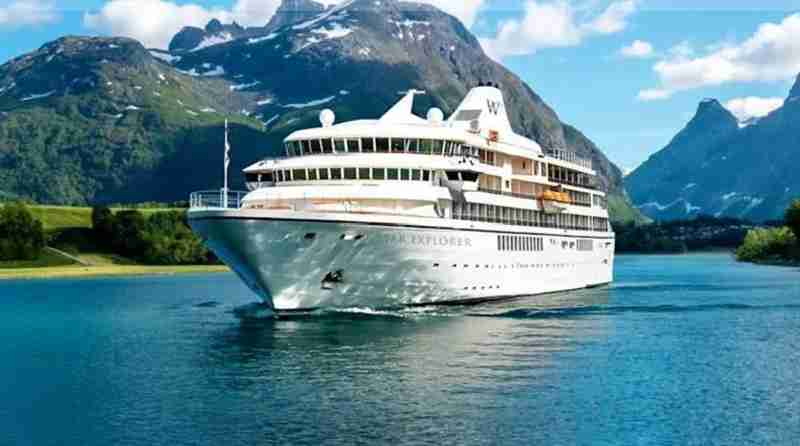
Windstar Cruises is preparing to add a handsome new name to the small-ship ledger, with the all-suite Star Explorer due to make her debut in December 2026.
The 224-guest yacht will expand the line to eight vessels and become the latest expression of Windstar’s Star Class. Yet the sales proposition is not simply that she is new, polished and blessed with enough glass to keep a window cleaner in permanent employment.
Windstar says her smaller dimensions will allow her to reach harbours and waterways inaccessible to many larger cruise ships, restoring a little intimacy to an industry increasingly fond of thinking in postcodes.
Star Explorer will feature 112 ocean-view suites. Nearly all will have either a full private veranda or a floor-to-ceiling infinity window, giving guests an unusually direct relationship with the passing coastline.
That detail is more than decorative. In Northern Europe and the Mediterranean, where the view frequently supplies the day’s best theatre, seeing the landscape without queuing at a rail is a genuine luxury. Windstar Cruises has confirmed these specifications and the December 2026 inaugural season.
Windstar’s introductory film places destination access squarely at the heart of the new yacht. Its inaugural program is expected to take guests through the British Isles, Norway, Spain and Italy, mixing famous ports with smaller harbours and less hurried encounters ashore.
Selected itineraries will combine ocean passages with river access, allowing Star Explorer to sail into waterways and berth closer to cities including London and Rouen. It is an appealing idea for travellers who prefer a coherent journey to a collection of disconnected port calls.
Small ship, large ambition
Star Explorer arrives at an interesting moment for cruising. Large ships keep growing, adding restaurants, rides, and attractions with the cheerful determination of suburban shopping centres. Windstar is sailing in the opposite direction.
Its argument is old-fashioned in the best sense: a ship should carry travellers into a destination, not become the destination’s most conspicuous landmark.
With capacity for only 224 guests, Star Explorer promises a scale at which crew may learn names, meals need not resemble a military manoeuvre and going ashore should involve considerably less choreography.
That intimate capacity also gives travel advisers a clear product to discuss with clients who have outgrown mainstream cruising but do not want expedition travel stripped of comfort.
Star Explorer occupies the increasingly valuable space between conventional luxury cruising and adventurous small-ship exploration. She offers refinement, but her real currency is proximity to coastlines, communities and experiences that bigger vessels may pass at a respectful distance.
The yacht’s European deployment sharpens that advantage. Norway’s fjords reward quiet observation; the British Isles offer a patchwork of ports whose charm is often inversely proportional to the size of their terminal; and Spain and Italy hardly require an advertising agency to make their case.
They simply need time, appetite and shoes capable of surviving cobblestones.
Suites built around the view
The accommodation plan reflects Windstar’s intention to keep the sea present throughout the voyage.
All 112 suites will offer ocean views, while nearly all will feature either a private veranda or a floor-to-ceiling infinity window that lowers to draw fresh air into the room.
The configuration should appeal to couples and mature travellers seeking room to settle in during longer or back-to-back journeys. It also supports the line’s “yacht-style” positioning more convincingly than a mere coat of nautical paint.
Space, privacy and an uninterrupted horizon remain among cruising’s most enduring pleasures. Star Explorer appears determined not to bury them beneath novelty.
Windstar says the vessel will represent a fresh evolution of its Star Class rather than a rejection of what loyal guests already value. That is a wise course. Cruise passengers can welcome innovation, but they are not generally asking their favourite line to undergo a personality transplant between voyages.
The challenge will be to make the new hardware feel unmistakably Windstar from the opening sailing.
Sister yacht Star Seeker provides the design foundation, while Star Explorer is intended to carry forward the line’s familiar emphasis on personal service, relaxed sophistication and destination immersion.
According to Windstar, Star Explorer and Star Seeker have been built with advanced environmental systems intended to support operations in remote destinations.
That is an important consideration as travellers, ports and tourism authorities place greater scrutiny on cruising’s environmental footprint. The claim deserves credit, although its practical performance will be judged over years at sea rather than during the christening festivities.
Windstar has confirmed the sister yachts share these systems in its official Star Seeker delivery announcement.
Basil + Bamboo brings flavour to the fore
Among the onboard additions is Basil + Bamboo, Windstar’s speciality dining concept blending Mediterranean and Asian influences.
The combination sounds daring until you remember that both culinary traditions take fresh produce, seafood, herbs, and balance seriously. In capable hands, it should feel less like a culture clash and more like lively conversation.
The restaurant adds another selling point for a vessel operating in regions where food is inseparable from place. A day among Italian markets or Spanish fishing ports deserves an evening meal with equal imagination.
Importantly, Basil + Bamboo is part of a broader Windstar dining evolution rather than a restaurant unique to Star Explorer, a distinction worth retaining amid the launch fanfare.
The concept debuted aboard sister yacht Star Seeker and has since been introduced more widely across Windstar’s Star Class fleet. Windstar describes it as a complimentary restaurant combining Asian influences with Mediterranean flavours. Further information is available through the line’s Basil + Bamboo announcement.
Guests can also expect established Windstar elements, including Amphora restaurant and the Yacht Club gathering space, alongside updated amenities.
The onboard experience will, of course, be properly judged only after paying passengers have sailed. Renderings are marvellous things, but the sea has never been overly impressed by an architect’s adjective.
A timely opening for travel advisers
For the travel trade, the December 2026 launch presents a useful forward-selling opportunity.
New ships naturally create interest, while a low guest capacity makes early planning sensible for clients seeking particular suite categories or inaugural-season departures.
Advisers can position Star Explorer around three straightforward benefits: small-ship access, all-suite comfort and regionally varied European itineraries.
That pitch is more durable than novelty alone. A maiden season may win the first booking; a distinctive experience wins the second.
The vessel also strengthens Windstar’s fleet at a time when experienced cruisers are becoming more selective.
Many still want excellent food, gracious service and a comfortable suite, but they increasingly want those pleasures connected to meaningful time ashore. The appetite is not necessarily for more activity. Often, it is for less friction.
Star Explorer’s planned combination of ocean passages and river access could be especially effective in meeting that demand.
The yacht is scheduled to navigate waterways including the Thames and Seine, placing guests closer to major cities. One published itinerary, for example, calls for Star Explorer to travel along the Thames and berth overnight in central London.
That is different from operating as a traditional river-cruise vessel. It uses the yacht’s size to connect coastal exploration with selected river ports.
Linking waterways can create a richer geographical story and reduce the stop-start feeling of some itineraries. Done well, the voyage becomes more than a timetable: it becomes a narrative, with each harbour providing the next chapter rather than an unrelated postcard.
Windstar looks beyond the ordinary
There is sensible restraint in Windstar’s promise.
Star Explorer is not being presented as the largest, loudest or most technologically theatrical ship at sea. She is being sold as a more personal way to explore compelling destinations, with modern comfort and fewer guests.
That may sound modest, but in contemporary cruising it is quietly radical.
The luxury of space is not always measured in hectares of deck. Sometimes it is an uncrowded harbour, a crew member who remembers your preference and a window that opens onto Norway before breakfast.
When Star Explorer enters service in December 2026, she will still have to prove that the warmth of an established brand can be carried into a new vessel.
No launch video, however elegant, can settle that question in advance. Service, food, itinerary delivery and the thousand small courtesies of life aboard will write the true review.
On paper, however, the new yacht has chosen an intelligent course.
With 112 suites, capacity for 224 guests and an itinerary map rich in European character, Star Explorer is shaped not merely to cross water but to make the world feel closer.
And that, after all, is what a good ship has always been for.