

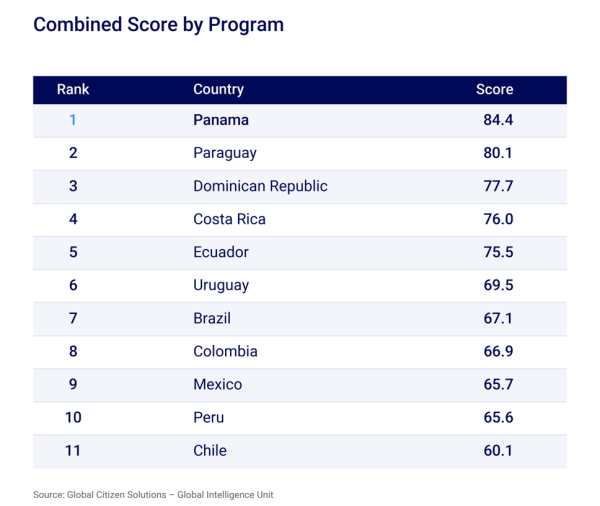
Global Citizen Solutions (“GCS”), a leading global residency and citizenship planning advisory firm, today released new comparative analysis entitled Investment Migration Programs in Latin America: a comparative analysis. The briefing assesses eleven active residency programs across the region on four measures: processing speed, tax attractiveness, investment flexibility, and presence freedom. Panama leads the combined ranking with a score of 84.4, followed by Paraguay at 80.1 and the Dominican Republic at 77.7, ahead of Costa Rica, Ecuador, Uruguay, Brazil, Colombia, Mexico, Peru, and Chile.
Panama is the most consistently competitive across all four measures, Paraguay offers the strongest value for money, Costa Rica trades speed for flexibility, Colombia is fastest on paper but least forgiving on presence, Chile leads on quality of life while ranking last as a program, and Mexico, the region’s second-largest economy, sits mid-table despite drawing the second-largest share of regional investment.
North America becomes Panama’s top source of investor demand
Panama’s Qualified Investor approvals rose 75% in 2024, from 187 to 327, while Self-Solvency Real Estate approvals more than doubled, from 63 to 133. The program now approves roughly 25 qualified investor applications a month against a target of 150, a sixfold increase, on the strength of a shift in its applicant base: North American nationals have overtaken Colombians as the largest single group. Panama leads the combined program ranking, ranking first or second across all four measures assessed, with the region’s widest choice of qualifying assets, from real estate and listed securities to bank deposits and forestry, and no mandatory minimum stay.
A region drawing global capital with US capital leading institutional flows into the region
The shift in investor visa demand tracks a larger capital story. Foreign direct investment into Latin America and the Caribbean reached $194.233 billion in 2025, up 1.7% year-on-year, with Brazil and Mexico together absorbing 62% of inflows. Amazon, Microsoft, and Google have collectively committed roughly $23 billion to the region as part of a global AI infrastructure build-out in which the four largest US technology firms are expected to deploy approximately $700 billion over the coming years. Microsoft alone has committed $2.7 billion to Brazilian cloud and AI infrastructure, $3.3 billion to its Chile data center region, and $1.3 billion to Mexico through 2027. Cross-border M&A activity is following the same trajectory, with Mexico’s deal value rising 86% year-on-year to roughly $32.5 billion in 2025, driven primarily by US and European acquirers.
Markets are pricing in the shift
The MSCI EM Latin America index returned 56% in 2025 and still trades at a 43% discount to global equities, a gap drawn in part to rising demand for the region’s AI-related commodities. Chile, Argentina, and Bolivia’s “lithium triangle” holds roughly 50% of the world’s identified lithium resources, while Chile, Peru, and Mexico supply close to 40% of global copper, both critical inputs to the data-center and energy-transition buildout underpinning the AI economy. Latin America’s high-net-worth population saw its collective wealth grow 5.1% in 2025, with Brazil (+6.0%) and Mexico (+5.4%) both outperforming the regional average.
Panama: the most balanced program in the region
Panama’s advantage lies in the absence of a weakness rather than a single standout feature. It ranks first or second across all four measures, offering the region’s widest choice of qualifying assets: real estate from $300,000, listed securities from $500,000, bank deposits from $750,000, or forestry investment from $100,000 to $800,000, with no mandatory minimum stay. Approval volumes hit records in 2024: Qualified Investor approvals rose 75%, from 187 to 327, and Self-Solvency Real Estate approvals more than doubled. Panama now approves roughly 25 qualified investor applications a month and is targeting 150, with North American nationals having overtaken Colombians as its largest applicant group.
Paraguay: the region’s best value
Paraguay pairs a $70,000 threshold with the region’s lowest headline tax rates, 10% corporate and 8 to 10% personal, and a presence requirement of just one visit every three years. It granted 29,765 residencies in the first half of 2026 alone, up 81% year-on-year, with Brazilian nationals accounting for 76% of them. Its new Investor Pass, introduced in April 2026, grants permanent residency directly and adds real estate, financial, and tourism routes to what had been a single business-investment pathway.
Colombia: fast on paper, demanding in practice
Colombia decides applications in as little as two to four weeks, faster than any other program assessed, but with less predictable timelines and heavier documentation, which leaves it mid-table overall at eighth. It is also the most demanding on presence, requiring 180 days in the country each year to keep a permit active, a requirement the report says effectively rules out investors not prepared to relocate in substance. Colombia is one of only four programs in the region that extends eligibility to an applicant’s parents as well as a spouse and dependent children.
Costa Rica: flexibility over speed
Costa Rica ranks fourth overall, trading processing speed, seventh of eleven, for one of the region’s widest ranges of qualifying investments, including real estate, listed shares, and a $2,500-a-month rentista income route. It is one of four countries, alongside Chile, Uruguay, and Panama, that lead the region on quality of life, making it a natural fit for investors who intend to spend real time in the country rather than simply hold a permit.
Chile: strongest on quality of life, weakest as a program
Chile leads the region as a place to live but finishes last of the eleven programs assessed, trailing on tax, flexibility, and presence while sitting eighth of eleven on speed. Its single qualifying route, an InvestChile-sponsored business investment with real estate excluded, reflects a program built to attract operating businesses rather than internationally mobile capital. Chile’s passport ties with Brazil’s as the strongest of the eleven, with 177 visa-free or visa-on-arrival destinations. Alongside Argentina and Bolivia, Chile also sits within the “lithium triangle,” which holds roughly 50% of the world’s identified lithium resources, and together with Peru and Mexico supplies close to 40% of global copper.
Mexico: scale without a matching program
Mexico is the region’s second-largest economy, with a projected 2026 GDP of $2.12 trillion, and absorbed $43.221 billion in foreign direct investment in 2025, or 22% of the regional total, second only to Brazil. Microsoft has committed roughly $1.3 billion to Mexican infrastructure through 2027, and cross-border M&A activity rose 86% year-on-year to approximately $32.5 billion, driven largely by US and European acquirers. Yet its residency program, based on proof of economic solvency rather than a formal investment structure, ranks ninth of eleven overall. It does combine worldwide taxation with no strict minimum stay, one of only a handful of programs in the region to pair those two features.
Brazil: leading the region’s capital attraction, trailing on applicants
Brazil is the region’s largest economy and its leading destination for AI-infrastructure investment, absorbing 40% of regional FDI in 2025. Despite entry costs as low as $30,000, its residency program ranks seventh overall, and its real estate route has attracted fewer than 700 applicants in five years, a gap the report attributes to limited awareness and advisory reach abroad rather than program design.
Price is a weak signal of program quality
Across the eleven programs, GCS’s analysis finds that cost bears little relationship to performance. Ecuador, at a $48,200 investment threshold, ranks fifth overall, and Paraguay, at $70,000, ranks second. Uruguay, whose $2 million threshold is more than forty times Ecuador’s, finishes sixth.
A region drawing capital as Europe retrenches
That momentum is compounded by retrenchment elsewhere: Spain ended its golden visa program in April 2025, Portugal removed its real estate route and lengthened naturalization timelines under a law taking effect in May 2026, and Greece’s tripled investment threshold in prime areas has been followed by a 24% fall in foreign property acquisitions under its program. For North American investors, Latin America’s combination of accelerating capital inflows and a widening menu of residency options positions the region as a growing alternative to a European market that is steadily closing off.
“Latin America is still largely underestimated with programs with real potential, and passports quietly offering some of the best mobility in the world. They complement Europe’s residence programs and the Caribbean’s citizenship offerings, while competing on cost, speed, naturalization timelines and access to a wider regional mobility space.”
– Patricia Casaburi, Founder and CEO, Global Citizen Solutions











