

On November 18, 2025, at the presentation of the Michelin Guide Italy 2026, Arnaldo – Clinica Gastronomica in Rubiera lost the star it had held without interruption since 1959, the longest run in the country. The next day, the sfogline were still rolling fresh pasta by hand, as they have every morning for nine decades, the bollito cart was still making its rounds, and reservations hadn’t dropped. For Your Custom Journey, a Venice-based travel design company founded in 1985, this is not an isolated event but a vantage point: the places that matter in Italy don’t depend on guidebooks, they depend on the families who have kept them open for generations, and they tend to sit well off the routes most travelers already know.
Fall, as It Actually Feels
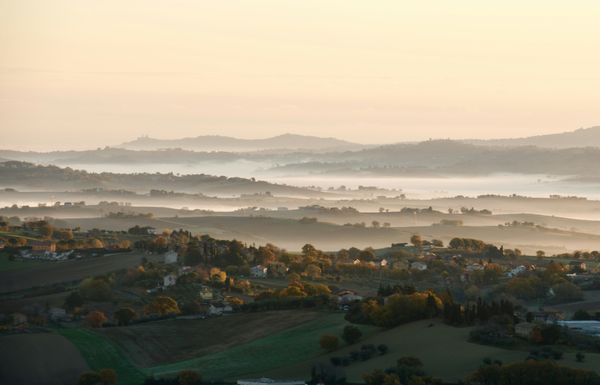
There’s a stretch of the year, from mid-October through late November, when Italy shifts register. The light drops low and turns slanted, vineyards turn copper and garnet, morning fog rises off the valleys and burns away by noon. Woodsmoke drifts through the villages, and near the olive presses the air carries the sharp, green smell of oil just pressed. Market stalls fill with chestnuts, porcini, squash, pomegranates. The weather stays mild enough that lunch is still eaten outside, while dinner moves closer to the fire.
It’s also the season when Italy belongs to Italians again. The piazzas that are hard to cross in August fall back into their own rhythm: the Saturday market, the after-lunch walk, a card game at the bar. Travelers who visit during these weeks don’t have to search for the real country, they’re already standing in it. The owner has time to sit down at the table and explain where a dish comes from, the winemaker has time to open the cellar outside normal hours, the truffle hunter has time to take a guest into the woods at dawn with his dog. In peak season, all of that is a marketing promise. In fall, it actually happens, because people have the time for it.
The Backdrop: Fall Is the New High Season
According to data presented by Virtuoso at Travel Week 2026, “fallcations” are one of the year’s leading trends: American travelers are pushing their European trips later into October and November, and Italy ranks second only to the United States among the most requested fall destinations. Demand is also shifting away from the traditional luxury hotspots and toward less-traveled regions, where food, culture, and a direct relationship with local people matter more than the name on the hotel.
The Calendar, in Brief
Italy’s fall harvest season isn’t a loose idea, it’s a calendar with precise windows that shift from one region to the next. White truffle: harvested from October 1 through mid-January, peaking in late October and November. New-pressed olive oil: pressing runs from late October through November. Zafferano dell’Aquila (saffron): hand-picked from mid-October into early November. Late-harvest Treviso radicchio: picked starting November 1, after two frosts, never earlier. Exact dates return within each of the four regions below.
How Your Custom Journey Works
Travelers who come to Your Custom Journey for a fall food and wine trip don’t receive a pre-written itinerary. They receive a proposal built around what they’ve actually asked for, often pointed well away from the circuits most operators already run, toward regions that rarely show up in general-interest catalogs. Four areas come up most often when the request centers on food, wine, and a direct connection to the people working the land: Carso, the Roman hinterland around the Monti Cimini, the Madonie, and the Colli Bolognesi. In each, the anchor is a member of Le Premiate Trattorie Italiane, an association founded in 2012 by four restaurateurs and now made up of 24 family-run, multigenerational establishments from north to south, many with rooms attached. Not a list assembled for the occasion, but a circuit that existed before anyone wrote about it.
“The best part of my job is talking with people from the other side of the ocean who have often already been to Italy. They come back looking for that way of life, for the traditions that make this country what it is. Guiding clients toward a side of Italy that’s less known but no less interesting is, for me, a privilege.” – Fabio Fasone, Head of travel designers, Your Custom Journey
Carso, Between Gorizia and the Sea
Carso is a limestone plateau that drops from the Collio down toward Trieste, swept by the bora wind, farmed in vine and vegetable plots tucked into pockets of red earth between the rocks. It’s a landscape closer to Slovenia than to the rest of Friuli, because for centuries this has been, and in part still is, a territory of Slovenian language and culture. In fall the wind picks up, the grape harvest wraps, the woods open for hunting season, and villages light fires for the season’s soups.
What lands on the table. Carso cooking sits at a crossroads of Slavic, Germanic, and Mediterranean traditions: jota, a stew of sauerkraut or turnip greens, beans, potatoes, and a piece of pork, is the signature dish of the cold months. There are Carso-cured meats, prosciutto crudo aged in the bora wind, game served with polenta, and cave-aged cheeses.
Where to sit down. Lokanda Devetak 1870, in San Michele del Carso, on the plateau between Gorizia and the border. Six generations of the Devetak family have lived through the destruction of World War I, exile, and more than one shift in the border, rebuilding the same inn on the same spot each time. Today it’s run by Gabriella and her daughters, all of them sommeliers. Eight rooms carved out of the old stable, a cellar cut into the bare rock holding more than twelve thousand bottles, and the region’s first Michelin Green Star.
Wines and cellars. Vitovska and Terrano are the grapes of the territory: the first a white, floral and easy-drinking; the second a red, acidic and rustic, built for cured meats and game. A few kilometers from San Michele, in Duino Aurisina, the Kante winery digs its own cellar eighteen meters into that same karst rock. Founded in 1980 by Edi Kante, one of the first to believe in this difficult terrain, it works Vitovska, Malvasia, and Terrano with a view over the Gulf of Trieste. A visit before dinner is the most direct way to understand why these wines don’t taste like anything else in Italy.
The Roman Hinterland, the Monti Cimini
Halfway between Rome and Tuscany, along the old Via Cassia and Via Flaminia, the Monti Cimini are a cluster of volcanic hills covered in centuries-old chestnut and hazelnut forests, with Lake Vico set at their center. It’s one of the most driven-through and least-visited corners of Italy: travelers heading north from Rome skirt right past it.
What lands on the table. October belongs to the marrone dei Monti Cimini, the region’s prized chestnut, celebrated at Caprarola’s Sagra della Castagna. Chestnuts turn into desserts, preserves, and roasted street snacks; the kitchen also turns out acquacotta alla viterbese, a farmhouse soup of vegetables and stale bread, and pappardelle al cinghiale (wild boar), alongside the cheeses and cured meats of the Tuscia.
Where to sit down. Trattoria del Cimino dal 1895, in Caprarola, on the road that climbs to Palazzo Farnese, the Renaissance residence that overlooks the village. The same family has been cooking here for a hundred and thirty years, marked in 2025: dishes tied tightly to the territory, from chestnuts to wild mushrooms, in a kitchen that has never stepped outside the Tuscia.
Wines and cellars. The local appellation is Colli Cimini, covering whites, reds, and rosés from the area between Viterbo and the upper Tiber valley; a little farther south sits Est! Est!! Est!!! di Montefiascone, one of Lazio’s oldest white wines. Trattoria del Cimino itself keeps a cellar carved into volcanic tufo beneath the dining room, curated by a sommelier from the family and internationally recognized for its wine list, an unusual detail for a village of five thousand people, and a stop worth a tasting of its own.
The Madonie, Sicily’s Interior
An hour from Palermo, the Madonie are a mountain park that climbs to nearly two thousand meters, with beech forests, limestone cliffs, and stone medieval villages. In fall, inland Sicily cools down before the coast does, the air lightens, and the forest becomes the real pantry behind the local kitchen.
What lands on the table. Wild mushrooms from the Madonie beech forests, free-range black pig, wild herbs, and manna, a sweetener drawn only between Castelbuono and Pollina from ash trees hand-scored the same way it has been done for centuries. For dessert, Madonie classics like Testa di Turco and sfoglio.
Where to sit down. Hostaria Nangalarruni, in Castelbuono, a stone village gathered around the Ventimiglia castle. Giuseppe “Peppe” Carollo has cooked here since 1984, now alongside his daughter Francesca. The cellar holds roughly six hundred labels of Sicily’s best.
Wines and cellars. South of the Madonie lies the Contea di Sclafani appellation, producing whites and reds at altitudes unusually high for Sicily, with a temperature swing that keeps even the reds fresh. A few minutes from Castelbuono, Abbazia di Sant’Anastasia makes organic wine inside a medieval monastery, a natural stop before or after dinner.
The Colli Bolognesi, Between Rubiera and Savigno
The first hills of the Apennines south of Bologna, along the Via Emilia and the Samoggia valley, are white truffle country, home to vineyards and to trattorie that have never stopped working the way they did a hundred years ago. This is also where the story that opened this release took place.
What lands on the table. White truffle, dug up a few hundred meters from the kitchens that serve it, reaches the table within hours of being unearthed, alongside game from the surrounding woods. It’s also the territory of bollito and roasts served tableside from a cart, a dining-room ritual that in Emilia survives almost exclusively in the historic trattorie.
Where to sit down. Arnaldo – Clinica Gastronomica, in Rubiera, the trattoria that opened this release: founded by the Degoli family along the Via Emilia, now in its third generation, known for its cart of boiled meats and desserts. A few kilometers away, Trattoria da Amerigo 1934, in Savigno, has belonged to the Bettini family since 1934 and is now run by Alberto, one of the four founders of Le Premiate Trattorie Italiane: a specialist in white truffle and game, with five rooms above the dining room for anyone who wants to head into the woods with a truffle hunter the next morning.
Wines and cellars. Colli Bolognesi is its own appellation: Pignoletto, a native white with notes of white flowers and almond, and Sangiovese di Romagna, which here comes across fresher and lighter than the versions grown closer to the coast, are the wines to pair with truffle and game at both trattorie.
Why a Local Guide Matters
The trattorie and inns across these four regions run small: few tables, few rooms (four to ten), weekday closures, and often limited English. These aren’t shortcomings, they’re proof that these places work for their territory, not for tourism. But it also means an American traveler showing up on their own often can’t get in the door.
A Note on Availability
The properties named here have between four and ten rooms. For fall 2026, remaining availability is limited to November windows; trips for fall 2027 are being planned now, in line with how far ahead these inns book during truffle season.
Boilerplate
Your Custom Journey is a Venice-based travel design company. The company builds fully custom itineraries in Italy for North American travelers: no group tours, a single point of contact for the full length of the trip, and a network of local specialists built over forty years of personal relationships. The initial consultation and itinerary proposal are complimentary.











