

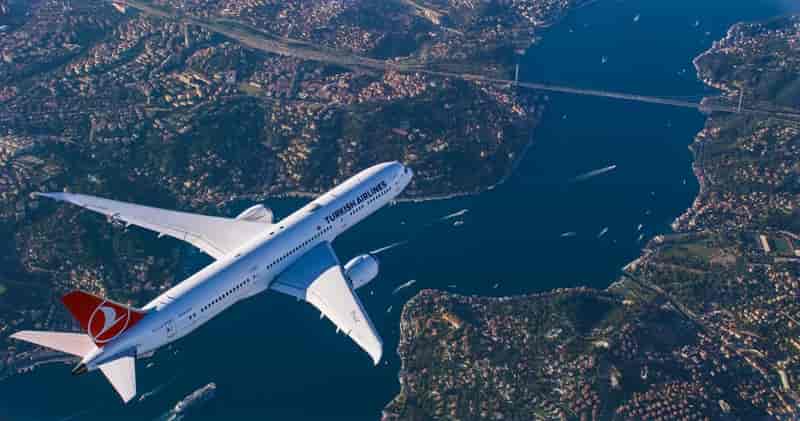
Turkish Airlines carried 9.5 million passengers in July 2026, rounding out another strong month for the group. Its total load factor reached 86.5%. Passenger numbers were up 4.6% from July 2025, when 9.0 million people flew with the group.
On international flights, the load factor was 86.2%. Domestic flights reached an even healthier 89.1%. Available seat kilometres (ASK), a key measure of airline seat supply, rose 2.7% to 25.7 billion.
Put simply, the group added more seats and still filled a larger share of them. In the peak summer rush, that is a handy result, particularly when empty airline seats have an unfortunate habit of earning precisely nothing.
Cargo also moved up. Turkish Airlines carried 203,100 tonnes of cargo and mail in July, up 4.9% from a year ago. International cargo and mail rose 5.3% to 197,900 tonnes. Domestic volumes, however, fell 9.9% to 5,200 tonnes.
Seven-month figures strengthen the story
The year-to-date numbers add considerably more weight to July’s performance.
From January to July, the group carried 54 million passengers. That was up 5.4% from 51.2 million during the same seven months of 2025. The total load factor climbed 2.1 percentage points to 84.2%, while ASK grew 4.7% to 161.2 billion.
International passenger traffic rose 6.2% to 35.4 million, while domestic traffic increased 3.8% to 18.6 million.
The Far East led the growth charge, with passenger numbers jumping 19.4% to 6.1 million. Europe rose a solid 9.2% to 18.8 million passengers. The Middle East travelled in the opposite direction, falling 17.6% to 4.2 million tonnes, proof, if the aviation business ever needed it, that global growth seldom follows a perfectly straight flight path.
Freight kept up its own brisk pace. Cargo and mail reached a more precise 1.3606 million tonnes in the first seven months, up 12% from 1.215 million tonnes in the comparable period in 2025.
Turkish Airlines fleet reaches 563 aircraft
By the end of July, the fleet stood at 563 aircraft, up from 491 a year earlier, a sizeable 14.7% increase. The group also served 358 destinations, five more than during the comparable period last year.
The consolidated traffic figures cover both the Turkish Airlines main brand and AJet operations.
For travel agents, corporate buyers and tourism partners, the message is clear. Turkish Airlines is adding seats, carrying more people and moving more freight. More importantly, it is not simply adding aircraft to the fleet. It is putting that extra capacity to work.
With 54 million passengers already carried by the end of July, Turkish Airlines heads into the remainder of 2026 with firm momentum behind it.
And judging by those load factors, not many empty seats are coming along for the ride.
By: Soo James – © 2026.
Read Time: 2 minutes.
Author Bio:
 There’s nothing rehearsed about Soo James, and that’s precisely the point. Malaysian by heritage, Sydney by schooling, she arrived at UNSW to study Arts, then took a left turn into IT, not out of ambition, but curiosity. Somewhere among systems and schedules, she worked out what really held her attention: people, language, and the quiet spaces between them.
Writing followed naturally. Travel and lifestyle gave her room to observe, to listen, to notice the details others rush past. Soo writes like good travellers do: watching the room before admiring the view, catching the gesture before chasing the headline.
At Global Travel Media, her stories don’t shout or sell. They linger. They slow you down, open a door, and gently suggest there’s more to see if you’re willing to look.











