

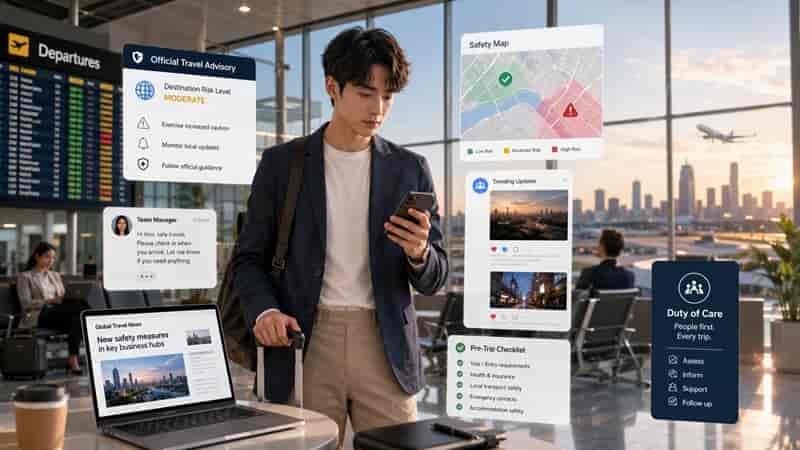
Gen Z travel risk is not a story about careless young travellers. Far from it. Younger business travellers think hard about personal safety, local conditions and what may go wrong on the road. What has changed is how they search for answers. It is also changing how employers should talk about risk.
That is Riskline’s key message after interviews with Gen Z travellers in Brazil and Europe. The company found that younger travellers use many sources before and during a trip. These can include official travel advice, news sites, Google, travel blogs, social media, workmates and people who have been there before.
For travel managers and employers, this matters to business travel safety. A sound risk policy has little value if a traveller cannot find it, follow it or use it at the right time.
“If your risk programme assumes it is the primary source of truth, that assumption is already outdated,” Riskline CEO Suzanne Sangiovese says.
Gen Z checks more than the company handbook
The old model was simple. Write a policy. Send it to staff. Add a training video. Then hope everyone remembers it when a problem starts.
Riskline’s work suggests that model is under strain.
Young travellers tend to cross-check what they see. Official advice may sit beside a news report, a Google search, a colleague’s view and social posts. That does not mean government advice has lost its value. It means official advice now competes for attention.
Riskline cites Booking.com for Business figures showing that 57% of Gen Z travellers use social channels such as TikTok and Instagram to shape travel choices. Perk’s Gen Z travel data also reports that 45% trust travel tips from influencers. About one in five use AI for tailored travel tips.
Those figures need care. Social media may inspire a trip, but it is not the same as formal safety advice. An influencer should never replace a foreign affairs agency. Even so, the numbers show where younger people already spend time and attention.
Australia’s Smartraveller service makes a similar point. The Department of Foreign Affairs and Trade now warns travellers to use trusted and official sources alongside AI tools and influencer content. Smartraveller gives advice on safety, health, local laws and entry rules. Travellers can also sign up for updates when advice changes.
The message is plain. The official voice still matters. It just has more noise around it.
How the message is delivered now matters
Travel risk has long favoured the big document. Add a long video, a few boxes to tick and a password nobody can recall, and the compliance job may look complete.
But a traveller in trouble does not need a fine-looking file. They need a clear answer.
Riskline’s interviews show that long videos and dense documents can lose younger users. One traveller, Yuri, put the point simply: “we need to speak to people”.
That does not mean Gen Z wants less detail. It means the detail must fit the moment.
Before a trip, staff may need a short country brief. They may need key phone numbers, transport tips, safe routes and clear links to official advice. During a trip, they may need a brief alert on a phone. It should say what changed, why it matters and what to do next.
That is the real test. Can a traveller grasp the risk while in an airport queue, a taxi or a hotel lobby?
If the answer sits on page 47 of a PDF, the risk plan may have created a risk of its own.
Make travel risk management work with younger travellers
Riskline says firms should involve younger staff when they review travel risk plans. That is a sound idea.
Young employees can test travel risk management alerts. They can read policy wording and flag what is vague. They can join risk drills. They can also tell managers what facts they need before a trip and what they need once they arrive.
This is not about handing travel safety to TikTok. Nor is it about letting peer views overrule expert advice. Formal controls still matter. So do verified risk data and official government warnings.
The aim is to make the system easier to use.
That approach fits the broader aims of ISO 31030:2021. The international standard gives guidance for organisations that manage travel risk. It covers policy, programme development, threat and hazard identification, risk assessment, prevention, mitigation and review.
The key point is simple. A travel risk plan should stay alive. It should change as the traveller, the trip and the threat change.
The real test starts after arrival
Pre-trip planning is vital. But risk does not stop when the plane lands.
A protest can block a road. Bad weather can halt trains. A safe route at noon may not feel the same at midnight. A hotel, driver or meeting point may need to change at short notice.
Riskline gives the case of a traveller in Baja California, Mexico. He said he had to work out safer areas and transport choices after he arrived. Much of that work was left to him.
That is where duty of care moves from paper to practice.
Employers should ask some basic questions. Can staff get fresh advice during the trip? Do they know who to call? Are alerts clear enough to trigger action? Can the company reach the traveller fast if conditions change?
A stream of vague alerts is not good enough. Nor is silence.
What can travel managers do now?
There is no need to throw out the company risk plan because a young traveller prefers a phone to a binder. The plan needs to be modernised.
Start with the user. Ask staff to test the pre-trip brief. Cut repeated text. Put the most urgent facts first. Make links to official sources easy to find. Keep contact details current. Use short alerts when risk changes.
Peer knowledge can help too. A staff member who visited the same city last week may have useful tips about drivers, routes and local habits. That lived experience can add context. It should not replace verified advice.
The same rule should apply to AI. It can help sort facts, build a checklist or explain a term. But it can be wrong, old or incomplete. Check any safety claim against a trusted source.
That hierarchy matters. Speed is useful. Verified facts are better.
For travel managers, a governance issue also lurks beneath all this shiny technology. If employees are turning to AI, social media and informal networks, companies should know where those sources fit within their official risk process.
A sensible hierarchy can remove much of the confusion.
Government travel advisories and verified security intelligence should sit at the core. Company policy should translate those risks into practical action. Peer experience can add local context. AI and social media may help identify questions, trends or breaking events, but they should be checked before a traveller acts on them.
That is not old-fashioned bureaucracy. It is good risk management.
Safety information has entered the attention economy
Another uncomfortable truth for corporate travel departments.
Safety advice now competes with almost everything else on a traveller’s phone.
Boarding passes, hotel apps, WhatsApp messages, calendar alerts, airline notifications, expense tools, emails, and social feeds all demand attention. A 14-page security briefing may be worthy, accurate and painstakingly prepared. It can still sink without a trace.
That makes design part of the duty of care.
Important information should be easy to scan. Key actions should appear first. Language should be plain. Alerts should explain what has happened, where it matters and what the traveller should do.
The objective is not to dumb down safety advice. It is to remove the fog around it.
After all, nobody has ever been made safer by a beautifully formatted paragraph they did not read.
Gen Z is forcing a useful question
Riskline’s interviews are qualitative. They should not be treated as a survey of every Gen Z traveller. That distinction matters.
But the findings raise a wider point that travel managers should not ignore.
Business travellers now expect advice to be current, brief, mobile and useful at the point of need. Gen Z may simply make that gap easier to see.
For employers, travel management companies and the wider corporate travel sector, this is less a generational rebellion than an overdue test of whether long-standing systems still work as intended.
The strongest travel risk programmes will not abandon formal advice. They will make it easier to find. They will not surrender to social media. They will understand how travellers use it. And they will not mistake issuing a policy for communicating one.
For the travel trade, the lesson is clear. Duty of care is not only about having good information. It is about getting trusted information to the traveller in a form they can use.
The corporate travel manual is not dead.
It may simply need fewer pages, a better phone screen and, heaven forbid, a human conversation.
By: Michelle Warner – © 2026.
Read Time: 5 minutes.
Author Bio:
 Michelle Warner has always carried stories the way others carry passports lightly, faithfully, and with purpose. She learned her craft in newsrooms, shaping sentences with care, before swapping deadlines for departures as a flight attendant with some of the world’s great airlines. Years aloft sharpened her eye for character and deepened her fondness for the small, dignified rituals of travel, the quiet kindness of strangers, the poetry of arrival, the patience learned between time zones.
Now grounded by choice, Michelle has come home to writing with the same calm authority she once brought to turbulent cabins. Her prose blends an editor’s discipline with a traveller’s wonder, tinged with humour and reverence for the golden age of travel. Each piece feels like a handwritten boarding pass, gracious, observant, and unmistakably alive.











