

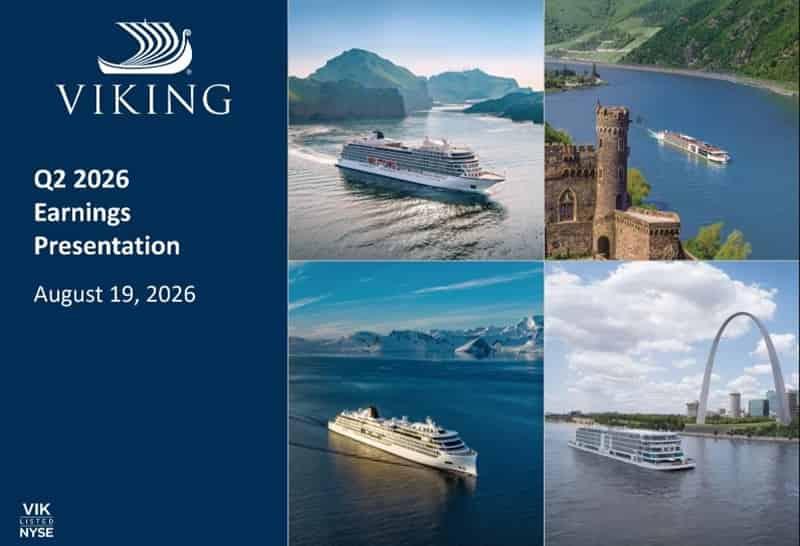
Viking has sailed into the second half of 2026 with the sort of numbers that make accountants smile, and competitors reach for a stronger coffee.
The cruise and experiential travel group reported second-quarter revenue of US$2.1905 billion, up 16.5 per cent year on year, as fleet growth, higher revenue per passenger cruise day and strong demand pushed the business firmly ahead. Adjusted EBITDA climbed an even faster 18.2 per cent to US$748.4 million, while net income rose to US$587.7 million, from US$439.2 million a year earlier.
For a company whose brand is built around measured exploration rather than pool-deck pyrotechnics, the financial performance speaks for itself.
Viking’s bigger fleet is earning its keep
Viking’s Capacity Passenger Cruise Days increased 10.9 per cent in the quarter, largely because of its expanding fleet. Occupancy reached 94.4 per cent.
Gross margin rose 15.7 per cent to US$928.8 million, while Adjusted Gross Margin increased 16.3 per cent to US$1.4389 billion. Net Yield advanced 6.2 per cent to US$645.
Those figures matter because they show growth coming from more than simply adding ships. Viking is also generating higher revenue per passenger cruise day, a useful sign for a business carrying the considerable cost of an ambitious newbuild program.
President and CEO Leah Talactac said the quarter reflected “the continued execution of our long-term strategy and the strength of the Viking brand”. She also pointed to strong demand for Viking’s destination-focused offering, fleet expansion and new land extensions and shore excursions as contributors to future growth.
That’s the corporate version.
In travel-trade language, Viking is putting more berths into the market, filling nearly all of them and persuading guests to spend more around the core cruise experience.
That combination is about as welcome as discovering you’ve been upgraded at check-in.
96 per cent sold and that deserves attention
The booking book may be the most striking part of Viking’s announcement.
As at 9 August 2026, Viking had sold an extraordinary 96 per cent of Capacity Passenger Cruise Days for its Core Products for the 2026 season.
Those Core Products comprise Viking River, Viking Ocean, Viking Expedition and Viking Mississippi, marketed across North America, the United Kingdom, Australia and New Zealand.
And Viking isn’t merely polishing off this year’s inventory.
For 2027, it had already sold 53 per cent of Core Product capacity, despite operating capacity being scheduled to rise 15 per cent compared with 2026.
Advance Bookings stood at US$6.386 billion for the 2026 season, 13 per cent above the comparable booking position for 2025. For the 2027 season, Advance Bookings had already reached US$4.711 billion, up 21 per cent from the 2026 season at the equivalent point.
Advance Bookings per passenger cruise day were heading in the same direction. The 2026 figure stood at US$833, up 6 per cent, while 2027 reached US$958, up 10 per cent.
In other words, ships are filling up well ahead of departure, while the value of those advance bookings per capacity day is also rising.
Cruise executives tend to find that a rather agreeable combination.
One important wrinkle in those booking billions
However, there is an important distinction for anyone reading the figures with an investor’s eye rather than a traveller’s sunglasses.
Viking defines Advance Bookings as the aggregate ticketed amount of guest bookings at a particular point in time. They include cruises, land extensions and air.
They are not the same as revenue already recognised in Viking’s financial accounts.
Even so, those bookings provide unusually strong visibility into forward demand.
Chief Financial Officer Linh Banh said Viking was “in a strong position for the balance of the year”, adding that its 2027 position reinforced management’s confidence in the company’s long-term growth prospects.
For travel advisers, wholesalers and cruise specialists, that’s more than corporate optimism. Forward capacity being absorbed this early can affect availability, selling windows and the wisdom of telling clients, “Don’t worry, we’ll book it later.”
Later has a nasty habit of becoming sold out.
US$4 billion in the Viking war chest
Viking’s balance sheet provides another significant part of the story.
At 30 June 2026, the company held approximately US$4.0 billion in cash and cash equivalents and had an undrawn US$1.0 billion revolving credit facility.
Deferred revenue stood at approximately US$5.0 billion. Scheduled principal payments were US$116.7 million for the remainder of 2026 and US$233.7 million for 2027.
Net leverage stood at 1.2 times, compared with 1.0 times at 31 March.
That’s worth watching as Viking continues pouring capital into new ships. However, its cash position, available credit, and substantial forward bookings give the company considerable financial room to manoeuvre.
Another financial footnote is worth keeping aboard.
Adjusted EBITDA, Adjusted Gross Margin and Net Yield are management performance measures rather than straightforward IFRS accounting line items. They’re useful for comparing operating trends, but sensible readers should consider them alongside Viking’s statutory accounts rather than treating them as substitutes. Viking spells out those definitions in its results.
Viking Mira joins an accelerating fleet
Then there are the ships themselves, and Viking’s shipyards certainly aren’t being troubled by inactivity.
Since its first-quarter earnings release, Viking has taken delivery of the Viking Mira, its latest ocean vessel, along with four new river ships.
The Viking Annar, Viking Fjolvar and Viking Dagur will operate in Europe, while Viking Ptah will operate in Egypt.
Viking has also exercised options for two additional ocean ships scheduled for delivery in 2032.
Its committed orderbook calls for another ocean ship and five river vessels to arrive during the remainder of 2026.
The Viking Mira joined the fleet in May, taking Viking’s ocean fleet to 13 ships as at 30 June 2026. The company says its overall operation now comprises more than 100 ships, exploring 21 rivers, five oceans and all seven continents.
That’s quite a journey for a company that began operations with four Russian river ships in 1997.
Why travel advisers should care
For travel advisers, the commercial message is straightforward.
More ships mean more sellable inventory.
Normally, rapid capacity growth can raise an uncomfortable question: can demand keep pace without prices being trimmed to fill cabins?
Viking’s current figures provide some reassurance. Core capacity is increasing, yet the company reports exceptionally high forward bookings, while Advance Bookings per PCD are also rising.
That doesn’t guarantee smooth sailing forever; no tourism business comes with that kind of warranty, but it suggests demand is keeping pace with expansion rather than Viking merely buying growth with discounted cabins.
The quarter also reinforces how deliberately different Viking remains from much of the mainstream cruise business.
Its proposition revolves around destination immersion, culture, history, science and food rather than waterslides, go-karts and enough neon to illuminate a medium-sized Australian suburb.
It isn’t trying to be everything to everybody.
That narrower proposition may reduce the potential audience, but it also gives Viking unusually clear brand positioning something travel advisers can explain without needing a 14-page PowerPoint presentation and emergency caffeine.
Even Viking’s occupancy needs translating
There’s also a fascinating wrinkle in Viking’s 94.4 per cent occupancy result.
Viking doesn’t calculate occupancy quite like some of its competitors.
The company does not permit more than two passengers to occupy a two-berth stateroom, while solo travellers may occupy those same double cabins.
Consequently, Viking’s occupancy cannot exceed 100 per cent. Other cruise groups using third and fourth berths can report occupancy figures above 100 per cent.
That makes Viking’s 94.4 per cent occupancy particularly solid and means casual comparisons with competitors should be treated with care.
Not every number is wearing a party hat
This growth naturally comes with costs.
Vessel operating expenses increased 17.1 per cent to US$442.3 million during the quarter. Excluding fuel, operating expenses rose 13.9 per cent to US$380.9 million.
Fleet expansion was the main driver.
New vessels require enormous amounts of capital. Fuel prices remain unpredictable. Geopolitical events can reroute ships, alter itineraries and generally give cruise planners the sort of excitement they would rather leave to their passengers.
Nevertheless, Viking’s underlying Q2 picture is difficult to dismiss.
Revenue is growing faster than capacity.
Adjusted EBITDA is growing faster than revenue.
Bookings already stretch deep into 2027.
And about US$4 billion sits in cash and cash equivalents.
That’s a tidy collection of green lights.
For the Australian travel trade, perhaps the most telling number remains the simplest: 96 per cent of Viking’s 2026 Core Product capacity was already sold by early August.
If clients have their hearts set on a particular Viking itinerary, cabin or departure, the numbers suggest “I’ll think about it for another few months” may not constitute a sophisticated booking strategy.
Viking may be famous for taking travellers gently along the great rivers, coastlines and cultural capitals of the world.
Financially, however, it’s moving at a considerably brisker pace.
By: Michelle Warner – © 2026.
Read Time: 5 minutes.
Author Bio:
 Michelle Warner has always carried stories the way others carry passports lightly, faithfully, and with purpose. She learned her craft in newsrooms, shaping sentences with care, before swapping deadlines for departures as a flight attendant with some of the world’s great airlines. Years aloft sharpened her eye for character and deepened her fondness for the small, dignified rituals of travel, the quiet kindness of strangers, the poetry of arrival, the patience learned between time zones.
Now grounded by choice, Michelle has come home to writing with the same calm authority she once brought to turbulent cabins. Her prose blends an editor’s discipline with a traveller’s wonder, tinged with humour and reverence for the golden age of travel. Each piece feels like a handwritten boarding pass, gracious, observant, and unmistakably alive.











