

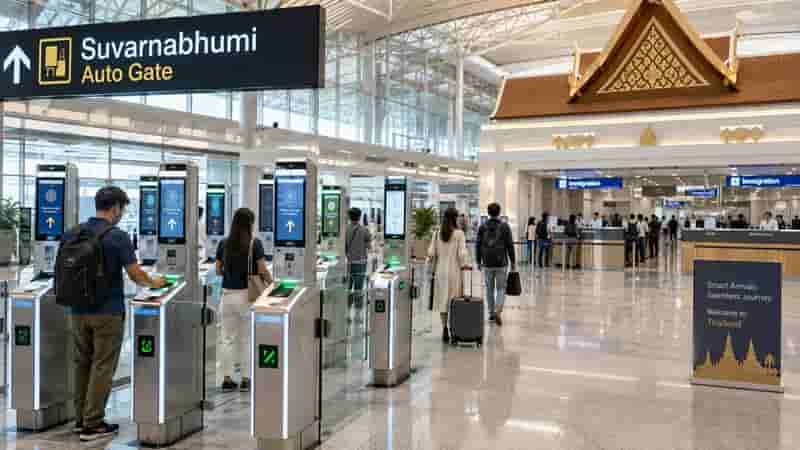
Thailand is preparing to tackle one of Suvarnabhumi Airport’s most stubborn passenger pain points with a technological push: the immigration queue.
The Immigration Bureau has approved in principle an expansion of Suvarnabhumi’s automated passport-control, or Auto Gate, system to passport holders from 31 additional nationalities. Final signatures were still pending when the plan was announced on 17 August, with the newer government timetable pointing to implementation by the end of August 2026.
That last detail matters.
Treat the expansion as imminent, not already universal. Nor have authoritative sources checked for this article released a final public list of the 31 additional nationalities.
For Australian travel sellers, that means one thing: do not yet tell clients that an Australian passport definitely qualifies for the expanded arrival gates.
It is a small distinction on paper and a very large one when a traveller is standing at immigration after an overnight flight.
A newer timetable for a longer-running push
The August announcement sharpens a program Thailand had already been moving forward.
On 17 July, the Tourism Authority of Thailand said the Ministry of Tourism and Sports, Immigration Bureau and Airports of Thailand were accelerating measures to improve passenger flow at Suvarnabhumi. That official update said a second phase of automated passport-control expansion was scheduled for September 2026.
The 17 August announcement therefore appears to bring that timetable forward, with authorities now aiming for the end of August, subject to the remaining formal approvals and system readiness.
That is worth spelling out because the July and August dates are not identical.
The later announcement is the more current timetable, but it is still a target rather than a date carved into the terminal floor.
And Suvarnabhumi has every reason to hurry.
The afternoon crunch
During peak tourism periods, Suvarnabhumi handles around 190,000 passengers a day. In quieter periods, the figure falls to roughly 140,000 to 150,000.
That wording is deliberate.
The 190,000 figure describes peak-period passenger traffic. It should not be confused with the airport’s formal design or certified passenger capacity.
International inbound traffic averages about 70,000 passengers daily, but the real pressure builds between 1 pm and 5 pm. During that afternoon window, immigration halls can face 5,000 to 6,000 arriving passengers an hour.
That is less a queue than a travelling population temporarily acquiring its own postcode.
The government’s response is not simply to install more machines and admire them.
Authorities are also looking to use the airport’s three immigration zones better, opening central space to disperse crowds and moving additional immigration officers into position during heavy arrival waves.
The Auto Gate expansion is the more eye-catching part of the plan because it could shift a significant share of routine passport processing away from staffed counters.
Officials estimate the wider eligibility rules could add about 6.5 million potential Auto Gate users each year, alongside around 900,000 holders of certain long-term visas.
When the system is fully operating, officials expect as many as 53 per cent of arriving international passengers to use automated gates. The remaining 47 per cent would continue through immigration officers.
That has obvious operational value.
Every straightforward, eligible passenger processed automatically is one less routine transaction competing for an officer’s time.
Biometrics are the key
The rollout is expected to be phased according to equipment readiness, biometric database integration and security checks.
Travellers who have previously entered Thailand and already have biometric information in the system are expected to gain access first. First-time visitors will still need to undergo biometric registration before becoming eligible for automated processing.
That is a more precise way of putting it than assuming every first-time visitor must follow one fixed sequence through a particular staffed counter.
The principle is clear: automated processing depends on having usable biometric data that can be matched to the traveller.
The technology itself is not new to Suvarnabhumi.
Airports of Thailand says its Automated Border Control system combines biometric technology with e-passport readers to automate identity verification, reduce queuing, ease terminal congestion and strengthen security.
AOT has also developed a broader digital passenger-processing ecosystem that includes self-check-in kiosks, self-service bag drop, passenger validation systems, self-boarding gates and biometric identity verification.
In other words, the airport is moving steadily towards the same basic proposition now shaping major hubs around the world: use technology for predictable transactions and reserve human judgement for cases that genuinely require it.
That is not about removing people from airports.
It is about stopping highly trained people from spending too much of their day doing work a secure machine can perform reliably.
Singapore and Hong Kong already point the way
The official July update said automated arrival channels at Suvarnabhumi were already available to eligible passport holders from Singapore and Hong Kong.
Thailand has previously operated automated immigration arrangements involving those markets, while the latest expansion is designed to push arrival automation much further.
TAT said in July that expanded automated passport-control capacity was expected to reduce congestion in immigration areas by more than 50 per cent.
Tourism and Sports Minister Surasak Phancharoenworakul framed the issue neatly:
“Our priority is to ensure that Suvarnabhumi Airport serves as an international gateway that delivers a strong first impression.”
It is a simple line, but an important one.
Airports are national front doors.
A destination can spend millions advertising beaches, cuisine, spas and five-star hotels, but the first practical impression may still be fluorescent lighting and a slow-moving passport queue.
Better ways to begin a holiday exist.
Why the travel trade should care
For travel agents and advisers, this is not merely an airport-operations story.
If Thailand succeeds in moving a larger share of passengers through immigration more quickly, the benefits should flow down the line: tighter airport transfers become less stressful, hotel arrivals become more predictable, and tour connections become easier to manage.
And travellers begin their holiday in a rather better mood.
The economic argument is equally straightforward. Thai officials themselves have linked smooth airport arrivals with activity across airlines, transport, hotels, restaurants, retail and other tourism services.
A visitor who has cleared immigration can start moving, connecting and spending.
A visitor standing motionless in a queue is, economically speaking, mostly admiring the back of somebody else’s shirt.
Deputy Prime Minister and Commerce Minister Suphajee Suthumpun led the high-level 17 August inspection, with Tourism and Sports Minister Surasak Phancharoenworakul and senior transport officials also involved.
That level of involvement reflects the broader importance the government places on the arrival experience at Thailand’s main international gateway.
Suvarnabhumi is not merely a building where aircraft park.
It is a major piece of tourism infrastructure, and its efficiency forms part of Thailand’s competitive proposition to international travellers and airlines.
Don’t confuse Auto Gates with TDAC
Travel sellers should make another point very clear to clients.
Auto Gate eligibility does not replace Thailand’s entry requirements, and it does not replace the Thailand Digital Arrival Card.
The TDAC was introduced on 1 May 2025, replacing the traditional paper TM.6 arrival card. Thailand’s Immigration Bureau requires non-Thai nationals entering the Kingdom to complete the digital arrival process.
There are limited exceptions. These include travellers transiting or transferring through Thailand without passing through immigration control, and people entering using a Border Pass.
The official TDAC service is free. Thailand’s Immigration Bureau has also warned travellers to beware of fake websites and scammers seeking fees or personal information.
That warning deserves emphasis.
A faster immigration gate is not a visa.
It is not an arrival card.
And it is not an exemption from border formalities.
It is simply a faster processing channel for travellers who meet the eligibility conditions.
The distinction is not especially glamorous, but neither is discovering it while standing in the wrong queue.
What happens next?
The most important missing piece is now the final list of the 31 additional nationalities.
Until that list is formally published, travel agents, airlines and passengers should resist guessing which countries will be included.
Officials have said selection considered immigration rejection statistics, the Henley Passport Index and national-security factors.
That may give the market clues.
Clues, however, are not immigration rules.
The second point to watch is timing.
The August announcement targets the end of the month, but the rollout depends on final signatures, equipment readiness, biometric integration, and security checks.
So the sensible editorial position is neither scepticism nor premature celebration.
It is cautious optimism.
Suvarnabhumi has a genuine congestion problem during heavy arrival periods. Thailand has identified a practical way to move a much larger share of eligible travellers through immigration automatically. The official estimates suggest the effect could be substantial.
If the plan lands as intended, officials expect more than half of inbound international passengers to be able to use Auto Gates eventually.
That will not make airport queues disappear entirely.
Airports, like taxes and relatives at Christmas, have a habit of finding ways to remain part of life.
But if Thailand can turn one of Suvarnabhumi’s most visible bottlenecks into a quicker, cleaner arrival experience, it will have achieved something far more useful than another glossy terminal promise.
It will have given travellers back time.
And at the end of a long-haul flight, that may be the most welcome Thai hospitality of all.
By: Prae Lee – © 2026.
Read Time: 7 minutes.
Author Bio:
 You can tell a great deal about a person by how they meet a Bangkok morning. Prae Lee doesn’t charge into it; she glides, unhurried, as if time itself has agreed to behave. There is a calm assurance about her, the sort earned by knowing both your roots and your destination.
A graduate of Chulalongkorn University, she took her business degree with quiet pride, then polished it further in Singapore and Australia. Travel didn’t change her. It refined what was already there: curiosity, discipline, grace.
Back in Bangkok, she slipped modern life into the family business, mastering social media with an instinct for listening and selling with Thai gentleness.
Prae never seeks attention, yet everything she touches grows brighter.
Now with Global Travel Media, she writes with authenticity, drawing on culture, travel and a rare, steady confidence.












Trackbacks/Pingbacks