

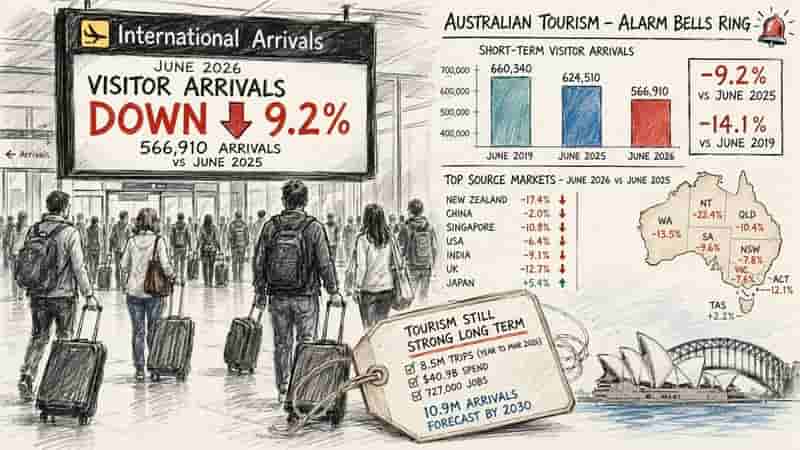
Australia’s inbound tourism recovery has hit a decidedly uncomfortable patch of turbulence, with the latest Australian Bureau of Statistics figures showing short-term international visitor arrivals falling 9.2 per cent year-on-year in June 2026.
The headline number is difficult to ignore.
Australia recorded 566,910 short-term visitor arrivals in June, down 57,600 trips from 624,510 in June 2025. More sobering still, the June result remained 14.1 per cent below the 660,340 arrivals recorded in June 2019, before COVID-19 rearranged global tourism with all the subtlety of a baggage trolley through a glass door.
For an industry that has spent years talking about recovery, rebuilding and return, June is a reminder that tourism rarely travels in a straight line.
It is not a collapse. It is not evidence that Australia has suddenly fallen off the world tourism map.
But it is a genuine warning that the easy post-pandemic gains are behind us and that international demand cannot be taken for granted.
The broader trend remains considerably healthier than June alone suggests.
Adding the ABS monthly short-term visitor data for the 12 months to June 2026 gives approximately 9.1 million arrivals, around 8.3 per cent higher than the preceding 12 months. That rolling total remains about 2.6 per cent below the comparable 12 months ending June 2019.
The figures come from the ABS monthly arrivals series.
That distinction matters.
One poor month can ring alarm bells without setting the building on fire.
The big source markets mostly went backwards
The June weakness was unusually broad across Australia’s major inbound markets.
New Zealand remained the country’s biggest source of short-term visitors, but arrivals fell from 119,730 in June 2025 to 98,960 this June.
China slipped from 60,200 to 58,970, while Singapore dropped from 60,860 to 54,260.
The United States eased from 51,750 to 48,440. India fell from 36,770 to 33,440, while the United Kingdom declined from 27,900 to 24,340.
Indonesia, South Korea and the Philippines also finished below their June 2025 levels.
Japan was the conspicuous exception among the top 10 markets, with arrivals increasing from 21,570 to 22,730.
No single villain is behind those figures.
Source-market performance is shaped by air capacity, exchange rates, consumer confidence, school holidays, economic conditions, geopolitical uncertainty, competing destinations and the simple question every traveller eventually asks: what will this holiday cost me?
Australia has an extraordinary tourism proposition.
It also has the geographical inconvenience of being a long-haul journey from many of the world’s largest markets.
That means price, frequency and convenience matter enormously.
A postcard may sell the dream.
The airfare still has to close the deal.
The states felt the chill
The downturn was also widespread across Australia’s states and territories.
New South Wales remained the largest destination, receiving 200,580 short-term visitor arrivals in June, but that was 7.8 per cent lower than a year earlier.
Victoria fell 7.6 per cent to 141,070.
Queensland dropped 10.4 per cent to 133,290, South Australia declined 9.6 per cent to 14,180, and Western Australia fell 13.5 per cent to 61,060.
The Northern Territory recorded the sharpest percentage fall, down 22.4 per cent to 5,510 arrivals, while the ACT was down 12.1 per cent to 6,110.
Tasmania was the lone bright spot, rising 2.2 per cent to 5,100 arrivals.
Those state figures matter well beyond an airport arrivals hall.
Inbound visitors fill hotel rooms, book tours, rent cars, eat in restaurants, join cruises, buy attraction tickets and disperse spending through regional economies.
A decline in international arrivals therefore reaches across a wide travel and hospitality supply chain.
For travel sellers and wholesalers, it also changes where the pressure sits.
Markets that were previously expected to deliver effortless growth may now require stronger offers, better packaging and more active trade support.
Spending still tells a powerful story
The arrival figures should not obscure one of the strongest parts of Australia’s tourism recovery: visitor spending.
Tourism Research Australia’s International Visitor Survey recorded 8.5 million international trips in the year ending March 2026, up 10 per cent on the previous year.
International visitors spent $40.9 billion in Australia, up 20 per cent.
Holiday travel accounted for 3.7 million trips and $13.5 billion in spending.
Visiting friends and relatives generated 2.8 million trips and $5.5 billion, while education travel accounted for 554,000 trips and $15.3 billion in expenditure.
That is an important reminder that tourism success cannot be measured by headcount alone.
A visitor who stays longer, travels more widely and spends more can be vastly more valuable than a quick stopover recorded in the same arrivals column.
Australia’s visitor economy is already a major national industry.
Tourism Research Australia reports that tourism contributed $81.1 billion to GDP in 2024–25, representing 2.9 per cent of Australia’s economy.
Tourism employment stood at 727,000 jobs in March 2026, or 4.5 per cent of all Australian jobs.
Those are not decorative statistics.
They explain why a 9.2 per cent monthly fall deserves attention.
Competition has become ferocious
Australia is not recovering in isolation.
Japan continues to attract extraordinary international demand.
Thailand remains a tourism heavyweight.
Vietnam is expanding quickly.
Singapore has built a formidable combination of aviation, events, hospitality and stopover appeal.
New Zealand continues to compete aggressively for long-haul travellers who could just as easily turn left at the Tasman.
Then there are Europe, North America, the Gulf and an expanding list of Asian destinations investing heavily in aviation partnerships, hotels, tourism infrastructure and destination marketing.
The traveller has never had more choice.
Australia cannot simply assume that a kangaroo, a reef and a harbour bridge will finish the sale.
They certainly help.
But today’s traveller also compares airfares, hotel prices, exchange rates, visa processes, connectivity, events, food, safety, service and the number of memorable experiences that can be squeezed from a holiday budget.
For Australian tourism, that makes competitiveness a daily discipline, not an advertising slogan.
The next phase has to be earned
The June numbers arrive at a particularly important moment because the long-term outlook remains positive.
Tourism Research Australia forecasts international visitor arrivals will reach 10.9 million by 2030, with international visitor spending climbing to $46 billion.
Total visitor spending, including domestic tourism, is forecast to reach approximately $233 billion by 2030.
Those projections provide every reason for confidence.
They are not, however, a permission slip for complacency.
Forecasts are built on assumptions about demand, aviation, economic conditions and traveller behaviour.
As every travel agent knows, assumptions are delightful things right up until somebody changes the flight schedule.
Australia’s task is now more demanding than simply rebuilding lost volume.
The country needs sufficient international air capacity, strong source-market campaigns, competitive pricing, compelling events, continued hotel and attraction investment and better dispersal of visitors beyond the traditional gateways.
It also needs the travel trade.
Travel agents, wholesalers, inbound tour operators and destination specialists remain vital in converting aspiration into bookings, particularly for long-haul visitors planning complicated itineraries.
Regional destinations, smaller tourism businesses and new products frequently depend on that distribution network to reach international travellers who may never discover them through a search box alone.
Warning bell, not funeral bell
So, should Australian tourism be alarmed?
Concerned, certainly.
Panicked, no.
June’s 9.2 per cent fall is significant because it was broad, most major source markets weakened, and seven of Australia’s eight states and territories recorded year-on-year declines.
But it sits inside a wider recovery that remains fundamentally strong.
Rolling 12-month arrivals are still well above the preceding year, visitor spending is surging and official forecasts continue to point towards further growth.
The sensible response is neither to shrug off June nor to turn it into an obituary.
Treat it as a timely warning.
Australia’s tourism assets remain world-class.
Its cities are sophisticated, its landscapes extraordinary, its food and wine increasingly powerful drawcards and its Indigenous culture offers experiences found nowhere else on Earth.
Yet tourism reputations, however strong, do not travel on autopilot.
The June figures say the next stage of recovery will need sharper marketing, competitive air access, trade engagement, value, service and relentless attention to what motivates travellers to choose one destination over another.
Australia is still very much in the race.
But June has blown the whistle.
Now comes the part where everybody has to run.
By: Stephen Peters – © 2026.
Read Time: 6 minutes.
Author Bio:
 Stephen Peters has spent much of his career proving that the straight-and-narrow path is considerably overrated. Armed with a Bachelor’s degree in Technology from the University of Queensland and a Master’s in Management, he first ventured into hospitality, working in and helping open several five-star hotels across Sydney and Asia.
After deciding he had experienced quite enough of five-star hospitality from the operational side of the desk, Stephen returned to technology, working with major US tech companies while based between Australia and Asia.
Then came the ultimate change of scenery. Stephen built his own yacht and, with his family aboard, sailed from Florida through the United States and its Great Lakes before crossing the Pacific to Asia. Several memorable years followed, exploring Indonesian waters before the Peters family eventually returned to Australia with considerably more sea miles, stories and perspective than when they left.











