

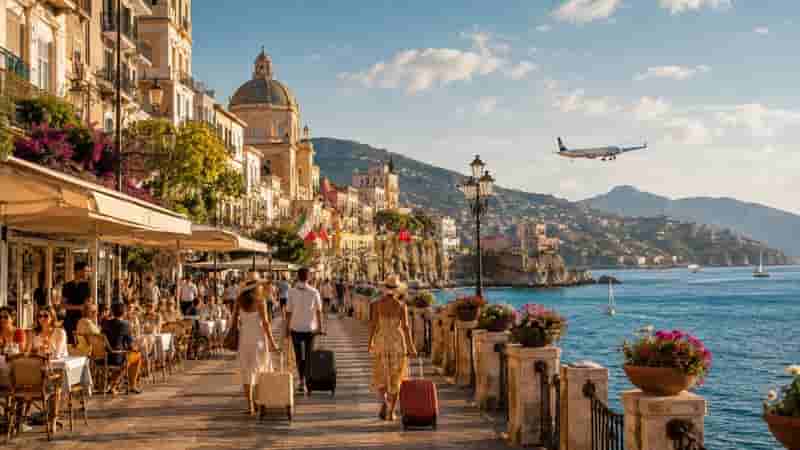
Europe still sells.
Europe has done it again. While travellers chased Mediterranean sun, good food and a seat with a view, the continent quietly took command of the world’s holiday wallet.
New 2026 data from the World Travel & Tourism Council (WTTC) shows Europe drew US$2 trillion in leisure travel spending in 2025. That was about one dollar in every three spent on leisure trips worldwide. Global leisure spending reached US$6.15 trillion, up 3.5 per cent from 2024, and made up 80.5 per cent of all global travel spending.
Those are big numbers, but the message is simple. Europe still sells.
Southern Europe owns the momentum
The latest WTTC Economic Impact Research, sponsored by Chase Travel as Lead Research Partner, puts Southern Europe at the heart of that strength. France, Spain, Italy and Türkiye remain key summer drawcards. Their appeal is broad: beaches, food, culture, history, shopping, nightlife and strong air links. Few regions can offer so many reasons to book another week.
In 2025, leisure spending rose 3.6 per cent in France, 2.6 per cent in Spain and 2.2 per cent in Italy. WTTC now expects Europe’s leisure spending to rise another 3.7 per cent in 2026. That would beat the global average of 3.1 per cent.
Italy is forecast to lead the next phase, with leisure spending up 4.7 per cent. Spain follows at 4.3 per cent, Türkiye at 4.1 per cent and France at 2.6 per cent.
For travel advisers, airlines, hotels and tour operators, that matters. It suggests Europe’s boom is not just a short-lived summer rush. Demand remains deep, and Southern Europe is in the best seat at the table.
WTTC also says some demand is being redirected from other parts of the world. That gives Southern Europe another lift as travellers weigh value, access and risk before they book.
The wider picture is also strong. WTTC forecasts Travel & Tourism GDP across Europe to grow 3.6 per cent in 2026. International visitor spending across the region is expected to rise 7.1 per cent. By contrast, the wider European economy is forecast to grow by about 1 per cent.
A boom with a bill attached
Success, however, has a price.
Airports, rail systems, roads, hotels and public spaces all face more pressure when visitor numbers rise. So do residents in the busiest cities and coastal areas. A full hotel is good business. A destination that feels full every day of the year is a harder sell.
That is why WTTC’s call for more investment in infrastructure, air access and sound destination management deserves attention. Growth must be managed, not merely admired.
Gloria Guevara, WTTC President & CEO, said:
“With summer travel at its peak, Europe continues to set the pace for global leisure tourism, capturing one-third of all spending worldwide and demonstrating the strength, diversity and resilience of its tourism sector.
“Southern Europe remains the engine of this growth. Destinations such as Spain, Italy, France and Türkiye continue to attract strong international demand thanks to their unique visitor experiences, excellent connectivity and competitive tourism offerings.
“With millions of travellers currently holidaying across the continent, it is essential that destinations continue investing in infrastructure, connectivity and sustainable tourism management to support future growth and maintain their global competitiveness. The outlook for 2026 shows Europe is well positioned to continue leading global Travel & Tourism.”
The quotation above has been checked against WTTC’s official published statement and retained verbatim.
Why the numbers matter
One useful detail lies behind the headline figures. Leisure spending is not the same measure as Travel & Tourism GDP. WTTC’s Economic Impact Research, produced with Oxford Economics, tracks several measures. These include GDP, jobs, domestic and overseas visitor spending, leisure and business spending, and investment.
That matters because the US$2 trillion figure is not simply a count of arrivals. It shows the scale of spending by leisure travellers across the European visitor economy.
WTTC also cautions that its 2026 forecasts reflect economic and geopolitical conditions at the time of publication. Inflation, energy prices, consumer demand and regional events can all shift the outlook.
What it means for the travel trade
For Australian travel sellers, the commercial signal is clear. Europe should remain a powerful outbound market, especially Italy, Spain, France and Türkiye. Strong demand can mean tighter air seats, higher room rates and less choice in peak periods. Early booking may again prove to be the traveller’s best friend.
Europe’s problem is no longer whether people want to go.
They do, in very large numbers.
The harder task is keeping the experience worth paying for. If Europe can grow without wearing out the places that make it special, its grip on the global leisure market may become even stronger.
By: Jason Smith – © 2026.
Read Time: 4 minutes.
Author Bio:
 Jason Smith didn’t learn travel from textbooks. He learned it in airports, taxis and hotel lobbies, watching the business unfold long before he played his own part. Half American, half Asian, he grew up around the quiet workings of tourism, where people come and go, and stories rarely stand still.
Bangkok came first, then formal study, then a career that carried him through Singapore, Malaysia and Vietnam. Each place left something behind. In the end, Thailand felt like home, along with a senior role in hotel sales.
Then everything stopped. Borders shut, planes grounded, and Jason found himself back in America with time to reflect.
Now at Global Travel Media, he writes travel as it really is, not polished, not perfect, but human, and all the better for it.











