

Thailand’s long-running visitor fee has returned. This time, it comes with a higher price and a clearer launch path.
But travellers heading to Bangkok, Phuket, Chiang Mai or the islands can keep their baht in their pockets for now.
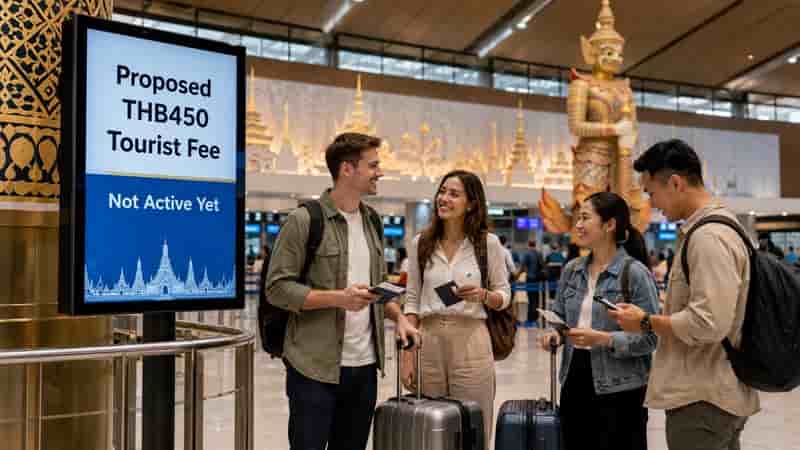
The proposed THB450 tourism entry fee is not yet payable.
Thailand’s Government Public Relations Department confirmed the new plan on 17 August 2026. The Ministry of Tourism and Sports is preparing a flat THB450 fee for foreign visitors. It would apply whether they arrive by air, land or sea.
That replaces an earlier model of THB300 for air arrivals and THB150 for land and sea arrivals.
The headline is simple. The legal position is not.
The plan has moved forward, but it still needs to clear approval steps. It should not be described as a fee that tourists must pay today.
Not payable yet
Thailand’s National Tourism Policy Committee has endorsed the draft principles and draft notification behind the proposed fee.
The next stage is a 30-day public hearing. The consultation is expected to include the private sector and other interested groups.
After that, the proposal is due to return to the committee for another review. If it proceeds, it would then go to Cabinet for approval.
Only after those steps would publication in the Royal Gazette become the key legal trigger for collection.
Under the current proposal, air travellers would be first. Collection would begin 180 days after the relevant notice is published in the Royal Gazette.
Land and sea arrivals would come later. The second phase is planned for about 360 days after the first phase begins.
Thai authorities say the staged rollout should ease pressure at busy border crossings. The Malaysian border is a key concern.
The government aims to begin collecting from air travellers in the first quarter of 2027.
That timetable should not be treated as guaranteed yet.
Put another way, the aircraft has moved closer to the gate.
Nobody should be calling wheels-up just yet.
One fee, however you arrive
The latest proposal makes one major change.
The fee would no longer vary by mode of entry. The proposed amount would be a flat THB450 per foreign visitor.
That would apply to air, land and sea arrivals.
For most Australians, THB450 is unlikely to decide whether a Thailand holiday goes ahead. But it is not invisible either.
For a family of four, the proposed fee would total THB1,800.
The bigger challenge could be at land borders. Some regional travellers enter and leave Thailand several times in a short period.
Officials are therefore considering a multiple-entry option linked to the length of insurance cover.
One example involves a traveller with one month of cover. That person could pay once, even with several entries during the month.
That remains under consideration.
It is not yet a final exemption or confirmed rule.
What would the THB450 fund?
The fee is being pitched as more than another charge on the holiday bill.
Thai authorities say the money would flow into a tourism development fund. The aim is to support the sector without relying only on the state budget.
Proposed uses are broad.
They include tourist insurance, safety and health cover, better infrastructure and upgraded attractions. Funds could also support new visitor experiences, research, conferences and tourism workforce development.
That gives the plan a broader purpose.
Thailand welcomes millions of international visitors each year. Those travellers use airports, roads, public spaces, tourism sites and, at times, emergency and health services.
There is a fair argument that visitors should help fund some of the systems that support their stay.
But the scheme will need to be clear.
Travellers will want to know what the insurance actually covers. They will also want to know how long cover lasts, what exclusions apply and how a claim would be made.
Those details have not yet been finalised publicly. The government has outlined the intended insurance and safety purpose, but the final traveller benefits and operating rules are still being developed.
A fee tied to real traveller protection may be easier to accept.
Visible improvements would help too.
A charge that simply disappears into a government account would be harder to defend.
How could travellers pay?
Thailand is also looking at several payment options.
One option is to add the fee to an airline ticket. Travellers might also pay through an official website or mobile app.
Self-service kiosks are another option.
The Tourism Fund Committee could approve other methods.
None of those methods is final.
For airlines, agents and travellers, building the charge into the ticket price may be the simplest option.
It could remove the need for another payment after arrival. It may also reduce queues and confusion.
Few travellers want extra fuss after an overnight flight.
One more screen, queue and card payment before the hotel would test anyone’s patience.
But ticket collection brings its own problems.
Any final system would need clear rules for exemptions and transit passengers. It would also need to handle refunds, itinerary changes and repeat entries.
Not every traveller fits the standard holiday pattern.
Those details are anything but minor.
They will decide whether Thailand creates a smooth visitor contribution or an awkward new piece of red tape.
Thailand has been here before
Anyone feeling a touch of déjà vu is excused.
Thailand has explored versions of a foreign visitor fee for years.
An earlier plan proposed THB300 for air arrivals and THB150 for visitors entering by land or sea.
The money was intended to support tourism development and visitor protection.
In June 2024, then-prime minister Srettha Thavisin’s government scrapped the THB300 proposal.
Thailand’s Government Public Relations Department explained the decision at the time. It said dropping the fee could encourage tourists to spend more elsewhere in the economy.
The idea did not stay buried.
The new THB450 proposal is therefore not a bolt from the blue.
It is the latest version of a policy Thailand has been trying to turn into a workable national system.
Do not confuse it with the TDAC
Travellers should also keep the proposed fee separate from the Thailand Digital Arrival Card, or TDAC.
The TDAC has been in use since 1 May 2025. It replaced the old paper-based arrival card for international travellers entering Thailand.
Non-Thai nationals entering Thailand generally need to complete the digital registration before arrival.
The Immigration Bureau says travellers can submit the card during the three days leading up to arrival. Travellers transiting through Thailand without passing immigration do not need to submit a TDAC.
Travellers should check the Immigration Bureau’s latest guidance before departure. Entry rules and exceptions can change.
For this story, the key point is straightforward.
Completing a TDAC does not mean the traveller has paid the proposed THB450 fee.
And the TDAC does not make the new fee active.
Travel agents should keep those two processes clearly separate when advising clients.
What should Australian travellers do now?
For Australians travelling to Thailand now, there is no THB450 tourism entry fee to add to the budget today.
Travellers should therefore be cautious online.
Social media posts, unofficial websites or payment requests may wrongly claim the fee is already compulsory.
Under this proposal, there is nothing to pay yet.
Thailand must first complete the consultation and approval process. It must then announce an official start date and payment method.
Travel sellers should also be precise.
“Thailand has introduced a THB450 tourist tax” goes too far.
“Thailand is advancing a proposed THB450 tourism entry fee for foreign visitors” is accurate.
That may sound like a small difference in wording.
In travel, it matters.
One version tells a client to expect a charge now.
The other explains that the policy is moving ahead but isn’t in force yet.
Will THB450 deter visitors?
Probably not on its own.
Thailand remains one of Asia’s great holiday drawcards, particularly for Australians. Beaches, food, culture, nightlife, wellness, resorts and extensive air connections continue to make the Kingdom an easy proposition.
THB450 may look modest in isolation.
The issue is the total cost of travel.
Visitors already pay plenty before the first pad thai reaches the table.
Airfares, airport charges, baggage fees, insurance, hotels and transfers all add up.
Every extra compulsory fee attracts attention.
That is especially true for families, repeat visitors and budget travellers.
Thailand will therefore need to show that the money delivers something useful.
Better visitor facilities, real insurance cover and safer destinations would all help.
If the system is confusing or hard to use, THB450 could create more irritation than the amount itself suggests.
Thailand’s tourism strength has long been its easy appeal.
Travellers can move from Bangkok street food to a Chiang Mai temple with ease. Phuket resorts and southern islands are just as accessible.
Any new fee should preserve that ease.
The bottom line
Thailand’s proposed THB450 tourism entry fee has moved closer to reality, but it remains a proposal, not a charge foreign visitors pay today.
The National Tourism Policy Committee has endorsed the draft framework.
A 30-day public hearing is due.
Further committee review and Cabinet approval still lie ahead.
If the plan advances, publication in the Royal Gazette would trigger the countdown to phased collection.
Air travellers could begin paying in early 2027. Land and sea arrivals would follow later.
Until then, Australian travellers should watch official announcements.
Ignore claims that the fee is already compulsory.
For now, THB450 can stay exactly where it belongs in the holiday wallet.
By: Supaporn Pholrach – © 2026.
Read Time: 7 minutes.
Author Bio:
 Supaporn Pholrach came up in advertising when deals were sealed with a handshake, and deadlines lived on scraps of paper, not dashboards. She learned early that people mattered more than process, and it stuck. With solid training and a stubborn work ethic, she built a reputation for delivering results without turning hard or hollow.
Fifteen years at Bangkok Shuho would test anyone’s stamina. Supaporn stayed the distance. These days, as Sales Manager at Global Travel Media, she helps tourism brands cut through the noise with common sense, good humour and genuine warmth.
She doesn’t chase quick wins. She earns trust, builds loyalty and keeps her word. In an industry that rarely slows down, Supaporn is someone you’re quietly glad to have on your side.











