

Air Canada has found a rather elegant way to make its loyalty points work harder without asking them to squeeze into economy: it is selling a 25 per cent minority stake in Aeroplan for C$2.5 billion while keeping firm control of the program.
The investment, led by Blackstone and La Caisse, values Aeroplan at C$10 billion. Canada’s PSP Investments and British Columbia Investment Management Corporation are also joining the investor group.
For Air Canada, the deal turns part of a valuable but largely embedded asset into ready capital. It does so without surrendering Aeroplan’s strategy, daily management or place at the heart of the airline’s commercial operation. Air Canada will retain 75 per cent ownership and continue to consolidate Aeroplan in its financial statements.
That is the clever bit. The carrier is not selling the family silver so much as inviting several well-heeled guests to admire it, pay handsomely for a quarter share and leave the host holding the keys.
The announcement landed alongside Air Canada’s second-quarter 2026 results, which presented a striking two-sided picture. Demand delivered record quarterly operating revenue, yet higher fuel costs, labour-related charges and weather disruption kept profit under pressure.
Together, the announcements show an airline pursuing growth while sharpening its balance sheet and using the loyalty business as a financial lever rather than merely a points counter.
Aeroplan valuation unlocks capital
Settlement of the Aeroplan investment is planned for 17 August 2026. Air Canada said it would primarily use the proceeds to repay an upcoming US$1.2 billion bond maturity, equivalent to about C$1.7 billion in the company’s announcement.
Most of the remaining proceeds are expected to accelerate share repurchases under Air Canada’s long-term strategic plan. That includes a proposed substantial issuer bid of up to C$800 million.
The planned buyback, expected to launch after the Aeroplan transaction settles and conclude in September, would use a modified Dutch auction. Shareholders can tender shares within a price range or accept the final purchase price determined through the auction.
For travel sellers and Aeroplan members, however, the most useful news may be the least dramatic: Air Canada says nothing will change in the program’s operation. Members, commercial partners and employees are expected to experience full continuity.
Air Canada Executive Vice President and Chief Financial Officer John Di Bert said: “This investment highlights Aeroplan as a differentiated loyalty platform and showcases the exceptional value created since its acquisition.”
He said the transaction would strengthen the airline’s financial position, provide greater flexibility and support its pursuit of an investment-grade credit rating.
Aeroplan President and Air Canada Executive Vice President and Chief Innovation Officer Craig Landry was equally clear that the airline would retain control.
“Air Canada is committed to remaining the majority owner of Aeroplan, ensuring continued control of the program while positioning it for future growth and value creation,” Landry said.
The structure gives the investors customary minority rights and access to distributions when declared under an agreed policy. Air Canada also gains a future route back to full ownership. It may repurchase the investors’ interest between the fifth and eighth anniversaries of settlement, as well as after certain specified events.
The agreed formula provides the investors with a 6.5 per cent internal rate of return, net of distributions. In plain English, the new partners receive a defined economic pathway, while Air Canada retains the option to bring Aeroplan entirely back under its wing later.
Record revenue meets a costly quarter
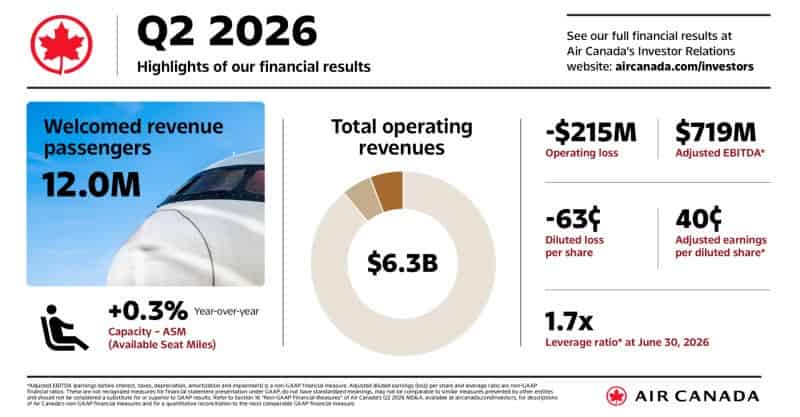
The transaction arrived on the same day Air Canada reported record second-quarter operating revenue of C$6.266 billion, up 11 per cent year on year.
Premium and corporate demand remained strong, while so-called Sixth Freedom traffic international passengers connecting through Canada between two other countries also supported the result. Capacity rose just 0.3 per cent, slightly below guidance, after poor weather disrupted flight completion late in the quarter.
Yet record revenue did not translate into a conventional bottom-line celebration. Operating expenses reached C$6.481 billion, leaving an operating loss of C$215 million and an operating margin of negative 3.4 per cent.
The airline recorded a net loss of C$178 million, equal to a diluted loss of C$0.63 per share. On an adjusted basis, however, it reported net income of C$114 million and diluted earnings of C$0.40 per share.
Adjusted EBITDA was C$719 million, at the top end of Air Canada’s guidance range, with an adjusted EBITDA margin of 11.5 per cent. The quarter also produced C$651 million in operating cash flow and C$174 million in free cash flow.
The gap between the operating loss and adjusted earnings warrants attention. Air Canada identified C$388 million in labour-related and other charges, while fuel expense climbed 49 per cent from a year earlier. Adjusted measures can help show underlying trading performance, but they are not standardised GAAP measures and should not be mistaken for the statutory result.
President and Chief Executive Officer Michael Rousseau said the performance reflected diversified revenue, pricing action, and disciplined cost control.
“Adjusted EBITDA reached $719 million, at the top end of our second quarter guidance range, despite a 49 per cent year-over-year increase in fuel expense,” Rousseau said.
Air Canada also spent C$125 million repurchasing more than six million shares during the quarter. Its leverage ratio stood at 1.7, up from 1.4 on 30 June 2025.
Guidance returns, but at a lower altitude
Air Canada reinstated its full-year 2026 outlook after suspending the previous guidance on 30 April. The revised forecast is more restrained than the original no surprise when jet fuel has been behaving like it has hired its own publicity agent.
The airline now expects adjusted EBITDA of C$2.9 billion to C$3.2 billion, down from its earlier range of C$3.35 billion to C$3.75 billion. Expected capacity growth has been reduced to between 2.25 and 3.25 per cent from the previous 3.5 to 5.5 per cent range.
Free cash flow guidance is now C$200 million to C$500 million, compared with C$400 million to C$800 million previously. Adjusted cost per available seat mile is forecast to rise by between 5 and 6 per cent from 2025.
The assumptions behind the outlook underline the pressure. Air Canada expects the Canadian dollar to average C$1.41 to the US dollar in 2026. It assumes jet fuel prices of about C$1.38 per litre in the third quarter and C$1.29 in the fourth.
The carrier believes pricing measures and hedging can offset about 60 per cent of estimated incremental third-quarter fuel expense above its earlier assumptions, and 100 per cent in the fourth quarter. Those estimates remain exposed to global energy volatility and conflict-related disruption.
Air Canada has also signed non-binding letters covering up to C$2 billion of aircraft sale-and-leaseback transactions planned for 2026 and 2027. Its current guidance assumes C$1 billion of those deals will close in 2026.
Why the Aeroplan deal matters
The transaction offers a vivid measure of how loyalty programs have evolved. They are no longer simply a thank-you card stamped after every flight. The strongest programs are data-rich commercial platforms, connected to banks, retailers, hotels and airline partners, with recurring cash flows and a daily relationship with customers.
Aeroplan has more than 10 million active members and access to more than 50 airline partners serving over 1,300 destinations, according to Air Canada. That reach gives the program value well beyond seats on the airline’s own aircraft.
For the travel trade, continuity is crucial. A change in ownership structure can raise concerns about redemption rules, partner relationships, or customer benefits. Air Canada’s continued operational control should help quiet those fears, although members and advisers will naturally watch future program changes with care.
Loyalty schemes tend to inspire close scrutiny; people can be remarkably relaxed about a delayed suitcase, but when points goalposts move, the gloves come off.
The investment also gives Air Canada capital at a useful moment. It can retire a looming bond, preserve cash, pursue share repurchases and continue investing in its strategic plan. That combination may strengthen the case for an investment-grade rating, although no rating outcome is guaranteed.
Air Canada’s longer-range ambitions remain substantial. It is targeting roughly C$30 billion in operating revenue by 2028 and more than C$30 billion by 2030. It also seeks an adjusted EBITDA margin of at least 17 per cent in 2028 and between 18 and 20 per cent in 2030, with a fully diluted share count below 300 million.
Those targets will require more than financial engineering. The airline still has to manage fuel, labour, weather, fleet investment, geopolitical risk and the daily theatre of moving millions of people on time. But the Aeroplan deal provides genuine room to manoeuvre.
Record revenue proves demand is present. The quarterly loss proves revenue alone is not enough. By unlocking C$2.5 billion from Aeroplan while retaining control, Air Canada has bought itself financial flexibility without handing over the flight deck.
That is not merely a points play. It is a calculated balance-sheet move and, for once, the loyalty dividend is being collected by the airline as well as its passengers.
By: Stephen Peters – © 2026.
Read Time: 7 minutes.
Author Bio:
 Stephen Peters has spent much of his career proving that the straight-and-narrow path is considerably overrated. Armed with a Bachelor’s degree in Technology from the University of Queensland and a Master’s in Management, he first ventured into hospitality, working in and helping open several five-star hotels across Sydney and Asia.
After deciding he had experienced quite enough of five-star hospitality from the operational side of the desk, Stephen returned to technology, working with major US tech companies while based between Australia and Asia.
Then came the ultimate change of scenery. Stephen built his own yacht and, with his family aboard, sailed from Florida through the United States and its Great Lakes before crossing the Pacific to Asia. Several memorable years followed, exploring Indonesian waters before the Peters family eventually returned to Australia with considerably more sea miles, stories and perspective than when they left.











