

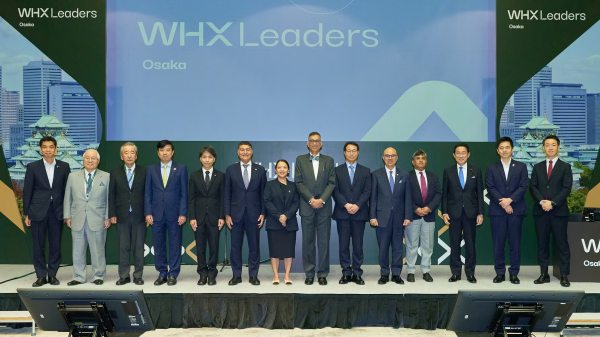
WHX Osaka was held from July 2 to 4, 2026, in Osaka, bringing together regional, national and international stakeholders from government, healthcare, academia, industry and life sciences innovation ecosystems.
Across the inaugural WHX Osaka, the Global Life Sciences Roundtable and the Osaka Pavilion in the exhibition area, discussions focused on how future medicine, regenerative medicine, healthcare innovation and healthy longevity can respond to shared global challenges, including ageing, rising healthcare costs, workforce shortages and disparities in access to care.
The event took place as Osaka continues to build on the legacy of Expo 2025 Osaka, Kansai, Japan and its theme, “Designing Future Society for Our Lives.” The discussions at WHX Osaka showed how this legacy can be extended into healthcare, life sciences and industrial innovation.
Healthy longevity as a shared global challenge
WHX Leaders Osaka placed healthy longevity in a wider international and policy context. Discussions addressed universal health coverage, medical innovation, proactive preventive healthcare, startup growth, advanced medicine, health data infrastructure and cross-border collaboration.
Governor Hirofumi Yoshimura connected the discussions to Osaka and Kansai’s strengths in advanced medical and life sciences technologies, including iPS cell-related innovation. He also referred to Nakanoshima Qross as a new hub for future medicine and highlighted Japan’s average life expectancy of around 85 years, one of the highest in the world.
“The pursuit of healthier and more fulfilling lives is not only a human aspiration, but also a source of future industrial and economic growth,” Governor Yoshimura said.
He also expressed Osaka’s intention to continue and expand WHX Leaders Osaka in the coming years, positioning the event as a platform for international dialogue and collaboration in healthcare and life sciences.
At the leadership level, the discussions showed that healthy longevity is no longer only a medical or welfare issue. It is increasingly connected to industrial policy, innovation ecosystems, human capital, data infrastructure and international cooperation.
As societies age, countries face common questions: how to help people live not only longer, but healthier and more fulfilling lives; how to sustain healthcare systems under demographic pressure; and how to ensure that medical innovation reaches patients and communities in practice.
Turning Research Excellence into Patient Impact
WHX Leaders Osaka framed healthy longevity and healthcare innovation as shared global priorities, bringing together policy, industry and international leadership perspectives. The Roundtable enhanced the healthcare innovation discussion by examining the practical conditions needed to translate life sciences innovation into clinical use, industrial growth, and international collaboration.
Participants, drawn from different ecosystems across the globe, examined how scientific discovery in areas such as regenerative medicine, cell and gene therapy, drug discovery and medical devices can be connected to manufacturing, regulation, capital, talent and international markets.
A shared issue came into focus: advanced healthcare innovation does not reach patients through research excellence alone.
Speakers noted that promising science can stall not because of weak research, but because the surrounding system is incomplete. Clinical access, GMP-level manufacturing, regulatory pathways, long-term capital, specialized talent, startup support, and international partnerships all need to be connected.
Without these links, innovation will get stuck in laboratories or early-stage projects rather than reaching patients, healthcare systems, and global markets.
In his keynote, Dr. Yoshiki Sawa emphasized that despite having world-class science and medical research, Japan is still facing challenges in building the systems needed to translate those strengths into benefits for patients and society. His message was that science and biotechnology do not reach society automatically; they require an ecosystem that connects research, medicine, industry, government, finance, and human resources.
International ecosystem builders also presented models that address different parts of this implementation challenge. The discussions highlighted the importance of patient-oriented regenerative medicine ecosystems, manufacturing and clinical trial networks, regulatory infrastructure, long-term capital, and expert support in early-stage drug discovery.
Nakanoshima Qross and Osaka’s life sciences ecosystem
Located in Osaka, Nakanoshima Qross is a key hub for advancing future medicine and regenerative medicine, bringing together medical institutions, research organizations, companies and support functions. Although discussed in the Roundtable, its significance extends beyond a single session: it represents Osaka’s broader effort to connect research excellence, clinical application, industrial collaboration, and international partnerships.
This role is particularly important in regenerative medicine, drug discovery, cell and gene therapy and other advanced medical fields, where scientific discovery must be supported by clinical translation, manufacturing capacity, regulatory pathways, financing, specialized talent, and market access.
The Osaka Pavilion and conference sessions held throughout WHX Osaka gave tangible form to this strategy by introducing Osaka and Kansai’s life sciences assets, related innovation initiatives, and opportunities for collaboration.
Together, the roundtables, exhibition area and side events showed that Osaka is becoming more than a host city for an international healthcare event. It is emerging as a connection point where life sciences innovation can move from research toward patients, healthcare systems and future growth.
The future direction of WHX Leaders Osaka was articulated through the “Osaka Vision for Healthy Longevity,” which aims to bring global leaders back to Osaka each year and expand international cooperation from the city. The vision calls for countries and regions to share experience, build cross-border partnerships, and turn dialogue into action.
During WHX Osaka, this commitment was reflected in the signing of memoranda of understanding with the Friuli Venezia Giulia Region in Italy, Biocat in Catalonia, Lyonbiopole in France, and POM Limburg and Health Campus Limburg DC in Belgium.
These new partnerships provide a foundation for continued international collaboration and reinforce Osaka’s role as a hub for healthy longevity and life sciences innovation.











