

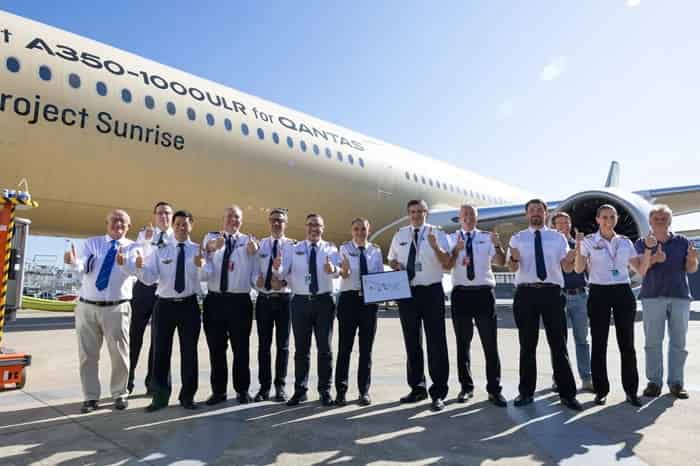
Qantas’ Project Sunrise has passed its toughest test yet. Its specially modified Airbus A350-1000ULR stayed in the air for 24 hours and 24 minutes on a non-stop development flight from Melbourne to Toulouse.
The test jet, known as MSN707, flew 12,460 nautical miles, or about 23,075 kilometres. It landed in France on 28 July 2026 after crossing the Pacific, North America, the Atlantic and the United Kingdom.
The flight was a major step towards Qantas’ plan to link Sydney with London and New York without a stop. It tested the jet’s fuel system, cabin air and long-range limits across the sort of working day that Project Sunrise will demand.
It also produced one eye-catching number. Flight-tracking data showed a peak groundspeed of 662 knots, or about 1,226 kilometres per hour, around three hours after departure from Melbourne.
That figure did not mean the A350 reached Mach 1.
Mach number is based on an aircraft’s speed through the surrounding air compared with the local speed of sound. Groundspeed is the aircraft’s speed across the Earth and includes the effect of wind.
The A350 was flying with a strong tailwind. That wind pushed its groundspeed beyond 1,200 kilometres per hour while the aircraft itself stayed within its normal subsonic flight range.
Put simply, the jet stream gave the A350 a mighty shove. The aircraft did not break the sound barrier, create a sonic boom or suddenly turn into Concorde wearing a red tail.
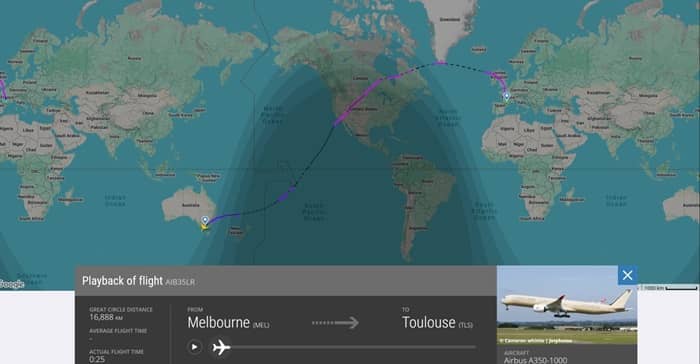
Airbus A350-1000ULR bearing the test registration F-WULR (MSN 707), embarked on the second leg of its world-spanning certification tour on Monday. – By FlightRadar 24
A Full-Day Flight With a Clear Purpose
Airbus classifies the Melbourne-to-Toulouse journey as a development flight, rather than a formal certification flight.
Its main aim was to show that the A350-1000ULR could support a 23-hour block-time mission. Block time starts when an aircraft releases its parking brake at departure and ends when the brake is set again at the arrival stand.
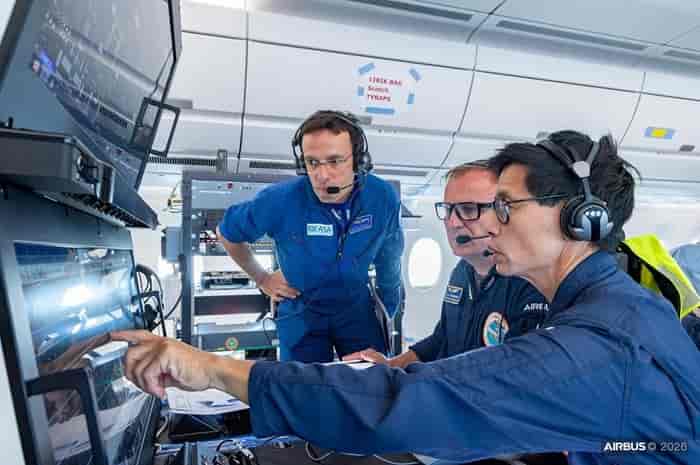
A350-1000ULR longest flight cabin FTE
Airbus says that capability provides cover for Qantas’ intended flight time of 21 hours and 40 minutes, together with taxiing, holding and possible diversion requirements.
That margin is vital. A daily airline service cannot rely on perfect weather, empty taxiways and a helpful tailwind. It must be able to cope when the real world arrives with clouds, queues and paperwork.
The flight also tested cabin temperature, ventilation and fuel use. A key part of the ultra-long-range design is a rear centre fuel tank that holds 20,900 litres. Airbus often rounds that figure to an additional 20,000 litres in its public information.
The tank helps give the jet a range of almost 10,000 nautical miles. The aircraft is powered by two Rolls-Royce Trent XWB-97 engines and can take off at a higher weight than the standard A350-1000.
Airbus has also fitted a lighter and more localised galley-cooling system. It saves about 300 kilograms compared with the previous system.
That may seem modest on a wide-body aircraft carrying almost a day’s worth of fuel. Yet every kilogram matters when it must be lifted, moved and fed kerosene for thousands of kilometres.
In ultra-long-range aviation, weight is the house guest who charges rent by the kilometre.
Five Pilots Share the Workload
Five pilots were aboard the return flight. Three came from Airbus, while two came from Qantas: Captains Andrew Coull and David Summergreene.
The Qantas pilots were already qualified on the A350, but the flight gave them their first experience operating the ultra-long-range version.
Airbus used four-hour pilot shifts and rotated the cockpit crew every two hours. This meant an incoming pilot spent two hours alongside the pilot who was preparing to leave.
The overlap allowed time for a detailed handover and helped maintain awareness throughout the unusually long flight.
The mission also evaluated the aircraft’s new twin flight-crew rest compartments. However, those spaces were filled with ventilation-measurement equipment during the test.
The pilots therefore slept in the eight-berth cabin-crew rest compartment at the rear of the aircraft.
This is not a small issue. Project Sunrise must manage people as carefully as it manages fuel. Crew rest, handovers and fatigue controls will be central to the safe operation of flights lasting about 22 hours.
MSN707 Tests While Vega Prepares for Delivery
MSN707 is the first A350-1000ULR built. Airbus is using it for development and certification work before the aircraft is prepared for Qantas commercial service.
Vega is the second A350-1000ULR produced, but it is scheduled to become the first aircraft delivered to Qantas. Airbus says that delivery is planned for April 2027.
Qantas has ordered 12 A350-1000ULRs for Project Sunrise. The airline plans to begin daily non-stop Sydney–London flights in October 2027, subject to aircraft certification and regulatory approval.
Seats are due to go on sale in February 2027. Sydney–New York is planned to follow, although Qantas has not yet announced a start date for that route.
Qantas says the new London flight could save passengers up to four hours compared with the fastest existing one-stop journey.
That will appeal to business travellers, premium holidaymakers and anyone who has raced through a transit terminal carrying a laptop, a duty-free bag and rapidly fading optimism.
Space Becomes Part of the Sales Pitch
An aircraft capable of flying for 22 hours is only half the answer. Passengers must also be willing to remain aboard it.
Qantas will fit each Project Sunrise A350 with 238 seats across four cabins:
- Six First suites
- 52 Business suites
- 40 Premium Economy seats
- 140 Economy seats
Qantas says the configuration will have the lowest seat density of any A350 in service. More than 40 per cent of its seats will be in premium cabins.
The aircraft will also have a dedicated Wellbeing Zone where passengers can stretch, drink water and follow simple movement exercises during the flight.
Qantas has worked with the University of Sydney’s Charles Perkins Centre on cabin lighting, meals, sleep and movement strategies. The aim is to support passengers’ body clocks and reduce the effects of jet lag.
Economy passengers will also receive more space than on many conventional long-haul aircraft. Qantas says more than 70 per cent of seats will offer at least 33 inches of pitch, while Economy Plus will provide 34 inches.
Fast Wi-Fi, Bluetooth audio and a journey-planning entertainment system are also planned.
These features are not mere decorative polish. A small discomfort on a seven-hour flight can become a major grievance by hour 19.
Project Sunrise must make the time saving feel worthwhile from the first suite to the final row.
From Seven Stops to None
Qantas first flew between Sydney and London in 1947. The original Kangaroo Route took four days and made seven stops: Darwin, Singapore, Calcutta, Karachi, Cairo, Castel Benito and Rome.
Project Sunrise also takes its name from Qantas’ wartime Double Sunrise services.
Catalina flying boats linked Western Australia and Sri Lanka during the Second World War. The flights could last about 33 hours, allowing passengers and crew to see the sun rise twice.
The new aircraft is faster, quieter and vastly more comfortable. Yet the aim remains familiar: use skill, sound engineering and a stubborn Australian streak to beat distance.
The 24-hour development flight does not mean Project Sunrise is ready to carry paying passengers today. More tests, certification work and regulatory approvals are still required.
It does show that the central idea is moving from promise to proof. The aircraft stayed aloft for more than a day, completed its planned test program and demonstrated the range needed for Qantas’ future mission.
No, it did not reach Mach 1.
But it did bring the world’s longest planned passenger services one substantial step closer to take-off.
By: Jason Smith – © 2026.
Read Time: 6 minutes.
Author Bio:
 Jason Smith didn’t learn travel from textbooks. He learned it in airports, taxis and hotel lobbies, watching the business unfold long before he played his own part. Half American, half Asian, he grew up around the quiet workings of tourism, where people come and go, and stories rarely stand still.
Bangkok came first, then formal study, then a career that carried him through Singapore, Malaysia and Vietnam. Each place left something behind. In the end, Thailand felt like home, along with a senior role in hotel sales.
Then everything stopped. Borders shut, planes grounded, and Jason found himself back in America with time to reflect.
Now at Global Travel Media, he writes travel as it really is, not polished, not perfect, but human, and all the better for it.











