

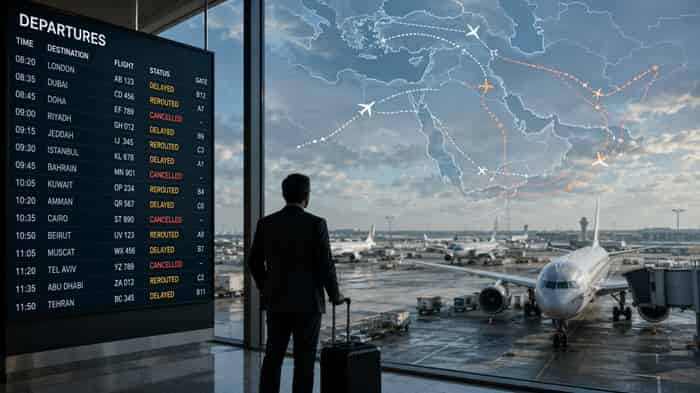
The Middle East has again become the pressure point of world aviation. When its skies close, the shock does not remain neatly parked in Dubai, Doha or Abu Dhabi. It reaches airport boards in Sydney, transfer desks in London and airline control rooms from Singapore to Frankfurt.
For Australian travellers, the lesson is blunt: a journey may begin thousands of kilometres from the conflict, yet still depend on a narrow piece of airspace sitting directly above it.
Military action, airspace restrictions and rapidly changing security assessments have forced airlines to cancel services, redraw flight paths and reconsider the hubs through which they carry passengers between Australia, Europe, Africa and the Americas.
Smartraveller warns that disruption may affect Australians even when their final destination is nowhere near the Middle East. It says airspace can close and flights can change or stop with little warning.
That is the diplomatic wording.
In airline operations, it means timetables written in pencil, crews placed on standby and aircraft taking the expensive way around.
A vital aviation crossroads under strain
The Gulf is not merely a destination. It is one of the world’s great aviation junctions.
For decades, airlines based in Dubai, Doha and Abu Dhabi have built vast connecting networks between east and west. Their schedules allow an Australian passenger to leave Brisbane, Melbourne, Perth or Sydney and reach dozens of European, African and Middle Eastern cities with a single change of aircraft.
Airservices Australia says about six per cent of Australia’s international flights rely on connections through the Middle East. That share sounds modest until it disappears at short notice.
By March 2026, the effect was no longer theoretical.
Airservices reported that Australia–Middle East traffic had fallen 77 per cent year on year. Direct Australia–Europe traffic was down 31 per cent as some services were redirected through other hubs.
Singapore, Kuala Lumpur, Hong Kong, Tokyo and Seoul were among the gateways absorbing displaced demand.
The map did not become smaller. It simply became considerably less convenient.
When the shortest route is no longer available
A flight diversion is not a line casually shifted across a screen by someone with a ruler and a strong cup of tea.
Airlines must consider conflict-zone warnings, national airspace closures, fuel availability, weather, crew-duty limits, airport curfews and the location of suitable diversion airports.
A longer route can require more fuel, a different aircraft, extra crew or a technical stop.
It can also force an airline to reduce the weight carried on board.
More fuel may mean less cargo. On some sectors, it can mean fewer passengers, particularly when heat, runway length and aircraft performance are already working against the schedule.
Longer flying times can also break carefully planned connections and push crews beyond their legal hours.
The disruption therefore spreads well beyond the affected airspace.
One aircraft arriving late can miss its next departure. One crew running out of duty time can delay another flight. One cancelled service can leave hundreds of passengers competing for seats that were already largely full.
Aviation is a global network. Tug one part hard enough and luggage begins falling off the metaphorical carousel elsewhere.
Safety, not convenience, decides the route
No serious airline flies through dangerous airspace merely because it produces a tidy schedule.
The European Union Aviation Safety Agency has active conflict-zone bulletins covering Iran, Iraq, Lebanon, Jordan, Bahrain, Kuwait, Qatar, the United Arab Emirates and part of the Gulf of Oman.
Its bulletin covering Bahrain, Kuwait, Qatar, the United Arab Emirates and part of the Gulf of Oman advises the operators covered by its rules not to fly through that airspace at any altitude.
EASA says missiles, drones, combat aircraft, air-defence systems, interception activity and falling debris create a high risk to civil flights. It also warns that military action may occur with little or no notice.
A separate bulletin advises covered operators not to use Jordanian airspace at any altitude. It points to missile and drone attacks, air-defence activity, falling debris and the risk that a civil aircraft could be misidentified.
Those bulletins remain valid until 31 August 2026 unless reviewed earlier. Active warnings also remain in place for Iran, Iraq and Lebanon.
This is why an airport can appear open while an airline still cancels its service.
A runway may be available, but the safe route to reach it may have narrowed, vanished or changed before the catering truck has finished loading the tea.
A ceasefire can reduce immediate tension. It does not restore aviation confidence by magic.
Airlines and regulators want evidence that a lower-risk environment will last, not merely survive until tomorrow’s first briefing.
The financial bill is climbing
Rerouting is a safety decision, but it is also an expensive one.
The International Air Transport Association expects global airline net profit to fall to US$23 billion in 2026. That is roughly half the estimated US$45 billion earned in 2025.
It forecasts net profit of just US$4.50 for each passenger carried.
That is not a margin so much as loose change found beneath the seat.
IATA also expects airline fuel costs to rise from US$252 billion in 2025 to US$350 billion in 2026. Jet fuel is forecast to average US$152 a barrel, compared with US$90 the previous year.
Airlines can recover some of that increase through higher fares, fuel surcharges, tighter capacity and greater ancillary revenue.
They cannot recover all of it without damaging demand.
For passengers, the likely consequences are fewer bargain fares, less flexibility on heavily disrupted routes and higher prices where alternative seats are scarce.
For travel advisers and corporate travel managers, the challenge is no longer simply finding the cheapest itinerary. It is finding one with enough resilience to survive contact with reality.
A $100 saving is not much of a triumph if the connection depends on a route that may disappear overnight.
Australia is distant, but not detached
Australia’s geography provides distance from the conflict, not immunity from it.
Passengers travelling to Europe and Africa have long relied on Gulf connections because they offer extensive schedules and efficient one-stop journeys.
When those services are reduced or rerouted, pressure moves to Asian hubs and the limited number of direct services linking Australia with Europe.
That can change more than the flight number.
A journey may gain several hours, require a new transit visa or produce a connection at an airport the passenger has never used.
Travellers with mobility needs, children, medical conditions or tight business schedules may find that an apparently simple substitute is anything but simple.
Separate tickets are particularly risky.
When each sector sits on a different booking, the second airline may have no obligation to rescue the passenger after the first flight is cancelled or seriously delayed.
The cheapest online combination can therefore become a very expensive collection of apologies.
What Australian travellers should do now?
First, check the operating airline rather than relying only on the marketing carrier shown on the ticket.
A familiar flight number may be attached to an aircraft operated by a partner. The operating airline will usually have the most current information about the service.
Second, check the official travel advice for every transit point, not just the final destination.
Smartraveller currently places Israel, Jordan, Oman, Qatar, Saudi Arabia and the United Arab Emirates at Level 3. Australians are advised to reconsider their need to travel to those locations, including for transit.
Bahrain, Iran, Iraq, Kuwait, Lebanon, Palestine, Syria and Yemen are at Level 4: Do not travel.
Anyone who must use a Level 3 transit point should keep the connection as short as possible and avoid unnecessary activity outside the airport.
Third, avoid tight connections.
A legal connection is not necessarily a sensible one. During widespread disruption, an extra hour or two can be far more valuable than another visit to an airport lounge.
Fourth, keep medicines, documents, chargers, essential toiletries and a change of clothes in cabin baggage. Keep enough money readily available to cover meals, transport and an unexpected hotel stay.
Fifth, ensure the airline and travel adviser have the correct mobile number and email address.
Emirates, for example, says it sends delay and cancellation notices to the contact details recorded in the booking. Passengers who booked through an agent should ensure that their latest information has been supplied.
An excellent disruption message sent to an old office number remains, technically speaking, excellent but useless.
Finally, read the travel-insurance policy rather than admiring the certificate.
Policies vary, but military action such as war, civil war, rebellion or insurrection is commonly excluded. Events known before a policy was purchased may also fall outside cover when they directly affect the journey.
Smartraveller says most standard policies are unlikely to cover Level 4 destinations. Travellers passing through Level 3 or Level 4 destinations may need a specialist policy designed for high-risk or complex environments.
Travellers should ask their insurer for written confirmation of what is covered before departure.
Hope is a fine travel companion. It is a poor claims department.
Travel advisers earn their place during disruption
This is precisely the sort of crisis in which professional travel advisers prove their worth.
In calm times, almost anyone can sell a seat.
In disruption, the work becomes far more demanding: tracing the validating carrier, checking fare rules, protecting onward sectors, comparing safer hubs and deciding whether the entire itinerary must be rebuilt.
A competent adviser can also see what an automated booking engine may overlook.
An alternative route may require an overnight stay, a transit visa or a terminal change. A cheaper flight may offer no protection when tickets are separate. A proposed connection may be technically available but operationally foolish.
The adviser’s task is not to spread alarm. It is to reduce surprise.
Corporate travel managers should identify employees travelling through exposed hubs, confirm who can approve higher replacement fares and establish clear arrangements for hotels, ground transport and emergency communication.
Agencies should review bookings with short connections, separate tickets and transit through more than one Middle Eastern hub.
Those itineraries deserve attention before the passenger reaches the airport, not after the departure board turns red.
Airlines must communicate plainly
Airlines face a difficult communications problem.
Operational decisions can change by the hour, and frontline staff may not receive certainty as quickly as passengers demand it.
Even so, polished fog is not a satisfactory product.
Travellers need to know whether the flight is operating, when the next decision will be made, whether a rebooking is protected and what refund or credit options apply.
“Operational reasons” may be accurate, but it is a phrase broad enough to park an Airbus in.
The best airlines communicate early, update regularly and explain the practical choices.
Silence forces passengers to invent their own answers, usually with the assistance of social media and somebody’s cousin who once worked near an airport.
That rarely improves matters.
The long way around may be the wise way home
Middle Eastern airlines and airports have considerable expertise in operating complex global networks.
Their operations teams have handled conflict, airspace closures, severe weather and sudden surges in demand.
Yet even the finest control room cannot remove a missile, reopen foreign airspace or manufacture jet fuel.
Australian travellers do not need to abandon international travel. They do need to regard every itinerary passing through the region as live and subject to change.
For passengers, the watchwords are time, flexibility and good records.
For airlines, they are safety, clear communication and disciplined planning.
For the wider travel trade, the duty is to guide customers honestly without pretending that uncertainty has been neatly checked through to their final destination.
The shortest route may still be a straight line.
In 2026, however, the safest route may be the one taking the long way around.
By: Jason Smith – © 2026.
Read Time: 8 minutes.
Author Bio:
 Jason Smith didn’t learn travel from textbooks. He learned it in airports, taxis and hotel lobbies, watching the business unfold long before he played his own part. Half American, half Asian, he grew up around the quiet workings of tourism, where people come and go, and stories rarely stand still.
Bangkok came first, then formal study, then a career that carried him through Singapore, Malaysia and Vietnam. Each place left something behind. In the end, Thailand felt like home, along with a senior role in hotel sales.
Then everything stopped. Borders shut, planes grounded, and Jason found himself back in America with time to reflect.
Now at Global Travel Media, he writes travel as it really is, not polished, not perfect, but human, and all the better for it.











