

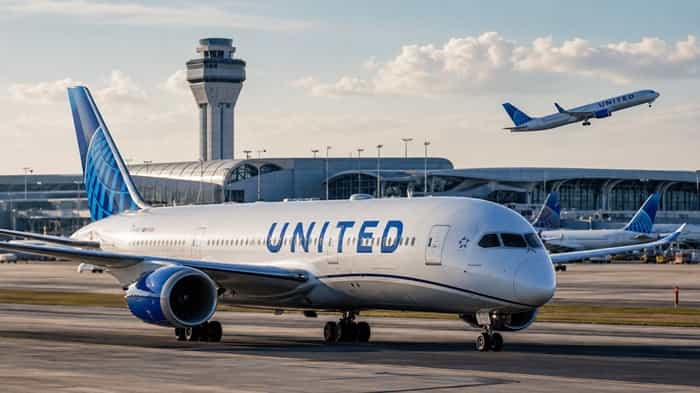
United Airlines has posted a strong second-quarter result in the face of a fuel bill large enough to make even a seasoned airline accountant reach for the oxygen mask.
The Chicago-based carrier reported total operating revenue of US$17.7 billion for the three months to 30 June 2026. That was 16 per cent higher than a year earlier. Diluted earnings reached US$2.46 a share. Adjusted diluted earnings were US$1.99 a share, beating Wall Street forecasts.
Pre-tax profit came to US$1 billion, with a margin of 5.8 per cent. Adjusted pre-tax earnings were US$843 million, with a margin of 4.8 per cent.
Those figures would stand out in a normal quarter. This was anything but normal.
United Airlines Q2 2026 results beat expectations
United now expects nearly US$6 billion in additional fuel expense in 2026, up from its view at the start of the year. Fuel expense rose by US$2.3 billion in the second quarter alone. That was an 84 per cent jump from a year earlier. The average fuel price was US$4.19 a gallon.
Even so, United lifted the lower end of its full-year profit forecast. The airline now expects adjusted diluted earnings of US$9 to US$11 a share. Its former range was US$7-US$11.
Put simply, the fuel bill has arrived wearing hobnail boots. United insists the floorboards are still sound.
Chief executive Scott Kirby said the result showed the value of steady investment in the passenger experience.
“Our results show why we have been investing in customer improvements throughout every cabin and winning brand-loyal customers,” Kirby said.
United believes its pricing power, global network and loyal customer base will help it recover the rise in fuel costs. The airline said it recovered about half of the second-quarter increase. It expects to recover 80 to 90 per cent in the third quarter and all of it in the fourth.
Strong demand gives United room to move
Total revenue per available seat mile, known as TRASM, rose 12.1 per cent. Capacity grew by only 3.5 per cent. Passenger yields also rose 12 per cent.
That tells a clear story. Travellers kept paying for United’s product even as fares moved higher.
The gains were spread across the business. Premium revenue rose 16 per cent. Basic Economy revenue increased 11 per cent. Loyalty revenue was also up 11 per cent, while cargo revenue climbed 23 per cent. Contracted business revenue grew 27 per cent.
Economy-cabin unit revenue also rose for a second straight quarter. That is important because it shows growth is not confined to the pointy end of the aircraft.
For travel advisers and corporate buyers, the mix is encouraging. United is generating revenue from premium cabins, lower fares, business travel, loyalty members, and freight. It does not rely on one market or a short-lived boom.
That is a stronger engine than one powered only by champagne and expense accounts.
There are still limits to the good news. United forecast third-quarter adjusted earnings of US$2.50 to US$3.50 a share. The midpoint was below the average analyst forecast reported by Reuters.
The airline also expects fourth-quarter capacity to sit below its published schedule. It may trim more flying if fuel prices stay high.
That is sound airline practice. An empty seat vanishes the moment the aircraft leaves the gate. Flying with a weak capacity simply to burn more costly fuel is not a strategy. It is a theatre.
Starlink Wi-Fi becomes a serious selling point
Passengers can see where some of United’s investment is going.
Starlink internet is now fitted to 450 United mainline and United Express aircraft. Nearly 1,000 aircraft are expected to have it by the end of 2026. United aims to complete the whole fleet by the end of 2027.
Starlink is free for MileagePlus members. United says Wi-Fi satisfaction on Starlink aircraft is more than twice as high as on its other connected aircraft.
The system has also reached the carrier’s first widebody transatlantic flight. Nearly 60 widebody aircraft are due to receive Starlink this year.
Fast and reliable internet is no longer a novelty. It is becoming part of the basic airline product, especially for business travellers and passengers on long flights.
The old model was less charming. Airlines often charged a handsome sum for a signal with the mood swings of a garden hose.
United is also introducing its Relax Row option in economy. It has taken delivery of its first Airbus A321XLR, fitted with the carrier’s Elevated interior. The aircraft includes updated Polaris and Premium Plus seats, Bluetooth screens at every seat and a self-service snack bar.
Domestic service is due in the northern autumn. International flights are expected to begin early in 2027.
New routes and better operations support growth
United launched 27 routes in the United States and Canada during the quarter. It began new Newark services to Bari, Split, Santiago de Compostela and Glasgow. It also launched a Washington Dulles–Reykjavik route.
Further routes have been announced across Japan, the Caribbean, Latin America and Mexico.
The airline also posted its best second-quarter on-time departure rate since 2021. It recorded its lowest second-quarter seat-cancellation rate in company history, apart from the pandemic years.
Newark delivered its best second-quarter on-time departure result in United’s history. The hub handled nearly 4.4 million departing passengers during the period.
June brought the 10 busiest passenger days in the airline’s history. On 18 June, United carried 640,717 customers, setting a company record.
Cargo also performed well. United moved almost 347 million pounds during the quarter. That was its strongest second-quarter cargo volume since 2020.
Balance-sheet discipline sits behind the expansion
The bright cabin upgrades rest on a more serious financial task.
United raised US$3.7 billion in fresh liquidity through private bank deals. It described the move as low-cost insurance against global tension and the risk of an extreme rise in oil prices. Available liquidity ended the quarter at US$19.6 billion.
The carrier has also prepaid about US$1 billion of higher-cost debt since the start of the second quarter. It is targeting an investment-grade credit rating in 2026.
Once fuel prices ease, United expects to use spare cash to cut costly debt and help fund aircraft deliveries.
The airline ended the quarter with US$26.5 billion in debt, finance lease obligations and other financial liabilities. Trailing 12-month net leverage stood at 2.2 times.
United generated US$1.6 billion in operating cash flow and US$322 million in adjusted free cash flow.
What United Airlines earnings mean for the travel trade
United’s result offers a useful view of the airline market in 2026.
Demand remains healthy. Premium products are earning their keep. Loyalty programs continue to act like private mints. Better digital tools are shaping passenger choice.
Fuel remains the unruly guest at the banquet. It can still overturn the table just as dessert arrives.
United’s answer is to keep investing while tightening its choices on fares, flying and finance. That carries risk. Travellers may resist further price rises, while global conflict could keep oil costs high.
The company’s guidance must also be read with care. It is based on fuel prices as of 14 July 2026 and includes adjusted, non-GAAP measures. United has warned that actual results may vary due to oil prices, demand, global conflict, capacity decisions, and other business risks.
For now, the airline has several revenue levers, improved operations, and a clearer offer across every cabin. It is also showing that scale and service can work together when backed by firm cost control.
The fuel bill may be enormous, but United’s ambition appears larger. The airline is not only riding out the turbulence. It is using the moment to argue that good products, broad networks and old-fashioned financial discipline can still produce lift.
By: Alison Jenkins – © 2026.
Read Time: 6 minutes.
Author Bio:
 Alison Jenkins has lived most of her working life in the slipstream of aviation, where timetables matter, and people matter more. In airline sales, she built a reputation the old-fashioned way: by knowing her clients, her routes, and never missing the human detail.
Quick with a smile, quicker with a solution, she made deals with warmth and kept her edge intact.
Trade shows, FAMILS, airport lounges and hotel lobbies became her second address. And somewhere along the way, notebook in hand, she began writing the journeys rather than selling them. Her reports grew lively, observant, full of the small truths only travellers notice.
That was the moment it dawned on her: she wasn’t simply travelling. She belonged in its stories.











