

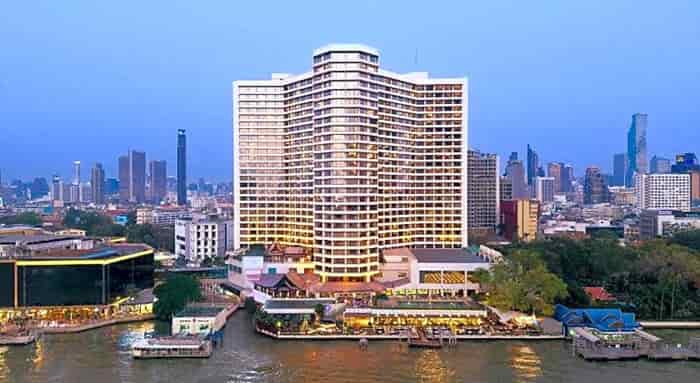
One of Bangkok’s most recognisable riverside hotels remains open for business, but behind its tranquil Chao Phraya façade, a multibillion-baht contractual dispute is raising serious questions about its future ownership.
One of Bangkok’s most famous riverside hotels has become the centre of a Bt4.873-billion ownership battle after a mandatory property buy-back was not completed by its contractual deadline.
The dispute involves Royal Orchid Hotel (Thailand) Plc, known as ROH; One Asset Management, or ONEAM; and MFC Asset Management, trustee of the Grande Royal Orchid Hospitality Real Estate Investment Trust with Buy-Back Condition mercifully shortened to GROREIT.
At the centre of the disagreement is the landmark Royal Orchid Sheraton Riverside Hotel Bangkok, which remains open and continues accepting reservations.
Guests arriving at the hotel may therefore notice little beyond the familiar river views, passing boats, and Bangkok’s enduring ability to make tranquillity and chaos coexist within several metres of each other.
Behind the scenes, however, the atmosphere is considerably less serene.
Buy-back deadline passes without transfer
GROREIT owns the freehold rights to the Royal Orchid Sheraton Hotel and Towers property under a sale-and-leaseback arrangement established in 2021.
The Stock Exchange of Thailand’s GROREIT factsheet identifies ROH as the former property owner, lessee and intended buyer under the asset buy-back structure. The lease was initially established for three years, with two possible one-year extensions and conditions allowing the asset to be sold back to ROH between the third and fifth lease years.
Under the agreement, ROH was required to repurchase the property at the end of the fifth lease year for Bt4.873 billion, excluding value-added tax.
The transaction was due to be completed on 14 July 2026.
ONEAM says ROH did not complete the purchase or accept the transfer of ownership at the relevant Land Office by that deadline. The expected proceeds were intended to repay GROREIT’s outstanding bank borrowing, distribute remaining funds to unitholders and permit the eventual dissolution of the trust.
ROH disputes the suggestion that it simply refused or was financially unable to complete the transaction.
The company maintains that it remained committed to the buy-back but could not proceed using the payment method communicated by MFC Asset Management, which ROH claims did not conform to the original contractual terms.
According to ROH, an authorised company representative attended the relevant Land Office on 14 July to address the alleged discrepancy. ROH says the transaction remains capable of completion once the payment disagreement is resolved.
The central question is therefore not merely whether the deadline passed. That is undisputed.
The real question is why the transaction was not completed and whether the missed deadline terminated ROH’s right to repurchase the property.
ONEAM maintains that ROH failed to perform its contractual obligation.
ROH maintains that the trustee’s proposed payment procedure prevented completion.
Contracts are wonderfully reassuring documents until two parties discover they have been reading different meanings into the same paragraphs.
ONEAM activates protection measures
Following the unsuccessful transfer, ONEAM and MFC moved to protect GROREIT’s interests, its bank obligations and the continuing operation of the hotel.
According to reporting by The Nation, the trustee issued a formal notice requiring ROH to comply with its contractual obligations within 30 days. Legal proceedings could follow if no resolution is reached.
ONEAM’s position is that ROH’s lease ended with the expiry of the fifth lease year.
The trust manager and trustee have also moved towards temporary management arrangements involving Starwood Hotels & Resorts Worldwide, the Marriott-associated entity behind the Sheraton brand. The stated objective is to keep the hotel operating and earning revenue while the ownership dispute is resolved.
ROH contests the trust’s interpretation and maintains its right to manage the hotel while the buy-back process is under consideration.
This is an important distinction.
Both sides appear to support the continuation of normal hotel operations. The disagreement concerns who possesses the contractual authority to oversee those operations.
For travellers, the immediate outcome is reassuring: the hotel remains open.
The beds are still made, the restaurants remain in operation, and nobody has asked the Chao Phraya to suspend services while the lawyers confer.
Possible sale enters the picture
ONEAM has also begun preparing for the possibility that the hotel may be sold to another investor if the buy-back is not completed.
Under the proposed process, the property would be offered through competitive bidding, with any transaction subject to valuation requirements, regulatory procedures and approval from GROREIT unitholders.
ONEAM believes a buyer could potentially be identified relatively quickly and has said several investment groups have expressed interest in the property. The trust manager has placed the hotel’s appraised value broadly between Bt4 billion and Bt5 billion.
The Bangkok Post report on ONEAM’s sale plans also confirms that the trust manager has begun legal and preparatory procedures following the missed repurchase deadline.
However, no sale has been completed, and it would be premature to describe the hotel as sold or even certain to be sold.
ROH continues to assert its right and intention to purchase the property.
Any headline declaring a “forced sale” as an accomplished fact would therefore be charging several boat lengths ahead of the evidence.
ROH says funding has been arranged
The dispute has also focused attention on the financial position of ROH and its controlling shareholder, Grand Asset Hotels and Property Plc, known as GRAND.
The Nation reported that ROH recorded a net loss of Bt957.72 million in 2025 and another Bt269.67-million loss during the first quarter of 2026. It reported shareholders’ equity of Bt1.771 billion and total liabilities of Bt6.36 billion.
Those figures have inevitably raised questions about ROH’s ability to finance the Bt4.873-billion repurchase.
ROH says funding is not the obstacle.
Company representatives maintain that approximately US$187 million reported as roughly Bt5.6 billion to Bt5.7 billion has been arranged through financing involving a Singapore private fund and a German bank.
ROH says the facility is sufficient to complete the hotel purchase and meet associated requirements. The company also says it has no policy to sell the Royal Orchid Sheraton.
These are ROH’s stated claims and should be treated as such until the funding is applied and the transaction is completed.
Money promised and money transferred have traditionally been recorded in separate columns in the accounting ledger.
What does the dispute mean for travellers?
For guests, travel advisers, and tour operators, the most important point is that the ownership dispute has not resulted in an announced closure.
The official Marriott website continues to promote accommodation, restaurants, swimming pools, meeting facilities and other hotel services at the 726-room property.
Existing bookings, therefore, remain valid unless Marriott, the hotel or a travel provider advises otherwise.
Travellers holding future reservations should monitor correspondence related to their booking, particularly if the legal dispute becomes prolonged or results in changes to ownership or management.
At present, however, there is no publicly reported reason for guests to cancel solely because of the corporate dispute.
The hotel’s trading operation also appears stronger than the boardroom drama might suggest. ONEAM has pointed to healthy occupancy and continuing hotel earnings as evidence that the asset itself remains commercially attractive.
That distinction matters.
The argument is primarily about ownership, contractual performance, financing and management authority not whether travellers still wish to stay beside the Chao Phraya River.
They plainly do.
A Bangkok landmark at a crossroads
The Royal Orchid Sheraton occupies an enviable position opposite ICONSIAM and within convenient river access of the Saphan Taksin BTS station, Bangkok’s historic districts and major commercial attractions.
Its location, recognised international brand, extensive meeting facilities and long hospitality history explain why the property is likely to attract investor interest should a formal sale proceed.
A change in ownership would not necessarily mean the disappearance of the Sheraton name, an interruption to hotel operations or redevelopment of the site.
A new owner could retain Marriott’s involvement, undertake further refurbishment or pursue a different long-term strategy. None of those outcomes has been confirmed yet.
Three broad possibilities remain.
ROH could resolve the payment dispute and complete the repurchase. GROREIT could regain undisputed control and proceed with a competitive sale. Alternatively, the disagreement could move into extended legal proceedings, delaying certainty for the parties and GROREIT unitholders.
The next 30 days following the trustee’s notice will be critical, although the ultimate resolution may take considerably longer if the competing contractual claims cannot be reconciled.
For now, Bangkok’s Royal Orchid Sheraton remains open, operating and firmly anchored beside the Chao Phraya.
It is not closing, sinking or disappearing downstream.
But behind that serene riverside façade, a Bt4.873-billion battle is underway to decide who will ultimately possess the keys.
By: Prae Lee – © 2026.
Read Time: 5 minutes.
Author Bio:
 You can tell a great deal about a person by how they meet a Bangkok morning. Prae Lee doesn’t charge into it; she glides, unhurried, as if time itself has agreed to behave. There is a calm assurance about her, the sort earned by knowing both your roots and your destination.
A graduate of Chulalongkorn University, she earned her business degree with quiet pride, then further honed it in Singapore and Australia. Travel didn’t change her. It refined what was already there: curiosity, discipline, grace.
Back in Bangkok, she slipped modern life into the family business, mastering social media with an instinct for listening and selling with Thai gentleness.
Prae never seeks attention, yet everything she touches grows brighter.
Now with Global Travel Media, she writes with authenticity, drawing on culture, travel and a rare, steady confidence.











