

The most unpopular seat in aviation has finally found a respectable second career: furniture.
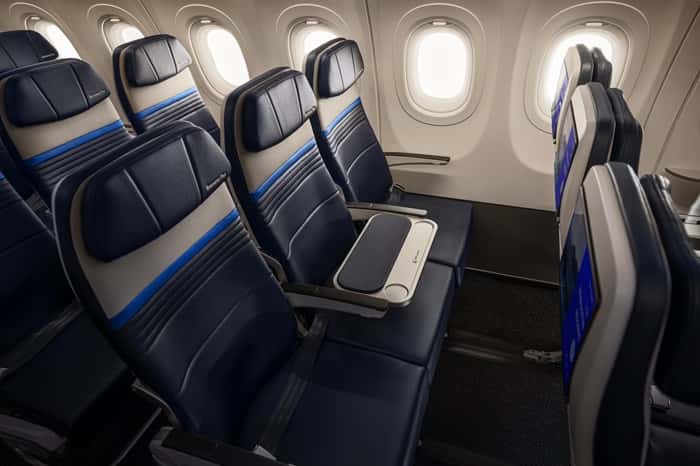
United Airlines has unveiled a new Economy Plus option for its coming Airbus A321XLR fleet. In one special row, the middle seat will be replaced by a broad, fixed table shared by passengers at the window and aisle.
It is a simple idea, but a telling one. Many travellers now assume cabin “innovation” means another inch quietly going missing. United, by contrast, is giving up valuable floor space to create more room.
The product is due to go on sale later in 2026, with flights starting soon afterwards. United plans to fit the layout across all 50 A321XLR aircraft on order. It is also studying whether the idea could work on other aircraft. The carrier expects to be the only United States airline with this type of seating.
Each jet will have one Economy Plus row with the middle places kept open. Custom tables will stretch from armrest to armrest. The soft, leather-like surface will include two recessed cup spaces. It should give both customers a useful spot for drinks, devices, paperwork or the in-flight habit of moving the same three belongings every 12 minutes.
More to the point, the design gives the window and aisle passengers extra elbow room on longer overseas flights. That space is on top of the three extra inches of legroom offered in Economy Plus on the A321XLR.
Nobody is calling it a private suite, steady on, but it is a welcome idea for economy travellers. They can reclaim the middle seat without having to win an airport-lounge lottery.
“We’re investing nose-to-tail across our fleet and giving customers choice and value in every cabin,” said Andrew Nocella, United’s Executive Vice President and Chief Commercial Officer. “The XLR is our newest aircraft and not only offers all-aisle access lie-flat seats in United Polaris® but now also includes seats in Economy Plus with extra leg and elbow room. Our customers are going to love all these new options.”
The move extends United’s effort to make the rear cabin a serious product, rather than an afterthought with a curtain in front of it. It follows the United Relax Row, a separate option planned for select Boeing 777 and 787 widebody jets starting in early 2027.
That design lets a bank of economy seats turn into a couch-like, lie-flat surface for long flights. Together, the two products show how United may sell unused or blocked seat space as comfort.
The business case is clear. Premium cabins matter, but many passengers want more room and privacy without paying a business-class fare. United is trying to add clearer steps between standard economy and the pointy end.
The Airbus A321XLR sits at the centre of that plan. United has designed its version as a premium-heavy replacement for older Boeing 757 aircraft. It will have 32 premium seats, which is 16 more than on the aircraft it replaces.
The cabin will include United Polaris Studio suites with lie-flat beds, aisle access and privacy doors. United Premium Plus and Economy cabins will follow behind.
Technology is also being given a proper seat at the table, so to speak. Every passenger will have a 4K OLED entertainment screen with Bluetooth. Screens will measure 19 inches in Polaris, 16 inches in Premium Plus and 13 inches in Economy.
Larger overhead bins should hold more rollaboard bags. A self-service snack bar at the rear may also offer a welcome alternative to pressing the call button and hoping diplomacy prevails.
United expects to start domestic A321XLR flights in the northern autumn of 2026. Overseas services are due to begin by early 2027. On most transatlantic flights, the airline plans to roster five cabin crew. That matches its usual approach to replacing the Boeing 757 aircraft.
Airbus calls the A321XLR a long-range route opener. It can fly up to 4,700 nautical miles, or about 8,700 kilometres, and remain in the air for up to 11 hours.
Its main appeal is the mix of single-aisle economics and long reach. This can support thinner overseas routes that may not fill a larger widebody jet all year.
For travel sellers, the new United Economy Plus row could become a useful upsell. It may appeal to couples, workmates, or solo travellers who value more personal space.
Pricing has not yet been released. That number will decide whether the shared table feels like smart design or merely a costly place to park a coffee.
Still, the message is positive. United has recognised that economy passengers notice detail, value space, and remember whether a long flight felt civilised.
The middle seat has not vanished across the cabin. Yet in one row, at least, it has been promoted from nuisance to benchtop. In modern aviation, that counts as progress.
By: Sandra Jones – © 2026.
Read Time: 4 minutes.
Author Bio:
 Sandra has spent a working lifetime quietly rescuing journeys, one itinerary, one anxious caller, one impossible connection at a time. Years in Australia’s finest travel agencies taught her the art of calm, how to find a flight in a fog of cancellations, how to soothe a traveller when luggage wanders, how to turn nine frantic days in Europe into something resembling sense. Qualified, seasoned, endlessly patient, she learned that good travel advice is part logistics, part listening.
But the storyteller in her was always waiting for her turn. Writing offered a new map, a way to turn experience into reflection, detail into delight. At Global Travel Media, Sandra now writes the truths only insiders know: the mishaps, the laughter, the grace found between gates and goodbyes. She reminds us that travel, for all its fuss, is still one of life’s better ideas.











