

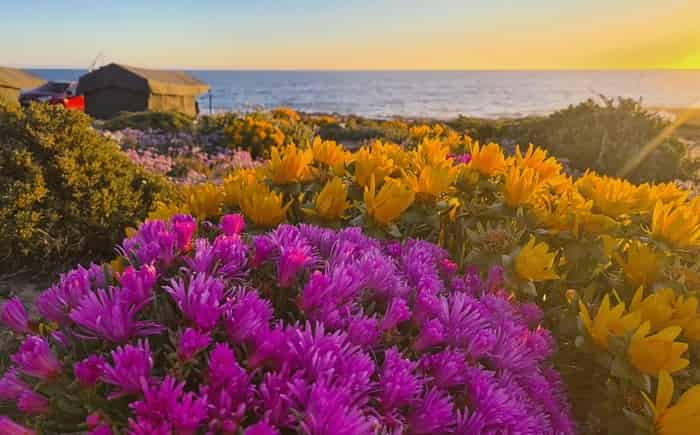
Namaqualand does not do half measures.
For most of the year, this far-flung corner of South Africa’s Northern Cape keeps its colour tucked away beneath sand, stone and tough little succulents. Then winter rain arrives, the sun returns and the desert stages a comeback so extravagant it makes most garden shows look underfunded.
The 2026 season is shaping up as one of Namaqualand’s strongest flower displays in years. According to the organisers of Namaqua Flower Beach Camp, exceptional winter rainfall along South Africa’s west coast has produced a far denser bloom than usual, sending millions of wildflowers across plains that only weeks earlier appeared dry and dormant.
It is a timely reminder that nature still keeps its own diary. No app can hurry it, no concierge can guarantee it, and no traveller can ask for a late checkout.
A rare show written by rain and sunlight
A superbloom occurs when an arid landscape receives the right mix of rain, temperature and sunlight, triggering vast numbers of dormant seeds to flower at once.
Namaqualand is among the world’s great stages for the phenomenon because it lies within the Succulent Karoo, a globally recognised biodiversity hotspot that stretches across western South Africa and southern Namibia. Conservation authorities have described it as the world’s only biodiversity hotspot located within an arid ecosystem.
The region’s botanical credentials are formidable. South African National Parks says Namaqualand supports an estimated 3,500 plant species, with more than 1,000 found nowhere else. The wider Succulent Karoo is also recognised for having the richest succulent flora on Earth.
That scientific weight is important, but visitors rarely need a degree in botany to understand the attraction. One look across a valley covered in orange, yellow, white and purple is usually sufficient.
The display also changes during the day. Many Namaqualand daisies and gazanias respond to sunlight, opening towards the sun and closing when skies are dull or evening approaches. A field that appears sleepy in the morning can become a blazing floral carpet by midday.
Timing, as in much of travel, is everything.
The luxury of arriving at the right moment
There was a time when luxury travel was measured largely by thread counts, chandeliers and the number of people available to carry one’s luggage.
Those comforts still have their admirers. Yet the more compelling luxury today is often access to something brief, remote and impossible to reproduce.
Namaqualand’s flower season fits that definition neatly. The blooms generally appear between July and September, with peak conditions shifting between districts as weather patterns change. South African National Parks describes early August and September as the period when dusty valleys can be transformed almost overnight into wildflower country.
This is not a static attraction with fixed opening hours. Rainfall, sunshine, and temperature determine when individual areas reach their peak.
A traveller may find one valley at full throttle while another is only beginning to stir. That uncertainty is not a flaw in the product; it is the product.
A camp that leaves almost no trace
Namaqua Flower Beach Camp mirrors the short life of the bloom itself.
The seasonal camp opens within Namaqua National Park for just four weeks, from 14 August to 13 September 2026, before being dismantled. The official camp website confirms that 2026 will mark its 15th season in Namaqua.
Guests stay in spacious en-suite cottage tents near the Atlantic coast. The camp accommodates no more than 30 people, keeping the experience intimate and the landscape firmly in charge.
Accommodation includes serviced tents, meals and communal spaces designed for unhurried evenings after a day among the flowers. There are sunsets over the cold Atlantic, fireside conversations, and the sort of silence city hotels tend to advertise but cannot manufacture.
“People remember how a place made them feel,” says Lysta Stander, Co-Founder of Chiefs Tented Camps. “Standing among millions of flowers one day, watching the sun set over the Atlantic that evening and knowing that in a few weeks the landscape will look completely different – that’s something that stays with you.”
The sentiment explains the camp’s appeal. It does not attempt to overpower the national park with permanent infrastructure or theatrical luxury. It appears, welcomes guests and then quietly withdraws.
The road north remains part of the story
For many travellers, the drive from Cape Town is not merely a transfer. It is the opening chapter.
The route heads north through the Western Cape and into the Northern Cape, passing vineyards, farming towns, fishing settlements and long stretches of increasingly spare country. Roadside flowers begin to appear before the national park, offering an unofficial preview of the spectacle ahead.
This is a journey best taken without a stopwatch. Small towns invite pauses, coastal views reward detours, and the changing landscape gives travellers time to understand just how remote Namaqualand is.
For those with less time, the new Flying Flower Safari provides a faster arrival.
Operated by Africa Sky Runners, the private overnight experience departs Stellenbosch and lands near Koingnaas on the Diamond Coast in less than two hours, according to the organisers. It combines scenic flying with an overnight stay at Namaqua Flower Beach Camp.
“The drive north has always been part of the adventure, and many guests still choose to experience it,” says Stander. “The Flying Flower Safari simply offers another option. For travellers with limited time, flying means they can spend more of their journey exploring the flowers, the coastline and the national park, while still enjoying everything that makes this experience so special.”
The choice is therefore between a classic South African road trip and a swift aerial entrance over a coast few international visitors ever see.
Neither option could reasonably be accused of being dull.
Why the 2026 bloom matters to tourism
The flower season delivers more than handsome photographs.
Its seasonal appeal draws travellers to remote towns and communities, creating business opportunities for accommodation providers, guides, restaurants and transport operators. It gives the Northern Cape a powerful, time-sensitive reason to travel and one that cannot simply be copied by the next destination with a marketing budget.
It also rewards responsible tourism.
Namaqua National Park protects a remarkable transition from upland areas near Kamieskroon to a largely untouched coastal section. SANParks says that the dramatic change from the high country to the coast helps drive the park’s exceptional biodiversity.
Visitors are entering a sensitive ecosystem, not an outdoor photographic studio. Staying on marked routes, avoiding flower picking and leaving the landscape undisturbed are basic courtesies with lasting value.
The temporary camp’s restrained model is well-suited to that setting. When the season ends, the tents are removed, and the flowers return to seed. Within weeks, the brilliant colour fades, and the desert resumes its quieter appearance.
That disappearance is precisely what gives the experience its power.
Namaqualand cannot be summoned on demand. It does not perform all year, and it has no interest in becoming convenient.
For travellers fortunate enough to arrive while the curtain is up, however, the 2026 superbloom promises a rare meeting of weather, wilderness and timing.
Nature has set the date. The sensible response is to pay attention.
Booking details
Namaqua Flower Beach Camp operates from 14 August to 13 September 2026.
Visit flowercamps.co.za or email [email protected] for camp and Flying Flower Safari enquiries.
By: Christine Nguyen – © 2026.
Read Time: 5 minutes.
Author Bio:
 Christine’s story is one of quiet courage, told without fuss and lived with remarkable grace. She arrived in Australia as a young refugee from Vietnam, carrying little more than hope, family, and a curiosity that refused to be extinguished. Sydney became home, built patiently, brick by careful brick.
She studied Tourism at TAFE and soon found her place in inbound travel, working with one of the city’s leading destination companies. Christine loved showing visitors the Australia that lives beyond postcards, warmer, truer, and far more interesting.
When the sea began to whisper, and life asked for a gentler rhythm, she listened. Designing brochures, writing blogs, she discovered storytelling waiting quietly inside her.
Today, at Global Travel Media, Christine writes with warmth and wisdom, reminding us, softly and persuasively, why travel still matters.











