

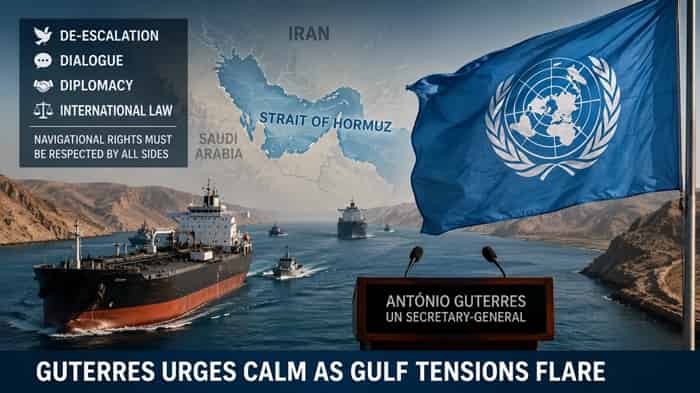
United Nations Secretary-General António Guterres has warned that renewed US–Iran fighting could pull the Gulf into full-scale war, threatening civilians, shipping, energy supplies and the global economy.
United Nations Secretary-General António Guterres has warned that renewed fighting between the United States and Iran could pull the Gulf back into full-scale war. He said the danger reaches far beyond the battlefield. It also threatens civilians, shipping, energy supply and the world economy.
In a statement issued on Wednesday, 15 July 2026, and delivered through his spokesperson, Stéphane Dujarric, Mr Guterres urged all sides “to take immediate steps for de-escalation and return to the path of dialogue and diplomacy”.
The words are formal, but the message is plain. Stop now, before the Gulf falls over the edge again.
“The Secretary-General reiterates that a return to full-scale hostilities would exact an intolerable toll on civilians and have catastrophic consequences for international peace and security and the global economy,” Mr Dujarric said.
A truce under strain
The warning came as the United States launched fresh strikes on Iran and Iran hit back across the region. The clash is again focused on ships and control of the Strait of Hormuz.
The United States and Iran signed a memorandum of understanding on 18 June. The deal aimed to end months of fighting, reopen the strait and help oil trade return to normal. For a short time, it gave the region and world markets room to breathe.
That relief has proved brief.
New attacks on merchant ships, more US strikes and Iranian retaliation have torn at the deal. Reuters reported that some shipping firms were refusing US military-guided trips through the Strait of Hormuz because they still feared for the safety of crews and vessels.
That is a telling sign. An armed escort may sound reassuring in a press release. It looks rather less comforting from the bridge of a tanker when missiles and drones are in the neighbourhood.
A small strait with a huge role
The Strait of Hormuz is narrow, but its role in world trade is vast. It links the Persian Gulf with the Gulf of Oman and the Arabian Sea. Oil and gas from major Gulf producers pass through it each day.
US Energy Information Administration figures show that about 20.9 million barrels of oil a day moved through Hormuz in the first half of 2025. Around 89 per cent of the crude oil and condensate went to Asian markets. About one-fifth of the global liquefied natural gas trade also passed through the strait in 2024.
In other words, this is not merely a dispute between two nations. It is a threat to fuel supply, freight, jobs and business confidence across much of the world.
The travel trade should pay close attention. Higher oil prices can lift jet fuel costs. Shipping delays can affect ports, supplies and cruise plans. Companies may change travel risk rules. Tourists may face altered routes, cancelled services or tighter insurance terms.
None of this is certain. Yet the risk grows each time another weapon is fired or another ship decides it is safer to stay put.
Navigation is a right, not a favour
Mr Guterres also called for the full return of international navigation rights in and around the Strait of Hormuz. He said all sides must respect those rights under international law.
The rule is clear. The United Nations Convention on the Law of the Sea allows ships and aircraft from all countries to use transit passage through straits used for international navigation. Coastal states may set some rules, but they cannot turn a world trade route into a private toll gate during a political row.
The UN Security Council has also affirmed that navigational rights and freedoms through the Strait of Hormuz must be respected.
That should be common ground. Merchant crews are not pawns. Cargo ships should not become stage props in a contest of pride. The sea is dangerous enough without governments adding live fire to the timetable.
Markets had started to hope
The latest violence comes just as energy markets had begun to expect calmer conditions.
In July, the EIA said traffic through Hormuz had risen after the June deal. It is expected that global oil output and trade will move closer to pre-conflict levels by the end of 2026. The agency also cut its forecast for Brent crude in the third quarter to an average of US$74 a barrel.
Those hopes now face a hard test.
A long conflict could cut traffic again and push oil prices higher. The impact would not end at the petrol pump. Airlines, hotels, tour firms, cruise lines and freight operators could all face higher costs. Families may also pull back on travel if household bills rise and confidence falls.
The world economy has seen this film before. It rarely improves with a louder soundtrack.
Diplomacy is the only useful exit
The UN’s call is simple. Stop the attacks. Protect civilians. Restore safe passage. Return to talks.
Diplomacy can seem slow and dull beside jets, warships and angry speeches. Yet it has one great strength: it does not set cities, ships or economies on fire.
Governments now need to show restraint and find a path back to the June deal. The travel industry, meanwhile, should watch official advice, keep plans flexible and speak clearly with customers. Rumour is no help in a crisis. Calm facts are.
The Strait of Hormuz is too important for brinkmanship. A full Gulf war would carry a terrible human cost and a heavy global price.
Mr Guterres has sounded the alarm. The next move belongs to leaders in Washington and Tehran. They must decide whether diplomacy still has a seat at the table or whether the region is about to pay for another round of political theatre with real lives.
By: Stephen Morton – © 2026.
Read Time: 4 minutes.
Author Bio:
 Stephen Morton has spent nearly fifty years shaping how the travel industry thinks, speaks and sells itself. From a family agency in 1976 to today’s digital frontier, he’s rarely followed the crowd; more often, he’s been waiting at the front long before anyone noticed the line forming.
In the mid-nineties, he pushed Agents Support Systems online while the industry still clung lovingly to the fax machine. In 2001, e-Travel Blackboard, a daily bulletin that grew into Australia’s most read industry newsletter, expanded across New Zealand, Asia, the Americas, and MICE.
Global Travel Media followed in 2009, earning international awards and spawning new titles, from Destination Thailand News to Global Cruise News and now GTM Holidays and the forthcoming GTM Mall.
Lecturer, founder, agitator Morton has always turned instinct into impact.











